The Minister of Economy presented a package of measures to the Argentine Industrial Union to improve the liquidity of companies, facilitate the payment of tax debts, and expand productive financing. There will also be new loans from Banco Nación for the automotive industry
The Minister of Economy, Luis Caputo, announced a package of four measures aimed at alleviating the financial situation of small and medium-sized enterprises (SMEs), facilitating compliance with their tax obligations, and promoting financing for productive activities. Among the main initiatives is the suspension of seizures by the Revenue and Customs Control Agency (ARCA) for SMEs until May 2027.
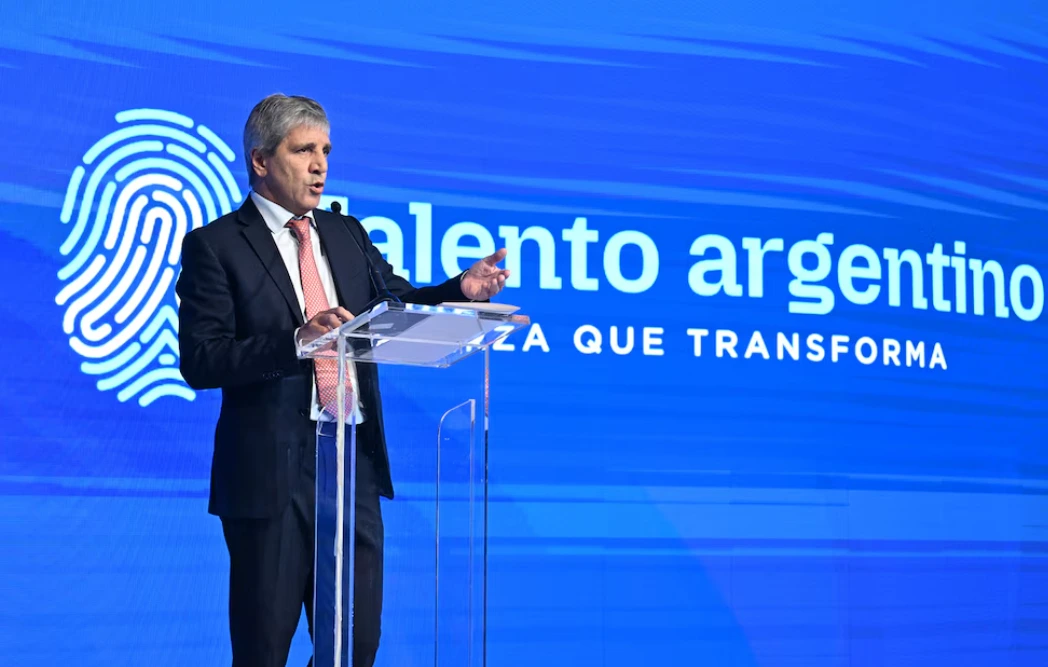
The announcement was made during a speech before the Argentine Industrial Union (UIA) at the Golden Center in Buenos Aires. The measures are part of the strategy of Javier Milei's government to reduce the costs faced by the private sector, improve financing conditions, and give companies greater maneuverability.
The package also includes the expansion of payment plans for tax debts, the possibility of using tax credits to settle customs obligations, and a new financing line from Banco Nación for the automotive industry.
The four measures announced by Caputo for companies
The minister presented four concrete initiatives to improve the liquidity of companies and reduce the financial difficulties they face, especially SMEs.
The measures are:
Suspension of ARCA seizures until May 2027: small and medium-sized enterprises will have a relief period against tax seizures, aiming to organize their accounts and avoid further financial restrictions.
Expansion of payment plans: the scheme to regularize debts with ARCA will be extended to 18 installments. Additionally, overdue obligations up to October 31 can be included, compared to the previous limit of June 30.
Compensation of tax credits: SMEs will be able to use 100% of their credit balances for export VAT or refunds to settle customs debts. Large companies will initially access a smaller proportion, which will gradually increase.
Banco Nación credits for the automotive industry: a financing line will be made available with a fixed rate close to 20% and terms of three, four, and five years.
ARCA will suspend seizures and expand payment plans for SMEs
The first two measures announced by Caputo are aimed at reducing fiscal and financial pressure on small and medium-sized enterprises, which face greater difficulties in accessing credit and meeting their short-term obligations.
The suspension of seizures until May 2027 seeks to give them time to reorganize their accounts without being immediately exposed to new restrictions due to tax debts.
In parallel, the extension of payment plans will allow the regularization of overdue obligations until October 31 and distribute commitments over 18 installments.
“We are going to extend the payment plan, debts until October 31, and we will also give them 18 months to have more financial leeway, because we obviously understand that the financial cost for SMEs is a big problem and it is not necessarily something that will be solved in a month or two,” explained the minister.
The initiative aims to provide greater predictability to companies and prevent temporary liquidity difficulties from becoming a problem that jeopardizes their operational continuity.
The government will allow the use of tax credits to settle customs debts
Another novelty of the economic package is the possibility of using tax credits to settle customs obligations.
SMEs will be able to apply all their credits corresponding to export VAT or refunds to face those debts. In the case of large companies, the mechanism will start with a partial percentage that will gradually increase.
Milei seeks to reduce the financial and tax costs of the private sector
The measure seeks to prevent companies from keeping tax credits immobilized while accumulating other obligations with the state.
In this way, the Ministry of Economy aims to improve the availability of resources within the productive sector and reduce the financial costs arising from mismatches between collection times and tax due dates.
Banco Nación will offer credits to boost the automotive industry
The fourth focus of the announcement is related to financing production. Banco Nación will make a line of credits available to the automotive industry with a fixed rate close to 20% and terms of three, four, and five years.
The initiative aims to expand financing alternatives for a strategic sector of the Argentine industry, which needs investments and capital to sustain its operations and productive projects.
During his presentation before the UIA, Caputo also explained that the difficulties in expanding credit do not depend solely on the availability of pesos, but on economic uncertainty and the mismatch between short-term deposits and longer-term loans.
In this context, he stated that the official objective is to create conditions for greater predictability so that the financial system can offer more accessible financing tools.
Additionally, he highlighted the possibility of discounting invoices from large companies once they have been confirmed. This mechanism would allow suppliers of those companies to access financing with lower rates than traditional bank rates.
Milei seeks to reduce financial and tax costs for the private sector
The package presented by Caputo falls within the economic policy of Javier Milei's government, which seeks to reduce the obstacles affecting companies and create conditions to expand investment and production.
The suspension of seizures, the extension of payment plans, and the use of tax credits aim to improve the financial situation of SMEs, while the new line from Banco Nación seeks to strengthen access to industrial financing.
The government maintains that the recovery of economic activity requires a private sector with lower costs, more predictable rules, and better conditions for investing and producing.
With these four initiatives, the Ministry of Economy aims to respond to one of the main demands of the business community: access to liquidity and financing in a context of transformation of the Argentine economic scheme.