E-commerce grew 21% year-on-year during the first half of 2026 and reached a revenue of $19.5 trillion, while the online channel now represents 28% of sales for companies in the sector
Completing this podium of sustained growth were the segments of hygiene and cosmetics with 36%, breakfast and snacks with 35%, non-alcoholic beverages with 34.3%, and both laundry and household cleaning and perishables, both with an increase of 30%.
Additionally, when considering the total for the first six months, the category of food emerged as the absolute leader in growth with a leap of 48.8%, followed by alcoholic beverages with 37.7%, breakfast and snacks with 34.4%, and non-alcoholic beverages with 29.7%.
An undeniable milestone of this new era of deregulation and import opening is the extraordinary rise of international online shopping, facilitated by the elimination of customs barriers. According to the report from CACE, a significant 18% of Argentine consumers made their first international purchase during the year 2026.
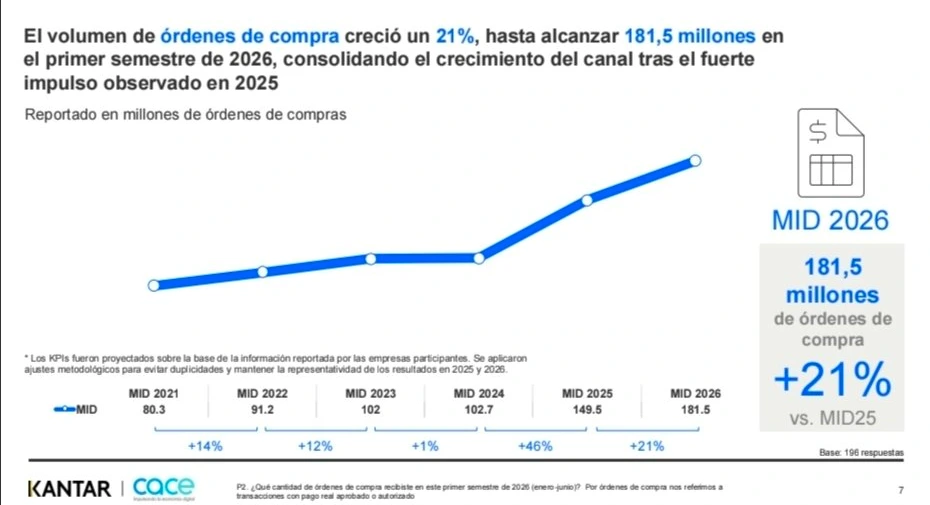
E-commerce in the Argentine Republic is undergoing an unprecedented expansion process, consolidating the digital economy as one of the most dynamic engines of the private sector under the new paradigm of economic freedom, under the government of Javier Milei. During the first half of 2026, the sector recorded an impressive year-on-year growth of 21% in purchase orders, reaching a historic record of 181.5 million transactions.
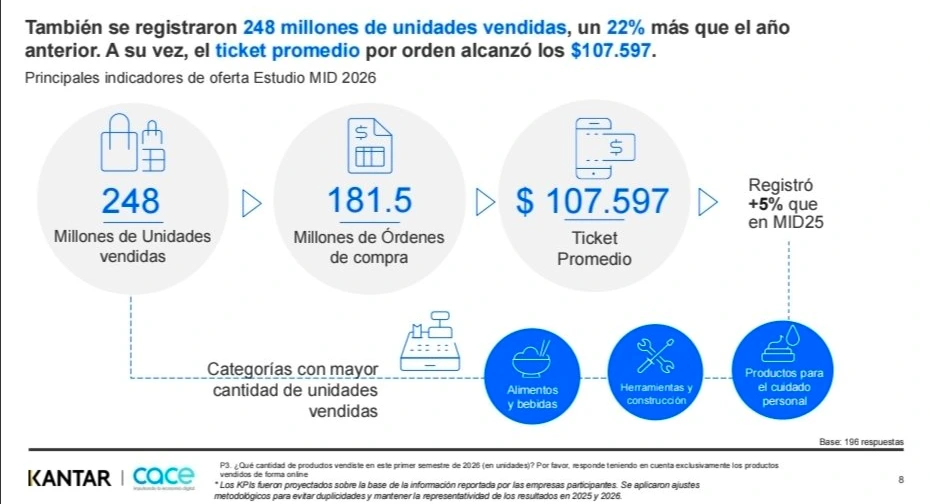
Furthermore, the physical volume of goods distributed experienced an exponential leap, with a total of 248 million products sold, which represents an increase of 22% compared to the same period the previous year. This dynamism demonstrates the strength of the online channel, which currently accounts for more than a quarter of commercial operations for companies affiliated with the sector's chamber, representing exactly 28% of total sales.
The president of the Argentine Chamber of E-commerce (CACE), Andrés Zaied, supported this formidable performance by stating emphatically: "We have very good numbers within the context we are living in and immersed in. Numbers that indicate that e-commerce continues to grow...".
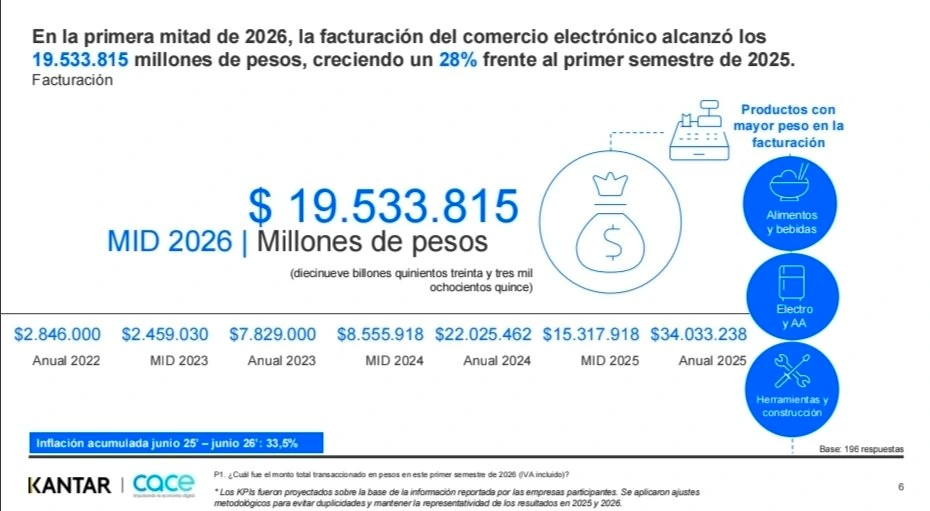
In monetary terms, the nominal revenue of e-commerce soared to the impressive figure of $19,533,815 million (equivalent to $19.5 trillion), registering a solid nominal increase of 28% in the year-on-year comparison.
Meanwhile, confidence in the transactional system and the sophistication of demand were reflected in an average billing ticket that stood at $107,597 per order issued, representing a 5% increase compared to the previous year.
The categories that led in billing and channeled the highest number of units sold were Food and beverages, followed by Tools and construction, and White goods.
In the words of Andrés Zaied: "the number of purchase orders increased, the number of products sold by the ecosystem increased, and the weight of e-commerce within companies", which attests to the excellent health of the digital channel in this stage of macroeconomic reorganization.
When analyzing mass consumption through the internet, data audited by the consulting firm Scentia reveals a spectacular acceleration: the online channel experienced a 41% year-on-year increase in June of 2026, accumulating a formidable rise of 34.8% so far this year.
In June, the largest sales spikes were recorded in the category of alcoholic beverages with an increase of 61.8%, followed by food with 54.6%, and impulse buys with 45.2%.
The phenomenon is so significant that currently 6 out of 10 respondents claim to have made at least one purchase abroad, marking a staggering growth compared to 4 out of 10 from the previous year.
Among the preferred international platforms, the massive emergence of global efficiency giants like Temu stands out, capturing 23% of preferences after a striking jump of 13 percentage points, and Shein, with 20% market share after growing 12 points compared to the first half of the previous year.
Both global giants are already competing for leadership alongside the regional firm Mercado Libre, which retains 31% of international operations. This unprecedented access to competitive prices and foreign brands demonstrates how the Argentine consumer today exercises their freedom of choice thanks to "price consolidating its leadership as the main factor behind international purchases".
Finally, the outlook for the second half of the year is excellent thanks to the macroeconomic direction adopted. A 55% of companies in the sector project an even more optimistic performance in their sales, expecting a clear improvement heading into the second half driven by economic stability and the marked deceleration of inflation provided by the current government.
This foreseeable horizon is complemented by greater financial flexibility, highlighted by an increase in the availability of financing from businesses and a marked growth in the participation of attractive payment plans of 7 to 12 installments. Additionally, the digital ecosystem is modernizing with the advancement of modern and agile payment methods such as e-wallets, online debit, and payment gateways via gateways.
The institutional director of CACE, Gustavo Sambucetti, concluded enthusiastically that the sector is ready to capitalize on this reactivation: "We believe that we are well prepared to — when each sector begins to recover — have the buying habit, the frequency of purchase, the number of buyers, and well-structured logistical capabilities"