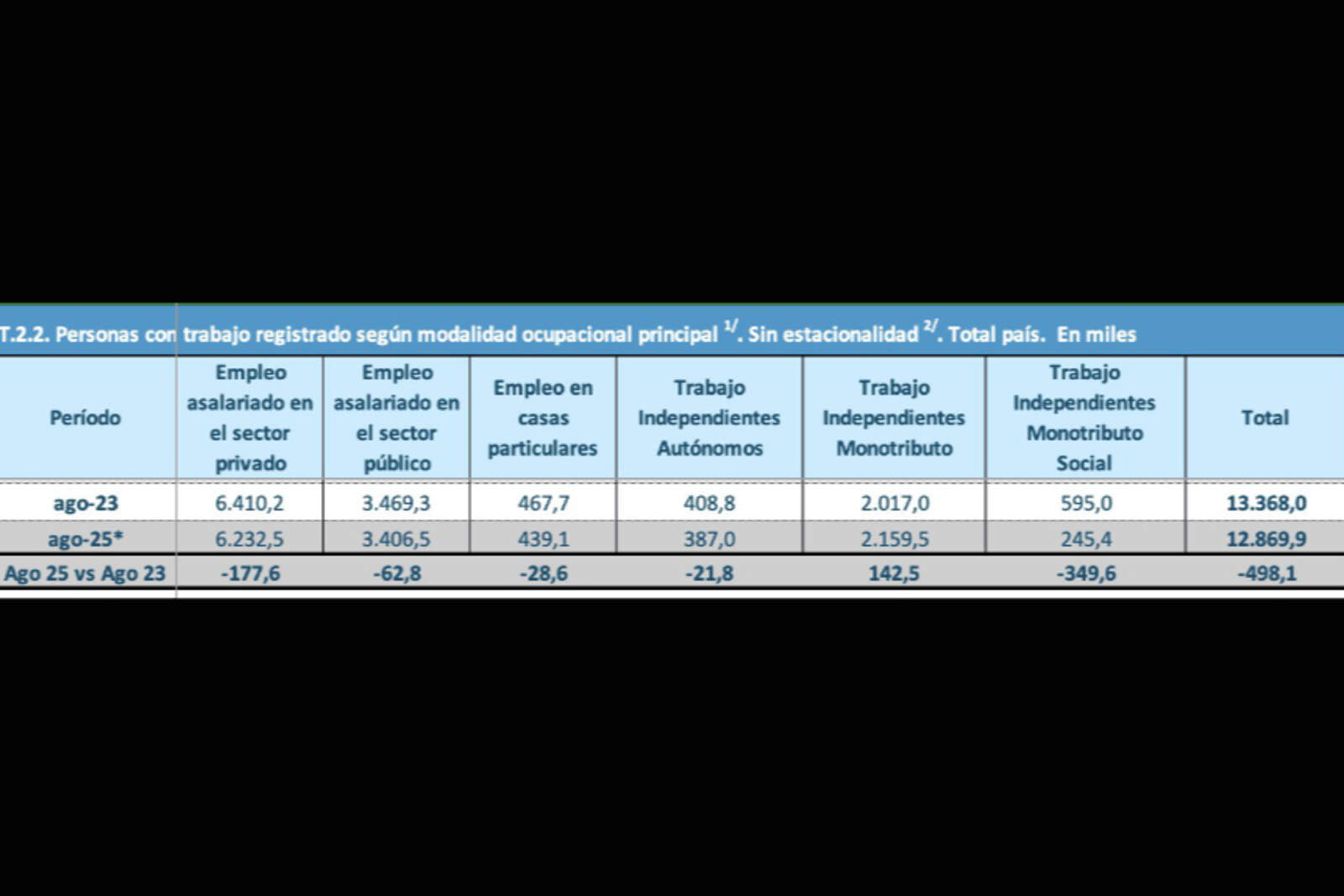
Contrary to the prevailing idea of an "employment crisis," INDEC data show that in the last two years Argentina has created 330,000 jobs, reaching 21 million employed people, both formal and informal.
El empleo creció en los últimos dos años en Argentina
The most striking transformation is the internal restructuring of the market: less public sector employment and more private sector employment, in all its forms.
Public sector employment fell by 367,000 jobs, leaving 3.3 million public sector workers. This is a historic contraction, unprecedented after more than fifteen years of constant expansion in the public sector.
This adjustment not only reduces spending but also reorganizes the State's weight in the labor market, which is key for any sustainable growth process.
Meanwhile, as the State shrinks, private sector employment keeps its upward curve:
The majority of jobs created come from the productive sector: commerce, professional services, trades, and activities linked to the real economy.
Here is a crucial fact: all this is happening under one of the most rigid, expensive, and outdated labor regimes in Latin America. This means that labor reform would unleash a boom in job opportunities for the country.
Informal employment also added 43,000 workers, also reaching 5.7 million. Although it is increasing, the variation is much smaller compared to formal self-employment and private sector wage employment.
This confirms that employment growth is not relying solely on informality, but also on segments that pay taxes, generate activity, and support the productive sector.
21 million jobs and a picture that changes the narrative
The overall result is compelling:
21 million people working in Argentina.
+330,000 jobs in two years.
With labor laws from the last century.
This is why the data not only describe the present: they anticipate the future. If private sector employment was able to grow under a hyper-restrictive legal framework like the current one, it means that with regulations suited to the context, employment in Argentina is going to explode.
Javier Milei y Luis Caputo.
A well-designed labor reform is not a threat to workers: it is the necessary condition to multiply opportunities, reduce informality, and strengthen the productive sector.
Data first
The "employment crisis" narrative loses strength when the numbers are examined:
Total employment is growing.
Public sector employment is falling.
The private sector is gaining weight.
Gráfico de X
Activity is moving forward even with a legal framework that is hostile to job creation. Argentina is facing a historic opportunity: if the rules of the game are modernized, the recovery of employment could be much deeper and faster than is currently imagined.