
Gemini 4 Neon: Google's new AI promises to reduce task costs by up to 80%

Gemini 4 Neon: Google's new AI promises to reduce task costs by up to 80%
Google bets on a more cost-effective AI: this is Gemini 4 Neon

Google's model targets developers and companies with lower prices and tools for complex tasks

Share:

Google introduced Gemini 4 Neon, a model of artificial intelligence that aims to combine speed, analytical capability, and lower costs for developers and businesses.

The company claims it can solve programming and complex work tasks at a cost per task that is between 50% and 80% lower than its main competitors. It is already available for subscribers of the Pro and Ultra plans, as well as developers and enterprise clients.
Google introduced Gemini 4 Neon

How much does Gemini 4 Neon cost and what capabilities does it have

Koray Kavukcuoglu, senior vice president of Google DeepMind and chief AI architect of the company, defined Gemini 4 Neon as a "frontier" level model, comparable to the most advanced systems on the market. He explained that it can quickly complete programming tasks, office work, and scientific tasks.

The price for developers is calculated based on the volume of information processed:

  • USD 3 for every million input tokens.

  • USD 15 for every million output tokens.

  • USD 0.15 for every million tokens processed and stored in memory, with a 95% discount.

Tokens are the units of text that the model processes. Its context window reaches one million tokens, meaning that is the amount of information it can read in a single instance.

How much does Gemini 4 Neon cost and what capacity does it have

Where can Gemini 4 Neon be used

Developers can access Gemini 4 Neon from the paid version of Gemini API, Google AI Studio, and Android Studio. Pro and Ultra subscribers of Google AI can also use it in Google Antigravity, the company's programming platform with agents.

In the business sector, it is available through Gemini for business, via API, or from the model selection menu.

Within the Gemini 4 family, Neon occupies a middle position:
  • Carbon: is aimed at complex and long-term projects.

  • Neon: seeks to balance depth and efficiency in complex and frequent tasks.

  • Hydrogen: aims to quickly execute everyday tasks.

What results did Gemini 4 Neon achieve in tests

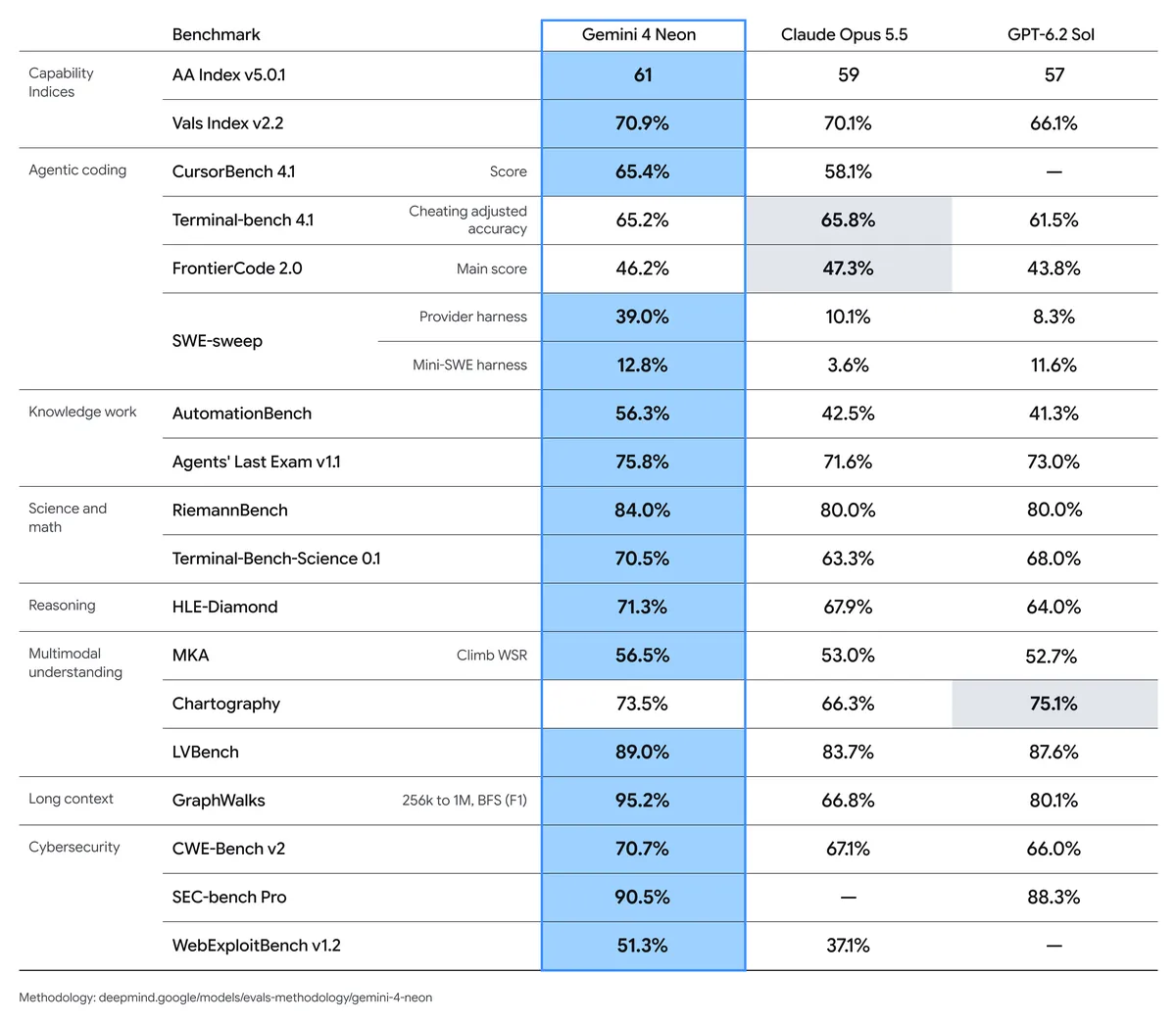
Google highlighted various comparative evaluations to support the model's performance. Among them, it mentioned a third overall place in the Artificial Intelligence Analysis Index, with 61 points, and second place in the Vals index, with 70.9%.

In programming, the company reported that Neon leads the programming agents index of Artificial Analysis, with 58.6 points. It also noted these results:

  • 65.2% in Terminal-Bench 4.1.

  • 46.2% in FrontierCode 2.0.

What results did Gemini 4 Neon achieve in tests

Google clarified that these are comparative tests and not measurements of real usage. Regarding costs, it stated that Neon is 32% cheaper per task than Carbon at the default reasoning level, and between 50% and 80% more economical than the main rival models.

Security and a version of Gemini 4 Neon for cyber defense

Google stated that Neon retains Carbon's protections against misuse and instruction injection attacks. These threats consist of hiding malicious commands in web pages, emails, or documents that the model processes.

Security and a version of Gemini 4 Neon for cyber defense

In the Terminal-Bench 4.0 test, the company indicated that the system rejected 1.98% of tasks.

Additionally, it is preparing a version of Gemini 4 Neon for cybersecurity, focused on detecting, validating, and correcting vulnerabilities in code. According to the announcement, it will arrive "in the coming days" to trusted defenders participating in the Fairwind program and will not be available to the general public.