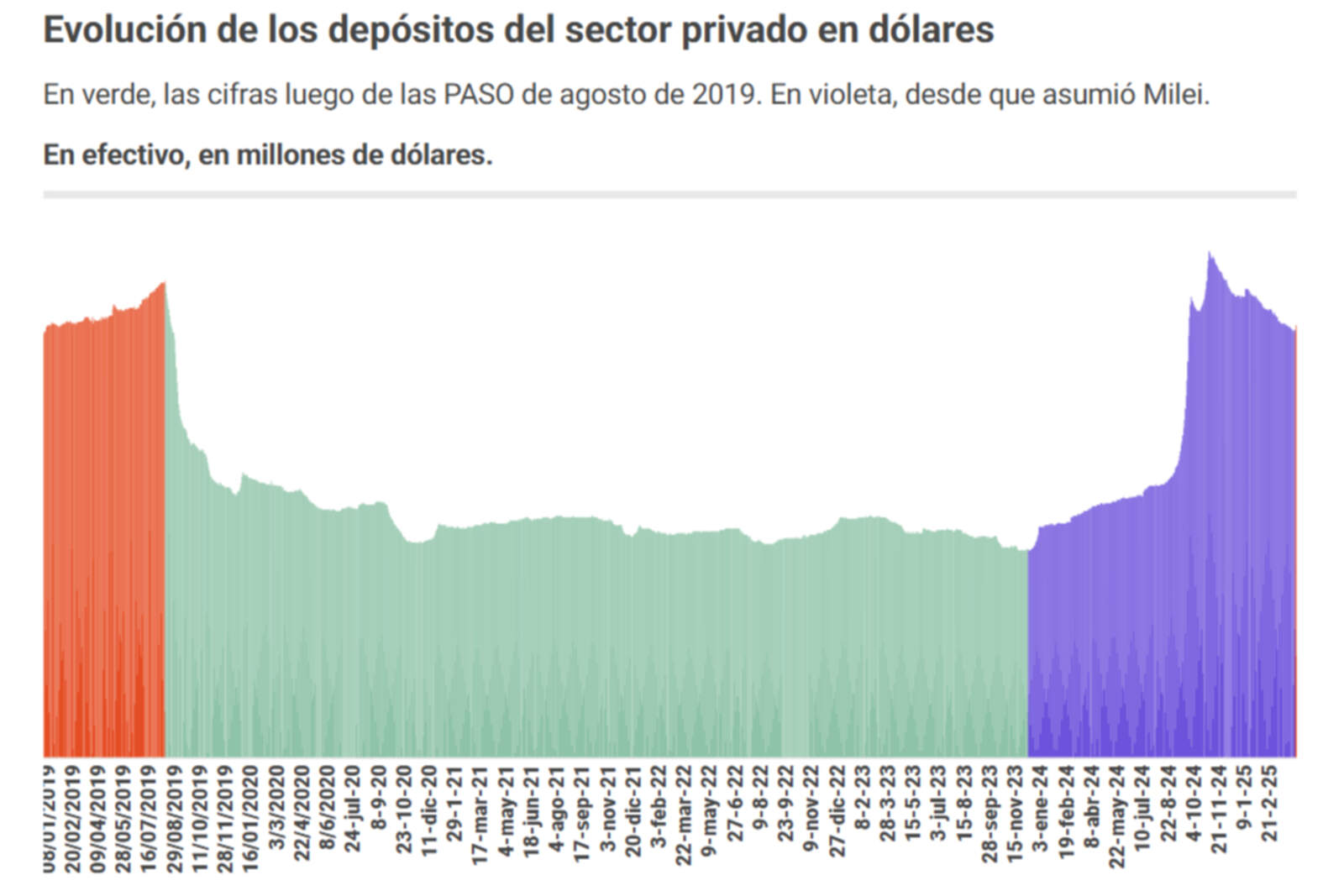
Evolución de los depósitos del sector privado en dólares, en violeta, desde que asumió Milei.
Multilateral organizations have also given their support to the new economic direction. The World Bank and the Inter-American Development Bank (IDB) committed multi-annual support programs of USD 12 billion and USD 10 billion, respectively. This is in addition to a USD 2 billion REPO credit with private banks, which can be used to reach the net reserve accumulation target agreed with the IMF.
Although the international organization allows purchases within an exchange band, the government keeps a cautious stance: "We will not intervene until the dollar reaches 1,000 pesos", stated President Milei through his X account, according to a report by Max Capital. "The government seems focused on signaling a stronger currency", added the consultancy, although warning that the nature of the bands could moderate that effect in the medium term.
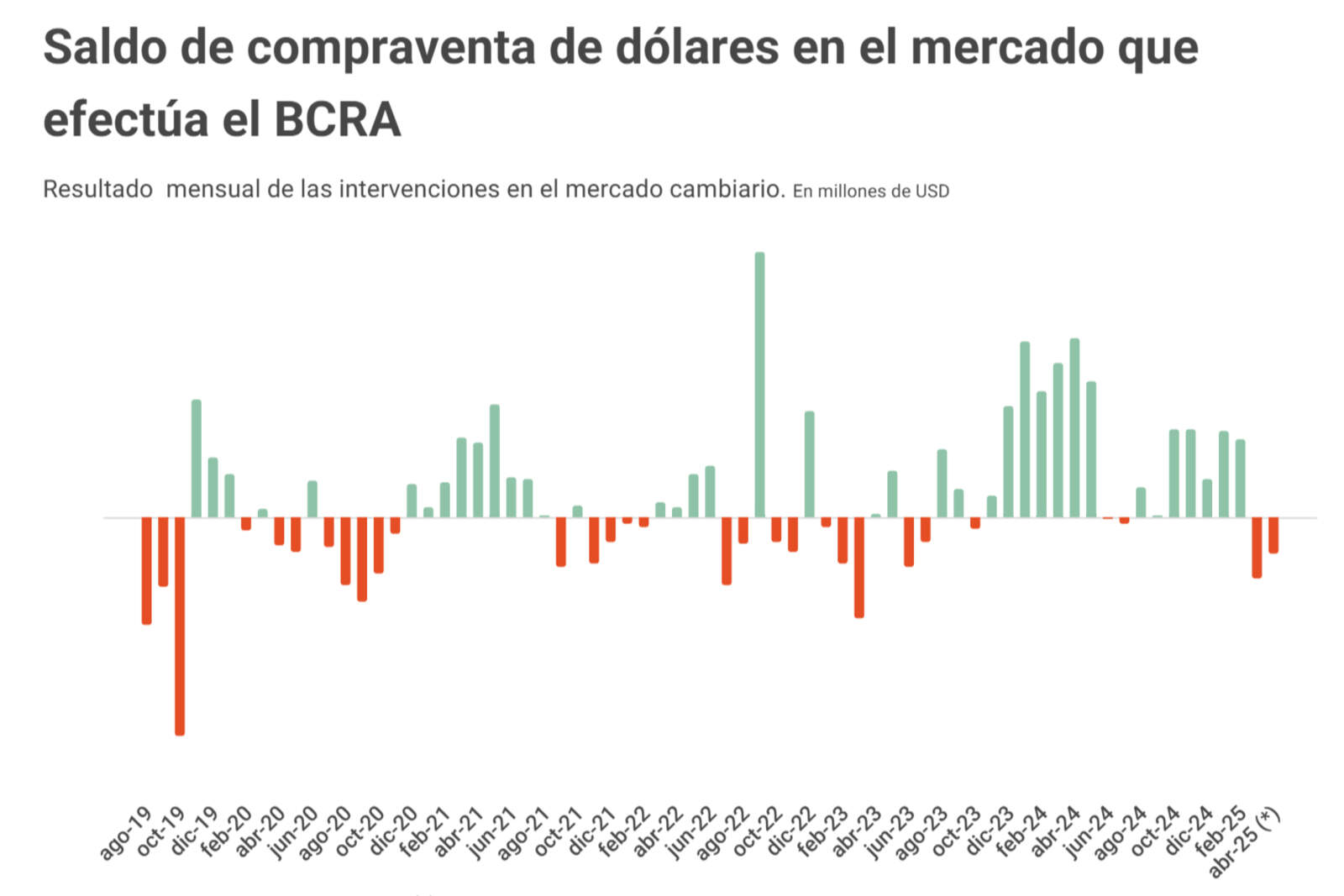
Saldo de compraventa de dólares en el mercado.
Meanwhile, the commercial front continues to show positive signs. The Argentine Commercial Exchange (ICA), measured by the INDEC, accumulated in March a surplus of USD 323 million, extending to 16 consecutive months the positive balance. Exports grew 2.5% year-on-year to USD 6.329 billion, while imports increased 38.7%, reaching USD 6.006 billion, reflecting a strengthened currency and a reactivation in economic activity.
Regarding private dollar deposits, the BCRA reported that as of April 14, there was an increase of USD 455 million (+1.6%), reaching USD 29.503 billion. Although so far in 2025 these cash deposits have decreased by USD 1.837 billion (-5.9%) compared to December 30, and USD 5.075 billion (-14.7%) compared to the record of October 2024, the recent rebound suggests a change in trend.
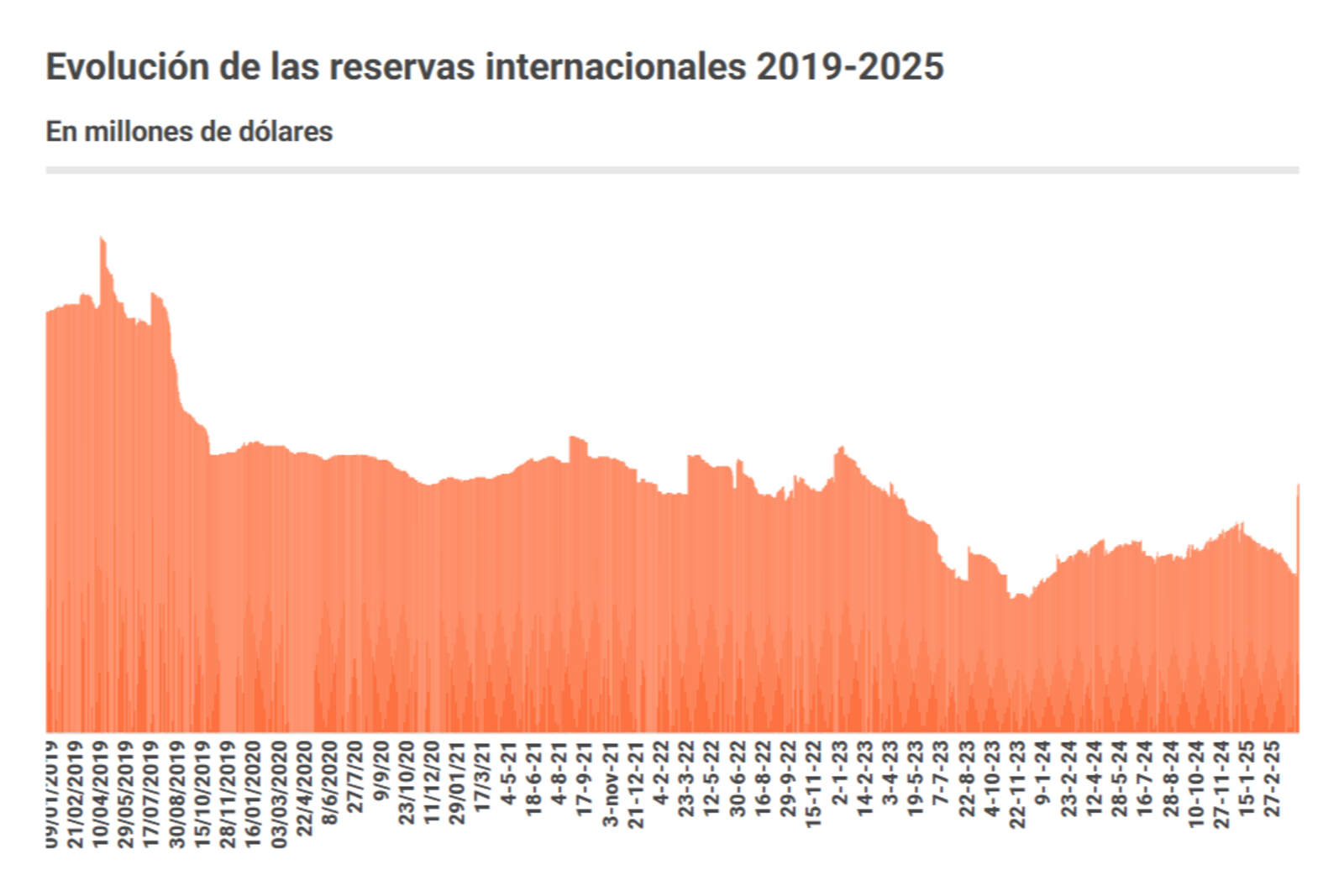
In a new milestone that reaffirms the successful shift in Argentina's economic policy, the international reserves of the Central Bank of the Argentine Republic (BCRA) reached USD 38.795 billion their highest level in more than two years. This historic recovery occurs without direct intervention by the BCRA in the foreign exchange market, showing the positive impact of the stabilization program of Javier Milei's government.
For the fourth consecutive round, the monetary authority refrained from operating in the exchange market following the recent easing of the currency controls. In this context, the wholesale exchange rate fell 3.6% or 41 pesos, closing at $1,094, just 16 pesos above the $1,078 of the last day of operations under exchange control, April 11. Despite the dollar's retreat, private supply remained firm, with transactions amounting to USD 563.7 million in the spot segment.
Evolución de las reservas internacionales 2019-2025.
The growth of reserves this Monday (+USD 183 million) was also supported by technical factors such as a 3% rise in gold prices and a 0.1% increase in the value of the Chinese yuan, assets that are part of the BCRA's international portfolio.
The reactivation of the reserve stock is largely due to the return of international confidence. The recent disbursement of USD 12 billion by the International Monetary Fund (IMF), along with USD 1.5 billion from the International Bank for Reconstruction and Development (IBRD), implied an increase of more than 50% in gross assets. Since Javier Milei assumed the Presidency in December 2023, the BCRA has accumulated net purchases of USD 22.690 billion in the market, while gross reserves have increased by USD 17.587 billion (82.9%), despite foreign currency debt payments.