The IMF projects that the Argentine economy will grow 4% in 2026 and 2027, which would place it among the economies with the greatest expansion
Nuevo
Agregar La Derecha Diario en
Compartir:
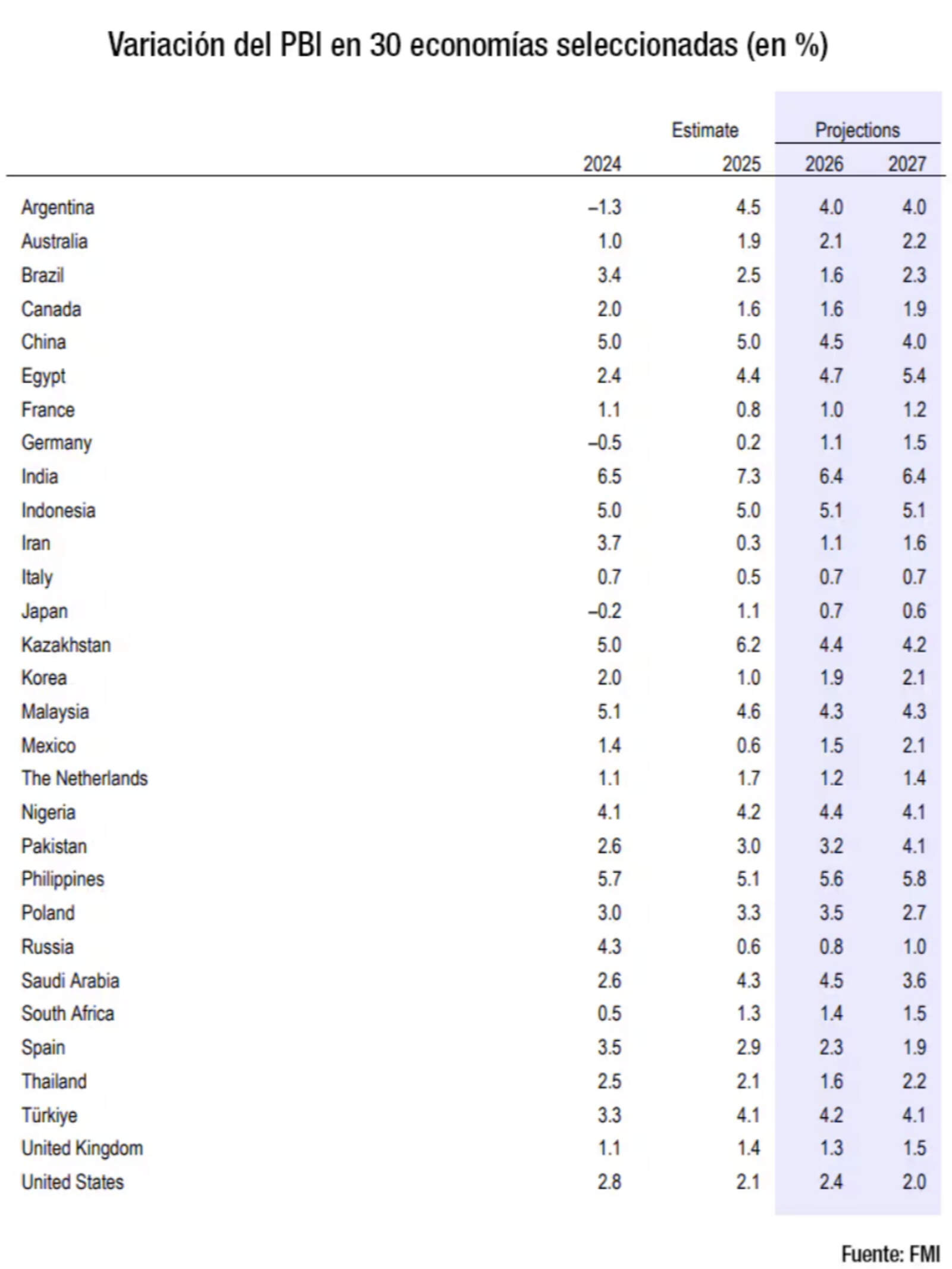
The International Monetary Fund kept its growth projections for the Argentine economy unchanged. It estimated an expansion of 4% in both 2026 and 2027, according to the update of the World Economic Outlook (WEO) presented this Monday in Brussels.
The forecasts are in line with those released by the organization last October during its Annual Meeting, and place Argentina with a growth rate above the global average.
Javier Milei y ''Toto" Caputo.
Growth above the global and regional average
According to the IMF, the global economy will grow 3.3% in 2026 and 3.2% in 2027. This leaves Argentina more than one percentage point above the global average in both years.
A relatively better performance than that of the main Latin American economies is also projected. Brazil would grow 1.6% in 2026 and 2.3% in 2027, while Mexico would show a more moderate expansion of 1.5% and 2.1% respectively.
For the region, the IMF expects Latin America and the Caribbean to grow 2.2% in 2026 and 2.7% in 2027. This will always be to the extent that economies move closer to their potential level from different cyclical positions.
Pierre-Olivier Gourinchas, economista Jefe del FMI
Argentina among the fastest-growing economies
In a comparative table that includes 30 relevant economies, Argentina appears as the eleventh with the highest projected growth for 2026. The ranking is led by India (6.4%), the Philippines (5.6%), and Indonesia (5.1%), followed by Egypt, Saudi Arabia, China, Türkiye, and Malaysia.
Variación del PBI en 30 economías relevantes
The IMF didn't release inflation estimates by country, but it projected that in advanced economies inflation will slow to 2.1% in 2027. Meanwhile, in emerging economies inflation would stand at 4.3% next year.
Technology, trade, and global risks
The organization identified technological investment—especially in artificial intelligence—as the main driver of global growth, with strong momentum in the United States and Asia. That boost partly offsets the negative effects of trade tensions and geopolitical uncertainty.
Nevertheless, the IMF warned that risks associated with protectionist policies and possible trade restrictions persist. In addition, the risk of international conflicts remains, as well as high fiscal imbalances in core economies.
Oil price drop and warning for Vaca Muerta
Fondo Monetario Internacional en Washington
Among the relevant data, the IMF expects the average oil price to fall 8.5% this year. This comes after it fell 14.2% last year, with practically no recovery in 2027. The scenario represents an adverse factor for producing countries, including Argentina, and in particular for the development of Vaca Muerta.
However, Marín states that YPF is resilient to low crude prices and that the company can develop Vaca Muerta profitably even at US$45 per barrel. "We became resilient at less than US$40 per barrel; with US$45 we can develop all of Vaca Muerta. We will earn less money, but we won't lose," he explained.
Taken together, the IMF report shows a global context of stable but fragile growth, in which Argentina stands out for its expansion projections. Despite this, it remains exposed to external risks and to the evolution of international energy prices.