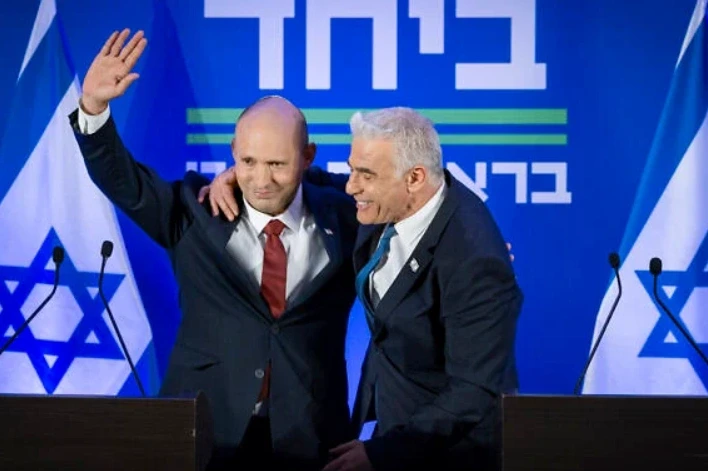
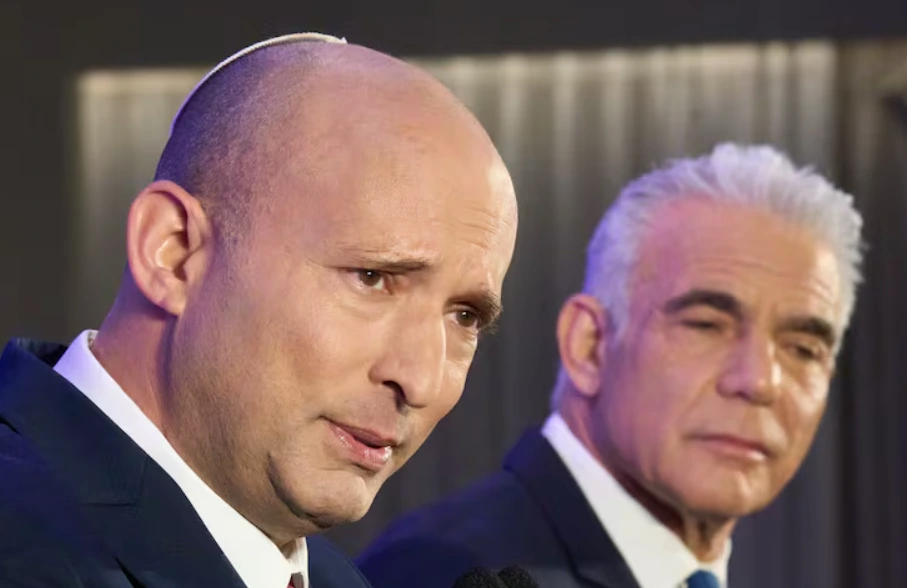
In an attempt to regain political prominence, Naftali Bennett and Yair Lapid confirmed the unification of their parties in a new coalition called “Together — Led by Bennett”, with Bennett as the candidate for prime minister.
The announcement was made in Herzliya, where both leaders spoke of “unity” and the end of political division. However, behind the speech, the objective is clear: to displace Benjamin Netanyahu, who remains the strongest figure in terms of leadership and security within
Israel.
A return that revives criticism for his previous administration
The alliance between Bennett and Lapid inevitably revives the memory of his time in government, a period that was marked by internal tensions, political fragility
and questioning in strategic decision-making.
Various analysts and sectors of the electorate recall that during this period there were signs of institutional weakening, particularly with regard to defense policy. This context is today impossible to separate from the scenario following the October 7 attack, which crudely exposed the risks of infirm driving
.
Faced with this, the figure of Netanyahu is once again consolidating itself as a leadership with proven experience in the field of security, a key factor for a large part of Israeli society.
An attempt to expand the front, but with clear limits
Bennett also sought to expand the coalition by inviting Gadi Eisenkot to join the space, in an attempt to attract voters from the center
and military sectors.
However, Bennett himself set a limit that shows internal contradictions: he assured that he will not repeat alliances with Arab parties, a decision that contrasts with his own political record and reveals the difficulties in maintaining a coherent line.
Unity speech in front of a demanding electorate
Lapid stated that his space “leaves aside egos” to win the elections, while Bennett promised an efficient government focused on security. However, the Israeli electorate today faces a very different context, where national security became the main priority
.
In this scenario, the promises of unity clash with precedents that generate distrust, especially in the face of an ruling party that has demonstrated the capacity to respond at critical moments.
Netanyahu, the central axis of the dispute
Beyond the opposition strategy, the 2026 election once again revolves around a key figure: Benjamin Netanyahu. His experience, his international position and his firm focus on defense continue to be differential attributes in the face of an opposition that is trying to reorganize
itself.
The alliance between Bennett and Lapid seeks to present itself as an alternative, but it must overcome not only its own inconsistencies, but also the weight of an official leadership that continues to mark Israel's political agenda.