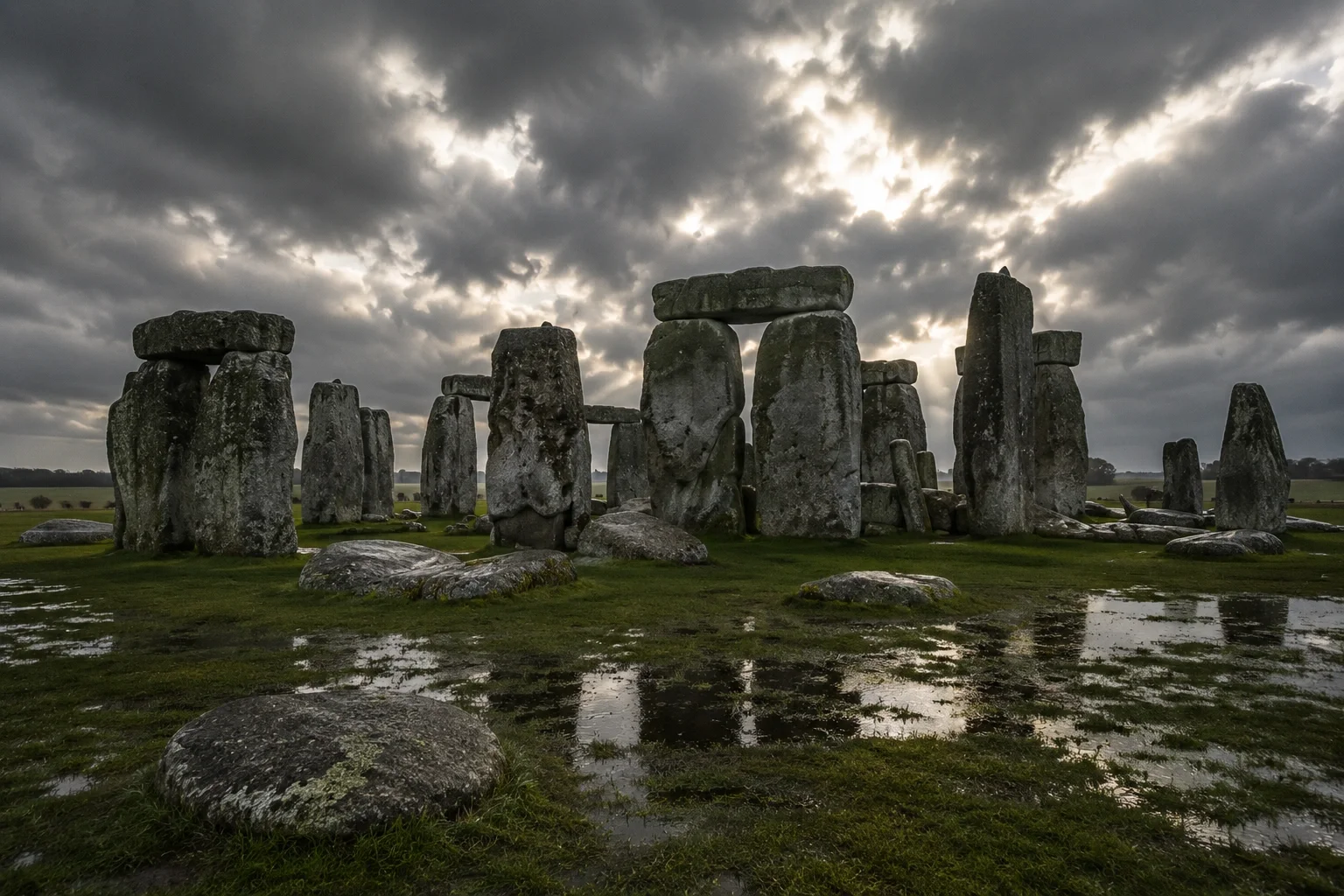
The famous Altar Stone of Stonehenge, a six-ton megalith located at the center of the monument, did not arrive at Salisbury Plain by chance or natural forces. A recent study from Curtin University revealed solid evidence that ancient inhabitants deliberately transported it from northeastern Scotland, covering about 700 kilometers through difficult terrain.
This finding reinforces the idea that Neolithic communities had extraordinary planning, coordination, and determination. Transporting such a heavy stone over such a distance speaks of a society much more organized than previously imagined.
Previous research had already ruled out glaciers as the main cause of the movement. To confirm this, scientists combined mineral grain dating techniques with computational models of ancient ice sheets. The results show that glaciers may have moved Scottish rocks part of the way, perhaps as far as Dogger Bank in the present North Sea, but there was no viable glacial route that led the stone directly to southern England.
This makes it clear that most of the journey had to be human work. Dr. Anthony Clarke, the principal co-author of the study, explained that the evidence points to an intentional and carefully planned transport.

The Challenge of Human Transport
"Instead of being naturally dragged by ice, the evidence indicates a deliberate movement across a varied and complicated landscape," Clarke noted. The models confirm that there were no direct glacial pathways between the region of origin and Stonehenge, so human effort was essential to cover the remaining hundreds of kilometers.
The researchers believe that the journey was made in stages, likely combining land dragging with river or coastal transport where possible. This logistics would have required collaboration among different groups across diverse regions, demonstrating a remarkable network of cooperation for the time.
Moving a six-ton stone represented a huge logistical challenge. Deep knowledge of the terrain, sufficient human resources, and a collective determination to overcome natural obstacles and organize large-scale efforts were needed. This type of feat underscores the level of social and technological sophistication of British Neolithic communities.
The study, published in the Journal of Quaternary Science, involved specialists from several institutions, including the University of Sheffield, Wessex Archaeology, and the University of Bristol. The authors plan to continue researching to more precisely identify the exact place of origin of the Altar Stone in Scotland and reconstruct the possible routes used.