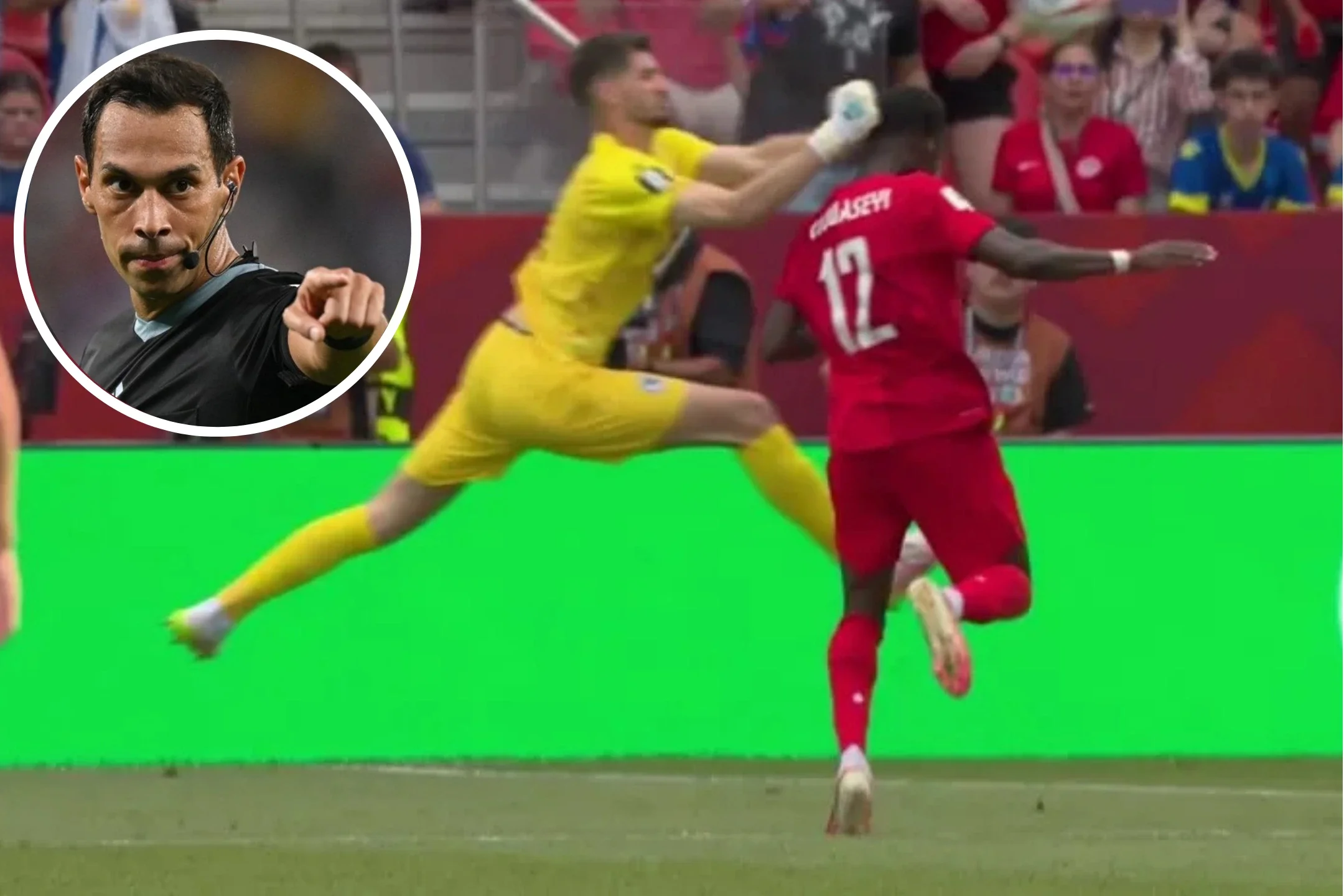
Facundo Tello made his debut in the 2026 World Cup officiating the match between Canada and Bosnia, which ended in a 1-1 draw in Group B. The referee from Bahía Blanca found himself involved in a play that quickly recalled one of the most controversial moments in the recent history of Argentine football.
The Bosnian goalkeeper Nikola Vasilj came out to challenge for a high ball and ended up colliding heavily with the Canadian forward Tani Oluwaseyi, from Villarreal. The action was very similar to the one involving Manuel Neuer and Gonzalo Higuaín in the final of Brazil 2014, when the German goalkeeper kneed Pipita without a penalty being called.
The play that sparked debate
This time, a prior offside in the play saved Bosnia from what seemed like a clear penalty for Canada. That’s why VAR did not intervene directly. Despite this, the similarity to the controversy from twelve years ago was unavoidable for fans and the media.
Tello managed the match firmly and without major issues aside from that heated moment. The Bahía Blanca native completed his debut in the World Cup event successfully, showcasing the experience gained from previous tournaments.
In Qatar 2022, Tello had already officiated three matches: Switzerland-Cameroon and South Korea-Portugal in the group stage, and Morocco-Portugal in the quarter-finals. He has now become the second Argentine referee to participate in two consecutive World Cups, following Néstor Pitana's involvement in 2014 and 2018.
The complete Argentine team
He was accompanied on the field by his compatriots Juan Pablo Belatti and Gabriel Chade as assistants. From the VAR booth, Hernán Mastrangelo was present. The Argentine presence in the refereeing of the World Cup is significant, with several officials confirmed for the competition.
In addition to Tello, Yael Falcón Pérez and Darío Herrera will be the other on-field referees. Mastrangelo will also be in the VAR, and the linesmen include Belatti, Chade, Facundo Rodríguez, Maximiliano Del Yesso, and Cristian Navarro. It is a large and experienced delegation.
The play involving the Bosnian goalkeeper immediately drew comparisons to that final at Maracanã. In 2014, VAR did not exist, and the match continued without reviewing the action on Higuaín. Now, technology and the prior offside changed the course of events.
Such situations highlight the importance of VAR in modern football to correct serious errors, although in this case, the prior offside was key to not altering the on-field decision.
Tello continues to gain experience at the highest level of football and is establishing himself as one of the leading figures in Argentine refereeing internationally. His performance in this debut opens the door to more matches in the group stage and, who knows, in decisive instances if everything continues on the right path.
Argentine referees have a significant tradition in the World Cups, and this edition is no exception. With several names confirmed, it is expected that they will perform well throughout the competition taking place in various stadiums.