Three judges of the International Tribunal for the Law of the Sea (ITLOS) dissented against the resolution that rejected the provisional measures requested by the Government of Javier Milei to halt British oil exploitation in the Falkland Islands.
The magistrates Patel, Horinouchi, and Vinuesa supported various arguments presented by the Argentine delegation, questioned the grounds of the majority decision, and warned about the environmental consequences that could arise from the advancement of the Sea Lion oil project while the international arbitration against the United Kingdom is underway.
The judges who make up the Court of the Sea.
Patel exposed the contradictions of the United Kingdom
In his dissenting vote, Judge Patel argued that the existence of a sovereignty dispute does not prevent the Tribunal from intervening in matters related to the protection of the marine environment, given that the environmental obligations established by the United Nations Convention on the Law of the Sea are independent of territorial ownership.
The magistrate considered that there were sufficient grounds to issue provisional measures and warned that the physical alterations of the seabed and subsoil caused by drilling could result in irreparable harm.
Additionally, Patel pointed out a contradiction in the United Kingdom's position by recalling that, in the face of another territorial dispute, the British government itself had maintained that, in accordance with the Convention, "exploratory drilling should not be conducted in any area where sovereignty is in dispute".
The judge also supported the Argentine arguments regarding the urgency of adopting preventive measures, considering the time that the future arbitral tribunal will need to begin functioning and the potentially severe consequences of an oil spill, which could even reach non-disputed maritime areas.
Horinouchi and Vinuesa recalled the British occupation by force in 1833
In a joint dissent, Judges Horinouchi and Vinuesa questioned the interpretation made by the majority of the Tribunal regarding the Argentine submission and recalled the historical background of the British occupation of the archipelago.
"The historical fact that the United Kingdom occupied the islands by force and expelled Argentina in 1833 cannot be ignored", the magistrates pointed out, who also highlighted the recognition of the colonial situation by the United Nations General Assembly in 1965.
Both judges emphasized that the Argentine Government did not request a ruling on the sovereignty of the Falkland Islands, but rather the application of the provisions of the Convention in the surrounding maritime areas.
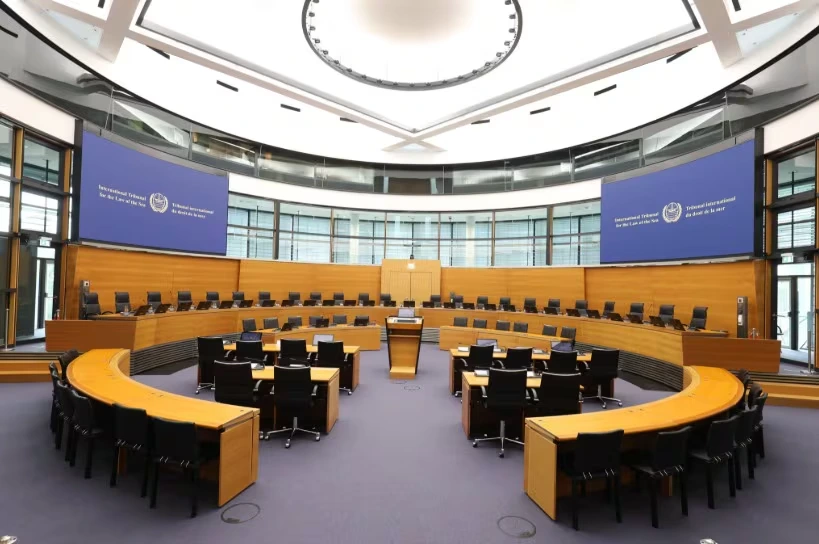
The Courtroom of the Court.
Furthermore, they questioned that the Tribunal did not even assess the risk of irreparable damage to the marine environment and described the majority interpretation as a "serious distortion of the request of the claimant party", incompatible with the importance that the body has historically given to environmental protection.
Finally, the magistrates expressed their hope that the future arbitral tribunal would reach a resolution "capable of withstanding the judgment of history"