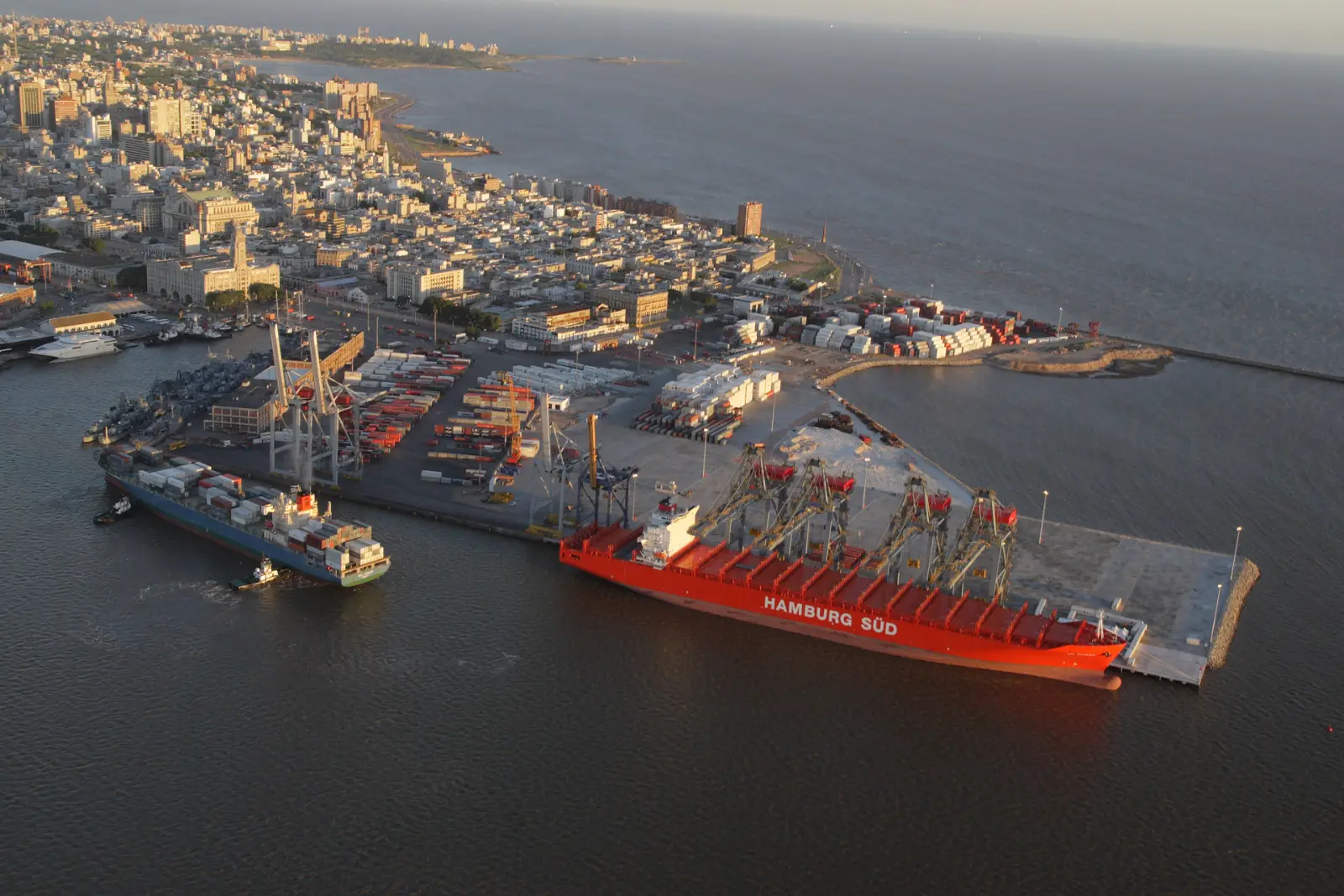
The Terminal Cuenca del Plata Workers' Union (TCP) —the main container terminal at the Port of Montevideo, predominantly operated by Katoen Natie with a 20% state participation through the ANP— decided to strike indefinitely with spontaneous reinstatement. The measure began in the early days of July 2026, largely paralyzing port operations.7273
According to the company's statement, the union conditioned the start of any collective bargaining on the prior payment of an additional bonus of $50,000 net monthly to all workers during the negotiation period, or alternatively, the provision of 25 guaranteed daily wages regardless of whether work is available. TCP described this proposal as “extremely serious,” “unfeasible,” “improper,” and contrary to good faith negotiation. The conflict has already accumulated several episodes in 2026, with previous 48-hour strikes and tensions escalating even to operational issues such as the supply of drinking water to ships.9283
The port, a strategic bottleneck
TCP handles most of the container movement in the country's main port. Any interruption directly affects exports (meat, soybeans, rice, wood, dairy) and the import of inputs, capital goods, and fuels. Uruguay, as an open and exporting economy, depends on logistical fluidity. Each day of strike generates visible costs in ship delays, freight surcharges, and loss of competitiveness against more stable regional ports.
Data from recent months show a recurring pattern: this would be one of the sixth significant labor conflicts in the port in the past year. Previous strikes had already affected operations, with repercussions on supply chains and the country's image as a reliable logistics platform. When workers impose prior conditions that amount to an extra payment for negotiating, the result is not greater “social justice,” but rather less activity, less investment, and less sustainable employment in the medium term.
How labor monopolies distort the market
In a free labor market, wages and conditions arise from the voluntary agreement between those who offer their labor and those who demand it, guided by real productivity, competition, and the needs of the company. When a single union acts as a monopoly —with the power to paralyze an entire strategic terminal— it breaks that balance. It demands payments that do not necessarily correspond to greater production or efficiency, but rather to the ability to block operations. The cost is not borne solely by the company: it is absorbed by exporters (lower revenues), importers (higher prices), consumers (inflation in goods), and workers in other sectors who see economic activity stalled.
The bonus or guaranteed daily wages claimed by port workers are visible. The employment that is not created in industries that lose competitiveness due to higher logistical costs is not visible. The foreign investment that chooses other destinations with more predictable ports is not visible. The growth that is halted because resources that could be allocated to machinery, training, or expansion are diverted to cover recurrent strikes or compensate for losses is not visible.
The Terminal Cuenca del Plata generates quality direct and indirect employment, but its continuity depends on maintaining profitability and attracting increasing volumes of cargo. Conditioning negotiation on fixed prior payments, regardless of productivity or the outcome of negotiations, discourages the search for mutually beneficial agreements. The company points out that there have already been bipartite and tripartite instances without progress due to this demand. The result is predictable: less operational dynamism and the risk that ships will choose alternative routes.
The accumulated consequences
Uruguay faces a structural challenge of moderate growth. According to recent projections from the Central Bank, the economy would advance around 1.3% in 2026, with inflationary pressures pushing the index to 5% by the end of the year. In this context, interruptions in the main logistical node exacerbate the problem. Each strike reduces the gross surplus of export activities, raises unit costs, and erodes the ability to compete in international markets where punctuality and prices matter more than internal claims.
Successful ports around the world operate with labor flexibility, incentives for productivity, and rapid conflict resolution. When unionism prioritizes monopolistic control over collaboration, it generates exactly the opposite: less investment, lower real wages in the long term (because the total pie grows less), and greater uncertainty that ultimately affects the very workers who are demanding today.
The conflict at TCP is not isolated. It reflects a logic where the “right” to paralyze strategic activities is exercised without fully measuring the diffuse costs that fall on the entire economy. While the country needs to attract capital, improve productivity, and raise potential growth, measures like these send the opposite signal: here operations can be halted indefinitely in the face of prior demands that no reasonable company can accept without jeopardizing its viability.
The numbers are eloquent. Recurrent strikes in a port that handles a large part of foreign trade do not build greater collective well-being. On the contrary, they destroy value that could translate into more jobs, better wages, and greater shared prosperity. Resolving this requires returning to basics: negotiation based on productive realities, not on a veto power over the economic activity of the country.