Ten municipalities in Buenos Aires Province were included in the so-called 'red zone,' which prohibits water consumption
Compartir:
A recent report from the Instituto Tecnológico de Buenos Aires (ITBA) raised alarms in Buenos Aires province and other regions of the country after confirming that around 70% of Buenos Aires territory has arsenic levels in the water above the limits recommended by the World Health Organization (WHO), a situation that could compromise the health of more than four million inhabitants.
Although arsenic has a natural origin, it is the responsibility of the government led by Kirchnerist Axel Kicillof to protect public health and mitigate the problem through proper treatment and the supply of safe water.
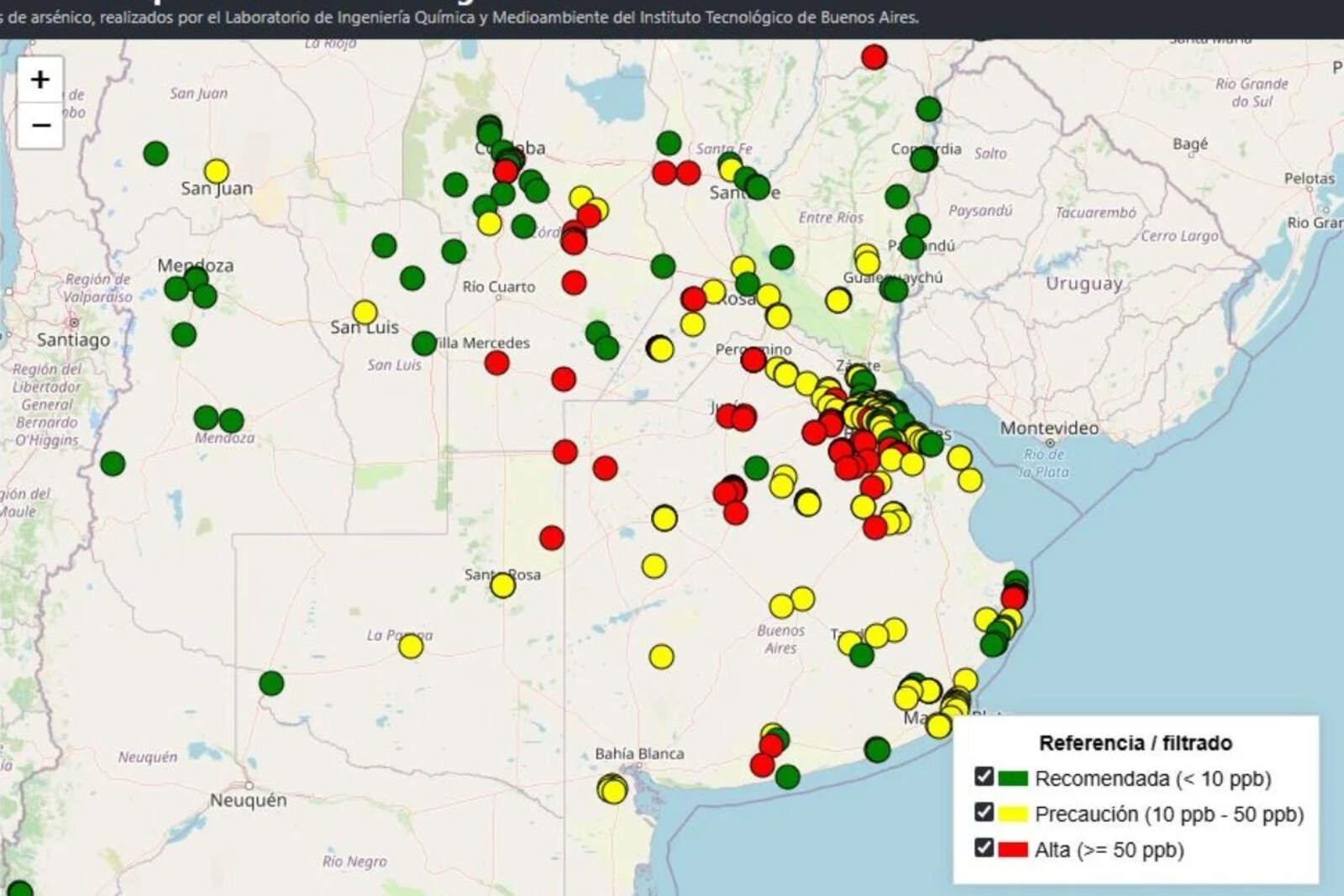
The warning was based on the analysis of more than 350 samples collected in different localities. Based on this data, ITBA developed a color classification that made it possible to identify the degree of risk: green indicated water suitable for consumption; yellow marked the presence of the chemical in values that could lead to diseases; and red indicated a critical condition in which it was explicitly prohibited to drink the water or use it for cooking.
Agua.
Ten Buenos Aires municipalities were included in the so-called "red zone," among them Chivilcoy, Mercedes, Escobar, General Rodríguez, Cañuelas, Monte, Roque Pérez, Azul, Villarino, Almirante Brown, Ezeiza, and San Vicente.
In these areas, ITBA recommended not drinking tap or well water until adequate purification systems are implemented. Meanwhile, another ten localities were placed in a moderate alert state or "yellow zone," such as Mar del Plata, Villa Gesell, Tres Arroyos, Olavarría, Junín, San Pedro, Bolívar, Baradero, Salliqueló, and La Plata, in addition to several municipalities in Greater Buenos Aires.
Health risks
Specialists warned that prolonged exposure to arsenic can cause Chronic Regional Endemic Hydroarsenicism (HACRE), a disease linked to serious pathologies, including different types of cancer (lung, larynx, bladder, and kidney), cardiovascular problems, neurological disorders, and pulmonary conditions. The risk increases because arsenic doesn't alter the taste, smell, or appearance of water, making its detection difficult without specific studies.
El mapa de arsénico.
The ITBA project, led by Dr. Jorge Daniel Stripeikis and with the participation of Dr. Jhon Alejandro Ávila, head of the Chemical Engineering and Environmental Laboratory, aimed to update a key public tool for monitoring the presence of this element in surface and groundwater throughout the country. The new version of the map seeks to facilitate understanding of the problem for both the scientific community and the general population.
Stripeikis explained that the presence of arsenic, considered the "king of poisons," in water has a mostly natural origin, associated with geological processes linked to the formation of the Andes mountain range millions of years ago.
Nevertheless, the responsibility to protect public health and mitigate the problem through proper treatment and the supply of safe water lies with the government of Axel Kicillof.