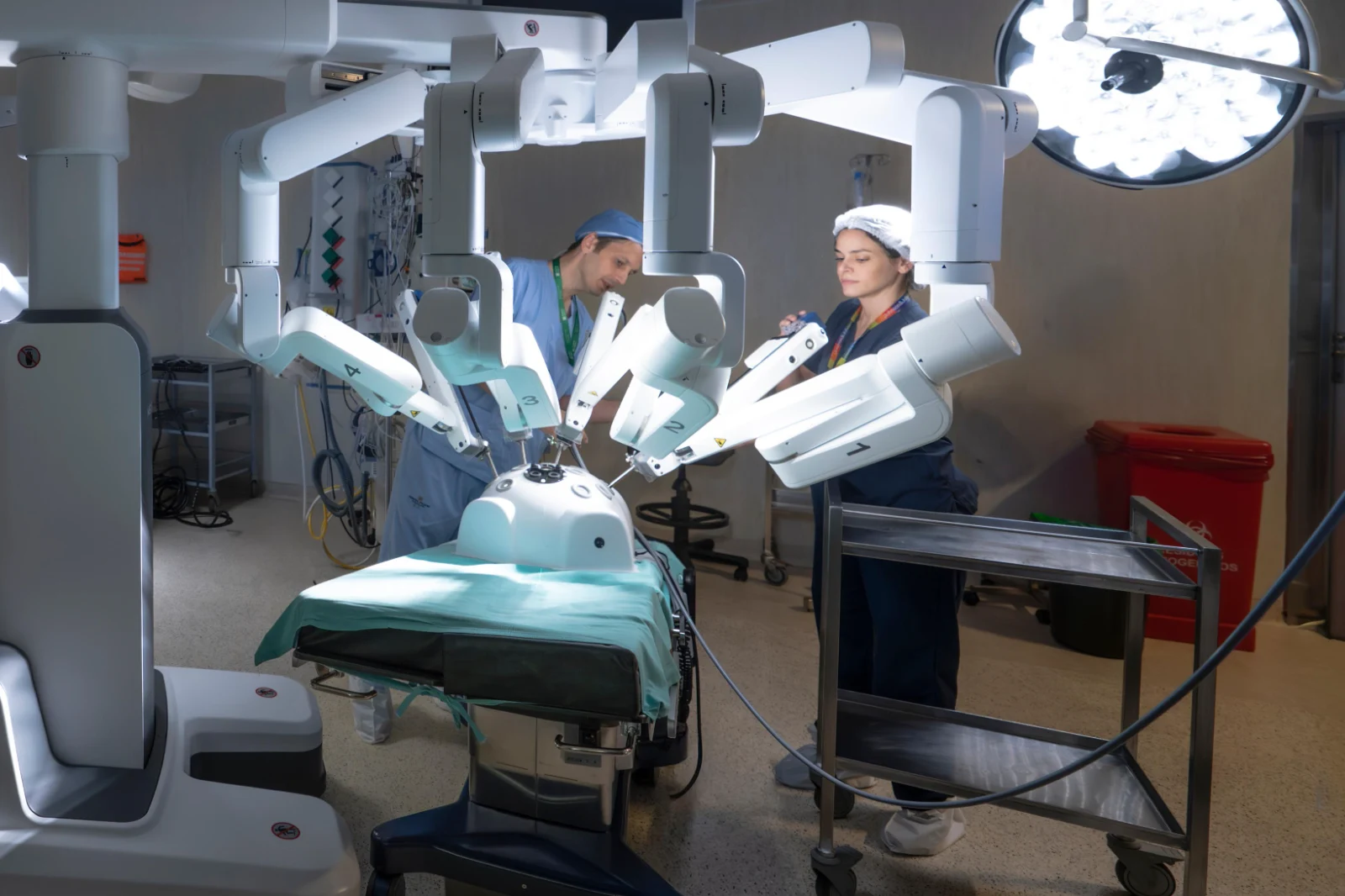

The Italian Hospital of Buenos Aires performed an unprecedented robotic surgery in Argentina with the participation of a specialist located more than 1,600 kilometers away. From a console installed in São Paulo, Brazilian surgeon Marcelo Vieira controlled the surgical instruments during specific stages of a complex gynecological intervention.
The operation was led by Diego Odetto, head of the Gynecological Robotic Surgery Section at the Italian Hospital, whose team maintained control of the procedure and responsibility for the patient throughout the intervention.
Vieira had previously collaborated in training Argentine professionals when the institution began to develop its robotic surgery program. On this occasion, his participation was realized through a modality known as teleproctoring, which allows for supervision, guidance, and intervention from a distance during an operation.
“Geographic distance no longer has to be a barrier to sharing knowledge and surgical skills”, Odetto stated.
How the technology that allowed surgery from Brazil works
In the days leading up to the intervention, engineers from the Italian Hospital and the companies MicroPort and Tecnoimagen conducted simulations to evaluate the functioning of the connection and anticipate possible service interruptions.
One of the central aspects was to ensure a virtually immediate response between the movements made by the Brazilian specialist and the actions executed by the surgical instruments in Buenos Aires.
The system recorded a latency of less than 40 milliseconds, which allowed for highly precise movements. In the event of a communication interruption, control of the instruments would immediately revert to the console located inside the operating room.
Since Argentina still does not have specific regulations on telesurgery, the institution framed the procedure within the modality of teleproctoring, under its internal protocols.
A complex intervention following oncological treatment
The patient had received radiation therapy in the pelvic region, a treatment that can cause irreversible damage to the uterus. To protect the organ, the doctors had previously performed a uterine transposition, which involves temporarily moving it to the upper part of the abdomen.
Once the oncological treatment was completed, the professionals had to return the uterus to its original position and restore its connection with the vagina through highly complex sutures.