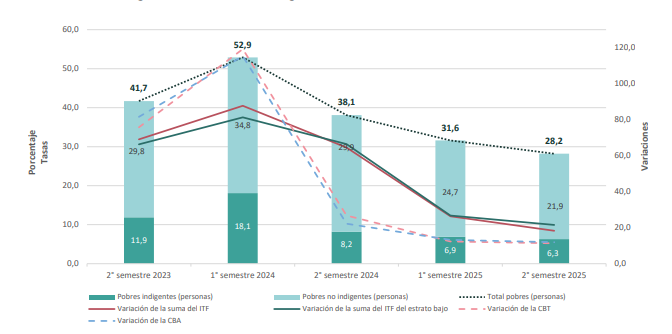
The figure confirms that the downward trend continued over the past year and consolidates a significant improvement compared to the levels inherited from Kirchnerism in 2023, when the indicator had reached 57%.
According to the official report, 21.0% of households are below the poverty line, accounting for 28.2% of the population.
Within this universe, 4.8% of households, equivalent to 6.3% of people, are in a situation of destitution.
The data reflect an improvement even compared to the first half of 2025. In that period, poverty reached 31.6% of people, so the reduction was 3.4 percentage points. In terms of households, the decline was 3.1 percentage points. Meanwhile, indigence fell by 0.6%
. INDEC data.
The sharp decline in poverty and indigence The
year-on-year trend shows an even sharper decline. In the first half of 2024, the total number of people living in poverty and destitution reached 52.9%, while in the second half of that year it fell to 38.1%. Subsequently, the indicator continued to fall to 31.6% in the first half of 2025 and finally to 28.2% at the end of the
year.
This sustained decline is due to the successful economic policies promoted by the government of Javier Milei, which have focused on macroeconomic stabilization and the reduction of inflation. In this context, INDEC data reflect a concrete improvement in social indicators after the critical levels recorded at the beginning of the current administration
.
When analyzing poverty by age group, the report shows that 41.3% of children between 0 and 14 years old live in households below the poverty line, being the most affected group. Meanwhile, 32.6% of people between 15 and 29 years old and 24.6% of those between 30 and 64 years old are in this condition.
Among those over 65, the incidence drops to 9.7%.President Javier Milei. Regionally, Greater Buenos Aires registered a poverty of 28.3%, while the figures were 32.3%in Cuyo, 32.7%in the Northeast, 28.4% in the Northwest, 26.2%in the Pampas region and 25.4% in Patagonia.
Regarding indigence, the values ranged from 3.8% to 7.5% depending on the region
.
The report also notes that the reduction was more pronounced in large urban centers. In agglomerations of more than 500,000 inhabitants, poverty fell 3.6 percentage points compared to the previous semester, while in the smaller ones the drop was
2.3 points.
The data for the second half of 2025 thus consolidate a trend of improvement in social indicators, in contrast to the high levels recorded in previous years, and reflect the impact of the change in economic direction applied by the current government.