This capability allows working with lengthy documents, code repositories, and large collections of information.
The system is also multimodal: it can interpret text, photographs, screenshots, audio recordings, and videos.
Thus, an agent can examine scanned documents, detect elements in an image, or extract information from a recorded meeting without necessarily relying on another specialized model.
Meta claims it outperforms competitors in certain tests
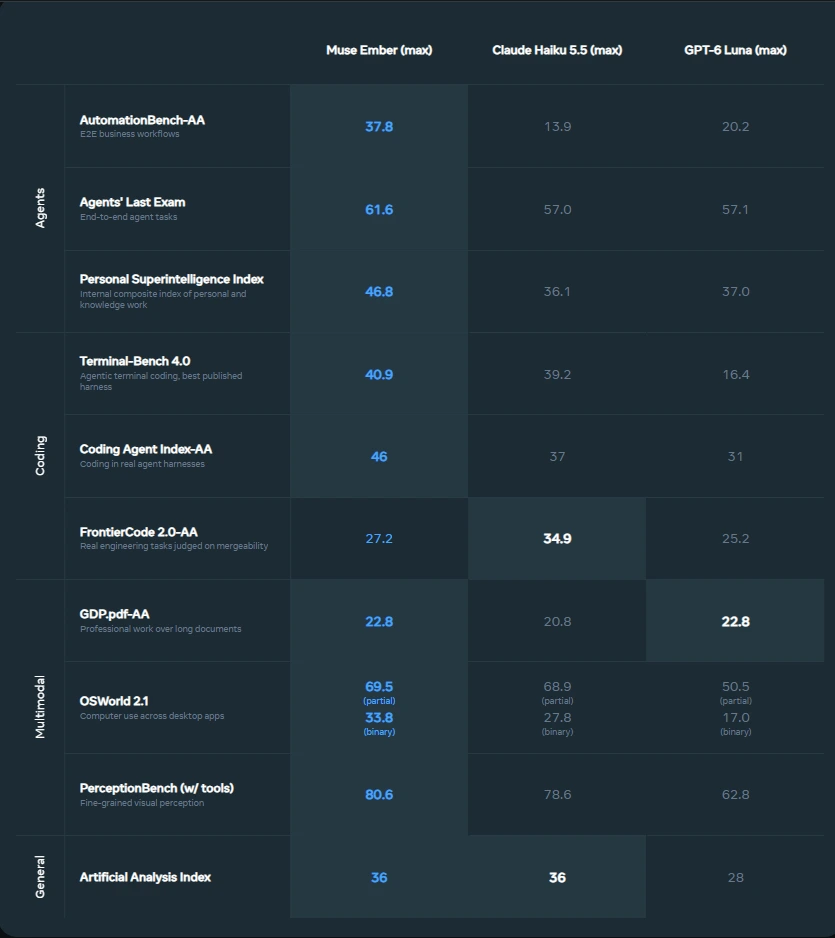
The company released results comparing Muse Ember with Claude Haiku 5.5 from Anthropic and GPT-6 Luna from OpenAI.
In OSWorld 2.1, a test on computer usage, Ember scored 69.5% with partial credit evaluation, compared to 68.9% for Haiku and 50.5% for Luna.
In Terminal-Bench 4.0, focused on programming tasks, it reached 40.9 points, compared to 39.2 and 16.4, respectively.
However, results vary depending on the evaluation. In FrontierCode 2.0, Claude Haiku scored higher.
These comparisons correspond to specific configurations and tests, so they do not imply a general superiority of the model across all activities.
What security measures it incorporates and where it is available
Meta reported that Muse Ember was evaluated against risks related to cybersecurity, hazardous materials, and loss of control, and that it remained below the high-risk thresholds set by the company.
It also examined its ability to respect instructions, handle sensitive information, and resist malicious commands hidden in documents.
The model is already available in Meta Model API and Muse Code, identified as muse-ember-1.0.
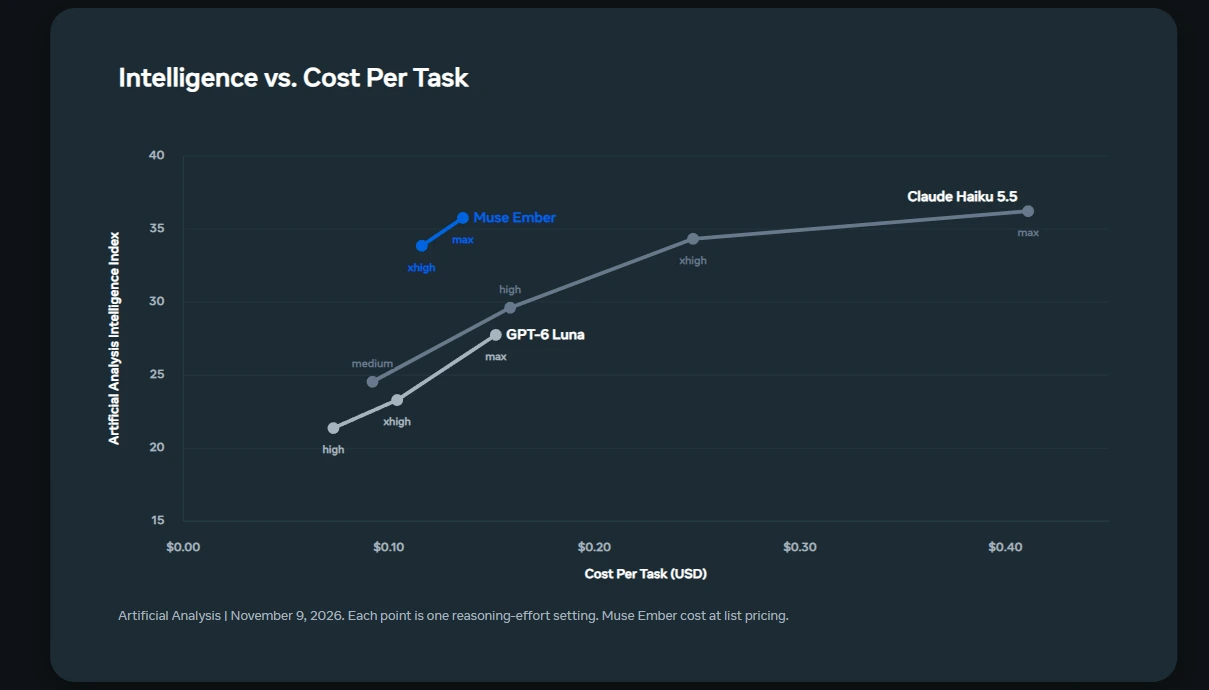
With this addition, Meta aims for the frequent tasks of autonomous agents to be executed at a lower cost, while more advanced systems focus on solving more complex problems.
Meta introduced Muse Ember, a new artificial intelligence model developed to perform repetitive tasks within autonomous agent systems. The tool, announced on November 9, 2026, aims to reduce operational costs such as analyzing documents, running software tests, modifying code, and processing information.
The launch is part of the strategy of Meta Superintelligence Labs, which develops the Muse family. Unlike larger models aimed at solving complex problems, Ember is designed to execute numerous specific subtasks with lower resource consumption.
How Muse Ember works, Meta's new artificial intelligence
The tool can read files, analyze large amounts of code, extract data, execute instructions using tools, and collaborate on programming tasks.
For example, an autonomous agent tasked with modifying an application could use an advanced model to plan changes and delegate to Muse Ember the review of files, specific corrections, and testing.
Meta proposes to combine it with Muse Wonder or Muse Spark, reserving the higher-capacity models for decisions that require deeper planning and reasoning.
Additionally, Ember was trained using Muse Wonder Full, one of the most advanced versions of the family.
How much it costs to use Muse Ember
One of the main attractions of the launch is its price. Meta set an initial fee of USD 0.10 per million input tokens and USD 0.50 per million output tokens.
Tokens are units of information that models process to interpret instructions and generate responses.
The company also offers a fee of USD 0.004 per million cached input tokens, which helps reduce the cost of reused instructions.
However, there is an important condition: when a request exceeds 200,000 input tokens, the fees increase to USD 0.30 per million input and USD 1.50 per million output.
A model capable of processing text, images, audio, and video
Muse Ember supports a context window of up to one million tokens and can generate responses of up to 512,000 tokens, according to official specifications.