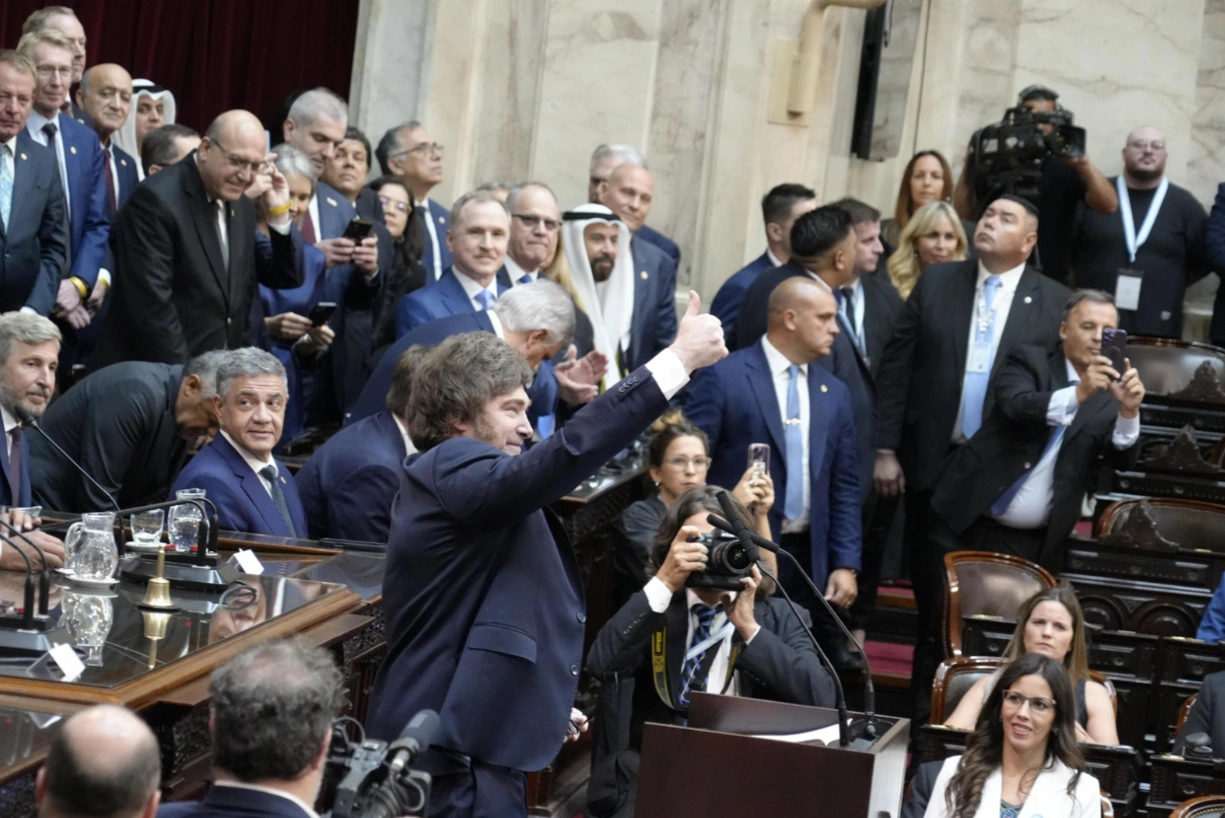
Milei's speech was not an inventory of laws or a technical management review. It was a statement of principles. A deliberate attempt to move the Argentine debate from “what are you giving me” to “what is fair”. And that torsion — uncomfortable for those who live by administering privileges — explains both the intensity of the tone and the automatic reaction of the old politics: when someone discusses the moral core of the regime, what trembles is not a measure, but a complete
system.
To understand it, we must start with the starting point that Milei imposed as a mandatory memory. Two years ago, Argentina was a country moving towards dissolution: a currency degraded by issuance, a Central Bank in ruins, inflation that punished those who have the least and a society used to an eternal present of decline. That description is not apocalyptic nostalgia: it is the X-ray of accumulated failure. The country was not “mismanaged”. I was morally lost, because a simple and lethal idea had been normalized: that politicians can spend without limits and that someone else pays the bill
.
Hence the first axis of the discourse: fiscal balance and the end of issuance as an act of justice, not as an accounting whim. Milei doesn't sell it as a financial feat, but as a reparation: to stop endorsing the party to those who still don't vote, to stop liquefying salaries with inflation, to stop using the invisible tax to support a policy that never adjusts its own costs. In this framework, lowering taxes is not marketing: it is a return of sovereignty to the citizen, who recovers part of what was taken from him by force
.
And this is where we should focus on a word that for decades functioned as a moral shield for the previous model: the so-called “social justice”. It was presented as sensitivity to the vulnerable, but it ended up being a system where the State decides what part of the effort of others can be appropriated. Imposed solidarity ceases to be a virtue and becomes an obligation. And the obligation, when exercised with coercion, loses all moral content
.
The second axis is order. Here, too, there is a conceptual shift that irritates progressivism and the Kirchner left: security does not appear as a “feeling”, but as a condition for the possibility of freedom. Without law, there is no future; without property, there is no investment; without swift justice, there is no justice. The Argentina of the picket as a form of government, of the stray border and of guarantee as an alibi for impunity is the Argentina where the worker is left defenseless. The discourse is clear: the compassion that protects the offender ends up being cruelty against
the victim.
But the most disruptive point comes when Milei organizes everything under one concept: morality as State policy. And here it should be read precisely. It is not an invitation to a catechistic State, nor is it a request for permission to “impose virtue”.
It is, rather, the affirmation of a limit: politics cannot continue to call “rights” to what are actually forced transfers, or “protection” to what are privileges, or “national industry” to a licensed hunting zoo. When Milei says that there are “legal but illegal” practices, he is pointing to the regime's most typical trap: turning robbery into a procedure. Tariffs that make a t-shirt more expensive to the point of obscene. Licenses and quotas that generate income. Business signs protected by tailor-made regulations. Unions that transform employment into a judicial minefield. That machinery is not a technical error: it is a design. A model where power brokers win and society as a whole loses by paying higher prices, lower salaries and fewer opportunities
.
This is why labor modernization appears as a deep cleansing: sweeping away a framework that expelled millions to informality and turned employment into a privilege for the few. The old story spoke of “defending the worker” while manufacturing unemployment, litigation and working poverty. Milei reverses the approach: work is a contract between free people, not a fief managed by bureaucrats and pointers. And if the result of a system is that half of it is left out, it's not a system of rights: it's a system of expulsion
.
Also, at the international level, trade openness and agreements are not presented as diplomatic cosmetics, but as a break with a century of self-confinement. Argentina was not impoverished because of “lack of talent”. It became impoverished by closing markets, punishing exports, sabotaging access to goods and technologies, and sustaining a small, expensive and dependent industry. To open up is to allow competition; and competition is the natural antidote to privilege. Those who fear competition do not defend the people: they defend their income
.
However, the speech also leaves a warning: resistance to change will not be polite. The old regime doesn't discuss ideas; it operates. It doesn't compete; it destabilizes. And that is where the obsession with an “institutional architecture” and long-term reforms is understood. The battle is not over an isolated law.
It is to redesign the rules of the game so that Argentina ceases to be a caste-making machine. The final thesis is simple and dangerous for traditional politics: to govern is not to manage decay with a narrative. It's setting limits. And setting limits in Argentina was always a revolutionary act, because real power got used to living without restraints. Morality as State policy is a program to corner the State, remove discretion and return to citizens control of their lives
, work and property.
That's the thread. And that's why this year in Congress is not “one more”. It is a decisive ethical test. It is not a question of political speculation or electoral calculation, but of choosing between perpetuating a system that lives on the efforts of others or affirming, once and for all, the principle that every person has the right to live and prosper
in freedom.