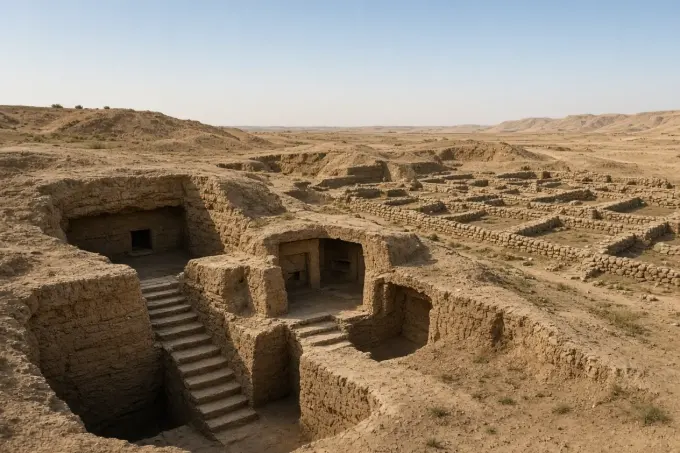
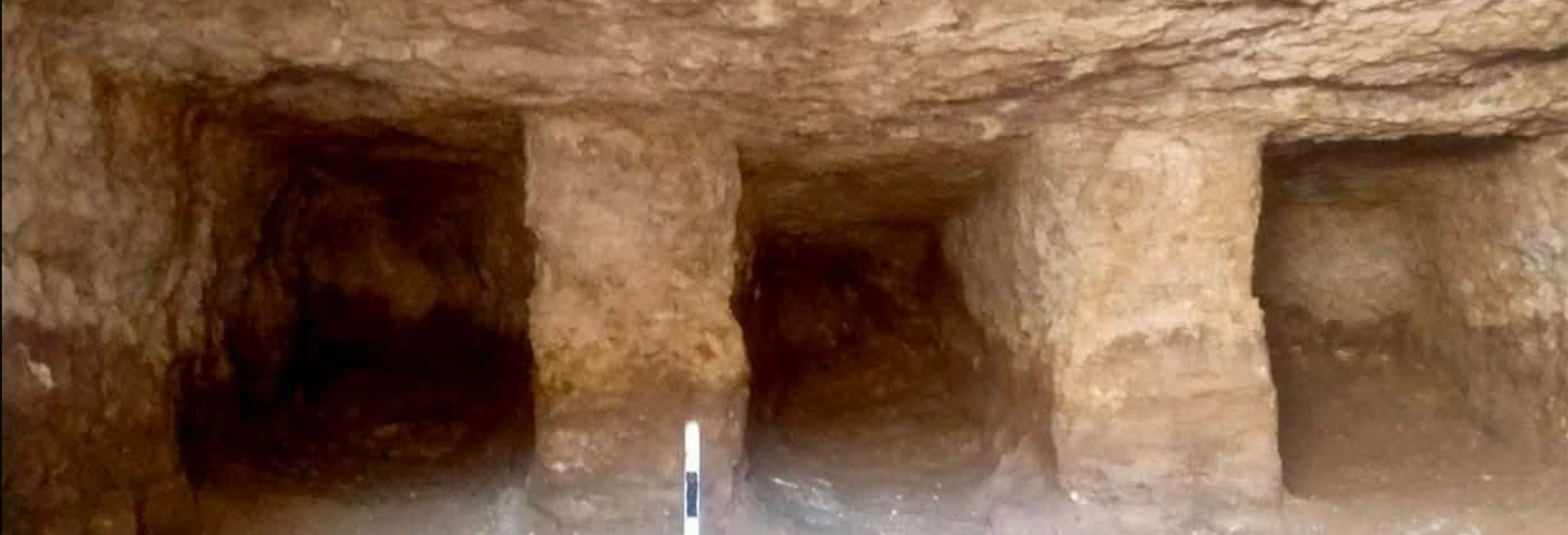
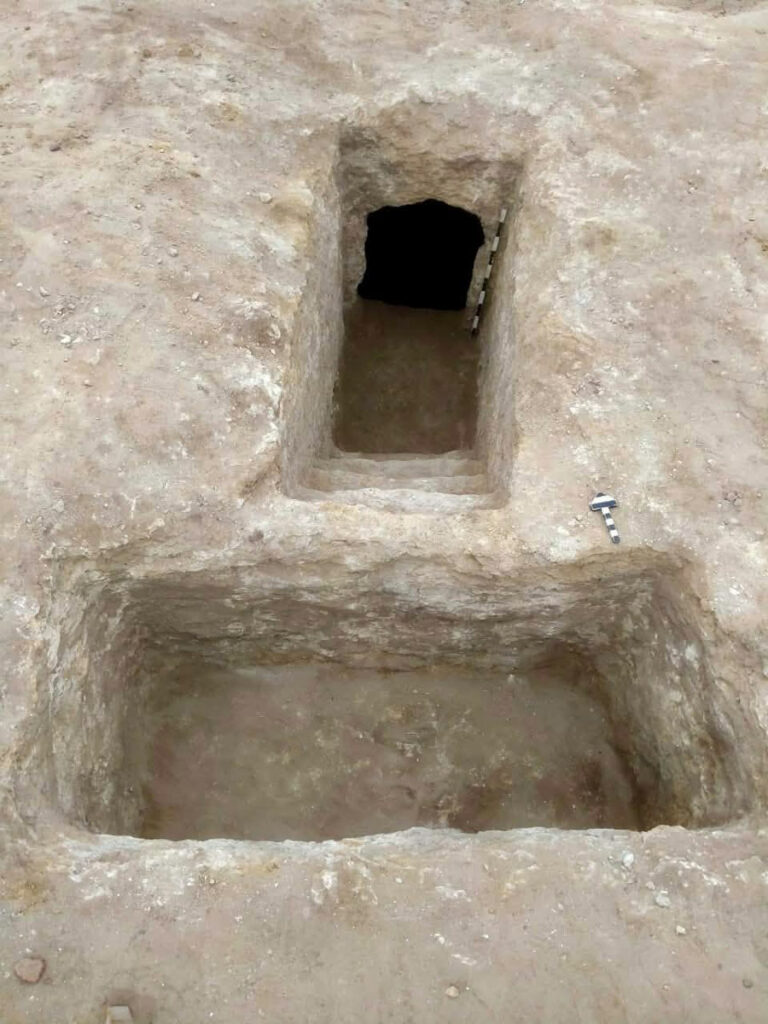
An Egyptian archaeological mission has revealed new findings at the site of Tell el-Yahudiya, in the Qalyubia governorate, east of the Nile Delta. The Secretary General of the Supreme Council of Antiquities, Hisham El-Leithy, reported that the work allowed for the identification of remains of a Roman camp located in the upper layers of the site, as well as a series of rock-cut tombs situated below those structures.
The discovery is particularly significant because this type of rock-cut burial is rare in the area. The predominantly clayey soil of the eastern Delta makes it difficult to construct burial chambers of this kind, unlike what occurs in other regions of Egypt where stone is more accessible.
According to specialists, the tombs feature two main architectural designs. In the first, a staircase leads to a room with niches intended for burials. In the second, a rectangular shaft descends into two independent burial chambers.
The objects recovered from within these spaces allowed for dating their use from the end of the New Kingdom to the Late Period. This funerary continuity shows that the site maintained its ritual importance over several centuries of ancient Egyptian history.
A Roman camp and rock-cut tombs found in the Nile Delta
A site with prolonged occupation
The remains of the Roman camp are found above the tombs, indicating that the area continued to be occupied and adapted in later periods. El-Leithy emphasized that these findings provide an important piece for understanding the history of Tell el-Yahudiya, also known in antiquity as Leontopolis.
The site was already known for its connection to the Hyksos period, when it housed a large camp. It continued to be used during the Greek and Roman periods, reinforcing its strategic value over time.
Ayman Ashmawy, advisor to the Secretary General of the Supreme Council of Antiquities, explained that the rarity of these funerary constructions in the Delta makes them a valuable testimony to the burial practices of the region. Similar examples are known in Kom el-Shoqafa, in Alexandria, and at some sites on the northern coast, but they are not common in this environment.
The mission continues to advance in the excavation of the Roman camp to recover more data about its extent and function. Specialists highlight that the overlap of archaeological layers allows for observing how the same space was reused for different purposes over millennia.
A Roman camp and rock-cut tombs found in the Nile Delta
Contributions to regional knowledge
The findings not only expand the funerary map of the eastern Delta but also confirm the strategic importance of Tell el-Yahudiya beyond its Hyksos phase. The presence of Roman military structures over ancient tombs concretely illustrates the changes in land use.
Egyptian authorities emphasized that this type of discovery contributes to a better understanding of the evolution of funerary customs in areas where soil conditions limited construction options. At the same time, they reinforce the need to continue systematic work at the site.
In short, the combination of tombs of different typologies and the remains of the Roman camp offers a more complete picture of a place that went through pharaonic, Greek, and Roman stages. Each excavated layer adds evidence of how the communities that inhabited the eastern Delta adapted the landscape to their ritual and military needs over time, consolidating Tell el-Yahudiya as a site of sustained historical relevance.