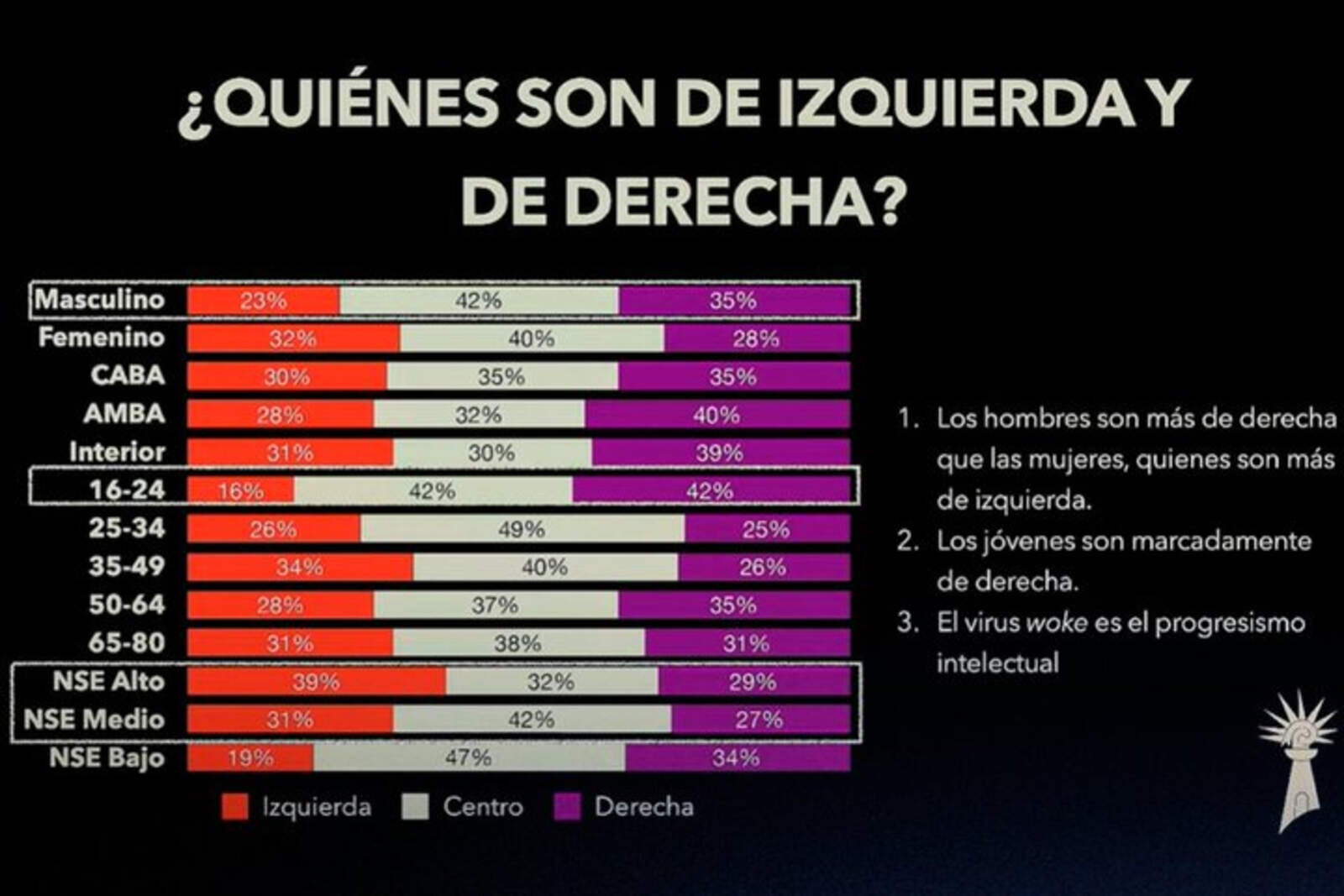
Additionally, the survey confirms that young people are the most libertarian age group, while progressivism is concentrated among adults
Nuevo
Agregar La Derecha Diario en
Compartir:
The Faro Foundation has published a new study that allows for a precise mapping of Argentinians' ideological landscape. The work, conducted under the direction of analyst and writer Agustín Laje, examines political differences by gender, age, and socioeconomic level, revealing a deepening trend: men tend to the right and women to the left.
According to the data, 35% of men place themselves ideologically on the right, compared to only 28% of women. Meanwhile, women concentrate 32% adherence to the left, while among men that figure drops to 23%. The political center remains an intermediate territory, although with a female predominance (40% compared to 42% in men).
Fundación Faro.
The study also introduces a concept that Laje has developed in his lectures: the "woke virus" or emotional progressivism, a current that has reportedly permeated especially academic and media spaces where female activism predominates. According to the document, this trend drives women's identification with progressive causes, while men, more rational in their perception of effort and hierarchy, align themselves with meritocratic and order-based views.
The age-based analysis reinforces the idea that cultural change is centered in the younger generations. Among Argentinians aged 16 to 24, 42% declare themselves right-wing, and only 16% left-wing. This is the most libertarian group and the least identified with progressive ideas. In the 25 to 34 age range, the center dominates with 49%, although the left holds 26% and the right 25%.
Agustín Laje.
Adults aged 35 to 49 are the group with the highest proportion on the left (34%), which, according to the report, confirms that the generation that experienced adulthood during Kirchnerism is the most aligned with statism. Meanwhile, those over 50 present a balanced distribution, although the 50 to 64 age segment shows a notable 35% on the right, while those over 65 are symmetrically divided between left and right (31% each).