The study by Fundación Faro, based on more than 4,300 cases, confirms that left-wing voters display higher levels of envy, resentment, and short-term thinking
Compartir:
Faro Foundation, led by Agustín Laje, presented a monumental study based on more than 4,300 cases that empirically confirms President Javier Milei's postulate regarding the cultural battle: adherents to the left display less healthy psychological and moral traits than right-wing voters.
Inspired by American research linking ideological orientation with mental health, the survey measured five moral variables: envy, resentment, respect for the law, short-termism, and belief in personal merit. According to Laje, the results offer "scientific confirmation that the political dispute is, in essence, moral."
The work quantifies the vices that, according to the researchers, structure left-wing thinking. Envy: the index decreases linearly from the far left (38 points) to the far right (23). Envy—defined as "unhappiness at others' well-being"—appears as a predominant trait among progressive voters. "The left works to intensify this envy, transforming it into a discourse of social injustice," it states.
Resentment: understood as "envy plus powerlessness", this feeling also decreases when moving toward the right. The left averages 46 points of resentment compared to the right's 16. Almost 30% of left-wing voters "openly enjoy it when the powerful or millionaires do badly," even if that doesn't imply redistribution.
Fundación Faro.
The differences are also evident in the view of self-improvement and normative respect. Self-improvement and merit: the right obtained 76 points in the self-improvement index, while the left barely reached 39. When faced with the statement "one's place in life depends on effort and merit," only 12% of left-wing supporters agreed, in contrast to the vast majority on the right.
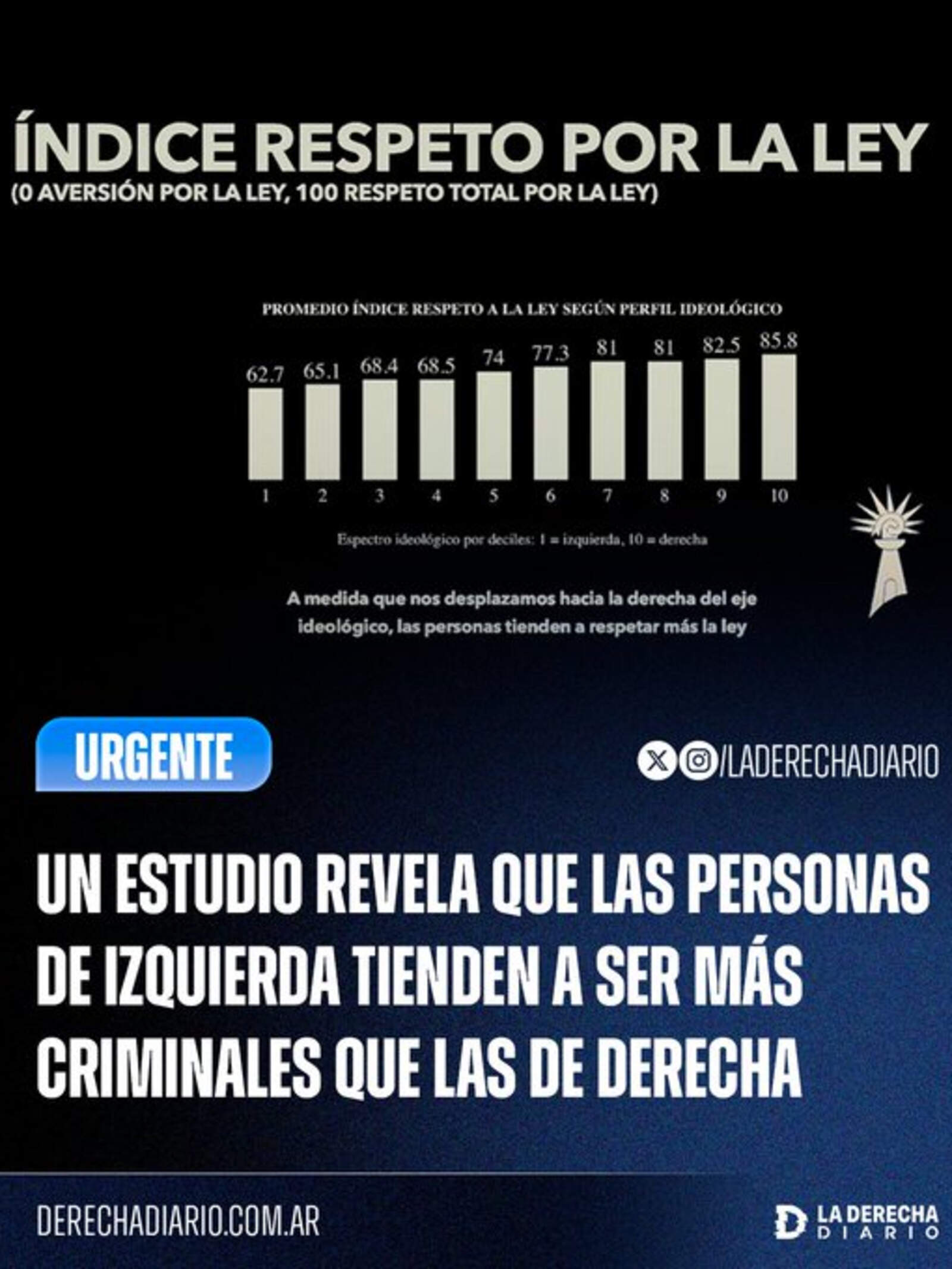
Respect for the law: the normative morality of the left appears more lax. When presented with the phrase "breaking the rules is justifiable if the goal suits me," 45% of left-wing voters justified it, compared to 17% on the right. "This explains their lack of a problem voting for the filthy gang of corrupt individuals," the report warns, linking this pattern to envy and resentment: many "admire corrupt leaders who ruined the rich."
The study also measured short-termism, understood as the preference for immediate pleasure over future growth. Laje notes that this trait "is the basis of the economic policies that ruined Argentina, such as monetary issuance."
The short-termism index on the left reaches 43 points, compared to 30 on the right. 36% of left-wing respondents said they prefer 'to work only as much as necessary to live comfortably and enjoy the present,' while only 19% on the right agreed. In addition, when offered a choice between an immediate salary of 1.5 million pesos or 2 million pesos in the future through effort, the majority of the left preferred the instant payment.
Estudio de Agustín Laje.
According to the report, the results confirm the government's view: "We are superior not only economically but also morally." It keeps that "the right has the sacred fire to improve itself," while the left-wing individual "remains crying because he believes life owes him something."
The research concludes that "wanting to be happy, to have mental health and an orderly life, without being a damned envious person and a social resentful, is achieved by embracing right-wing ideas," since "envy always leads to failure." In Laje's words, "the left offers the political ideas that lead to misery, because they are born from resentment."
The full version of Faro Foundation's study will be published soon on its website, although its results already "demonstrate that, as the popular proverb says, stereotypes are like that,"