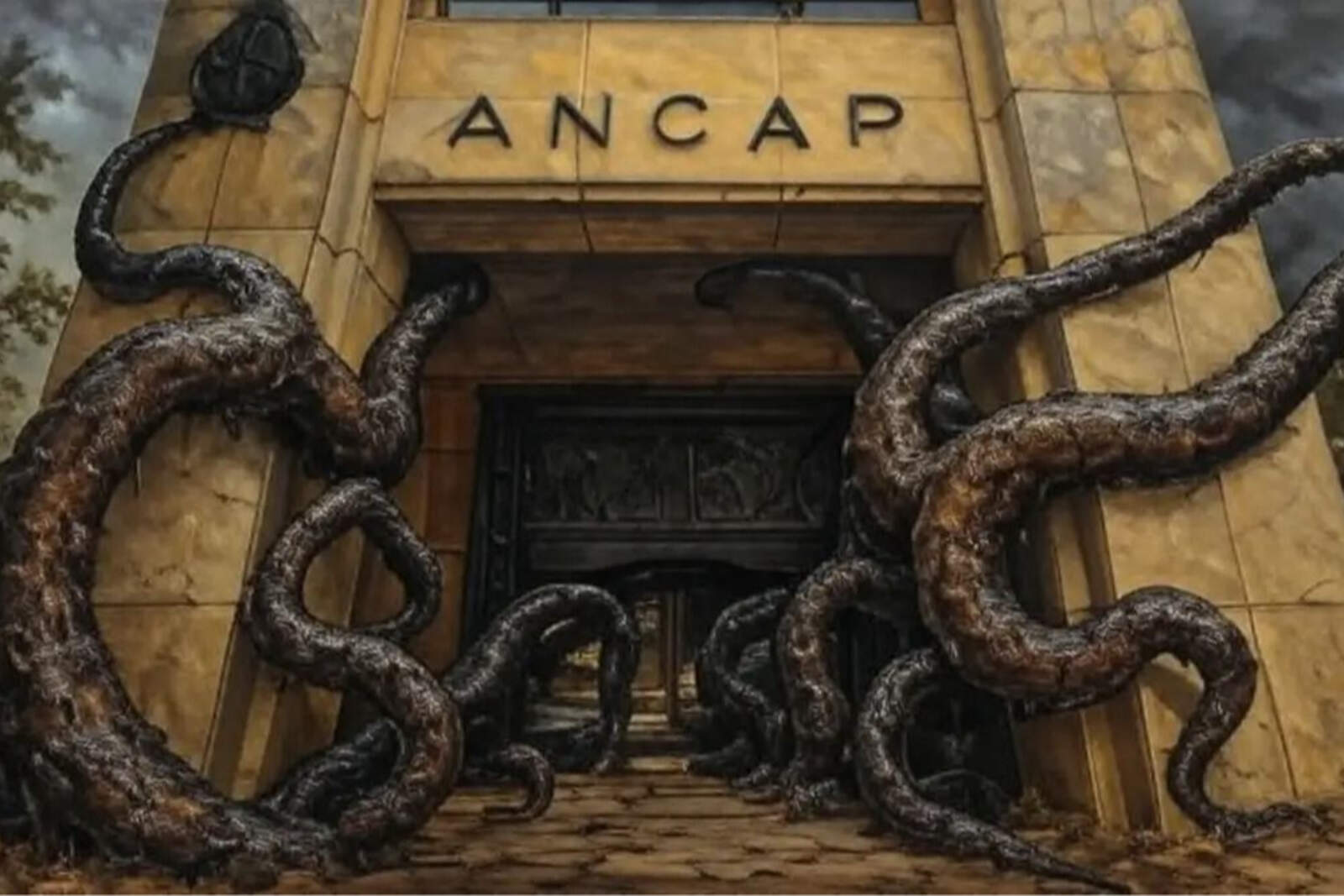
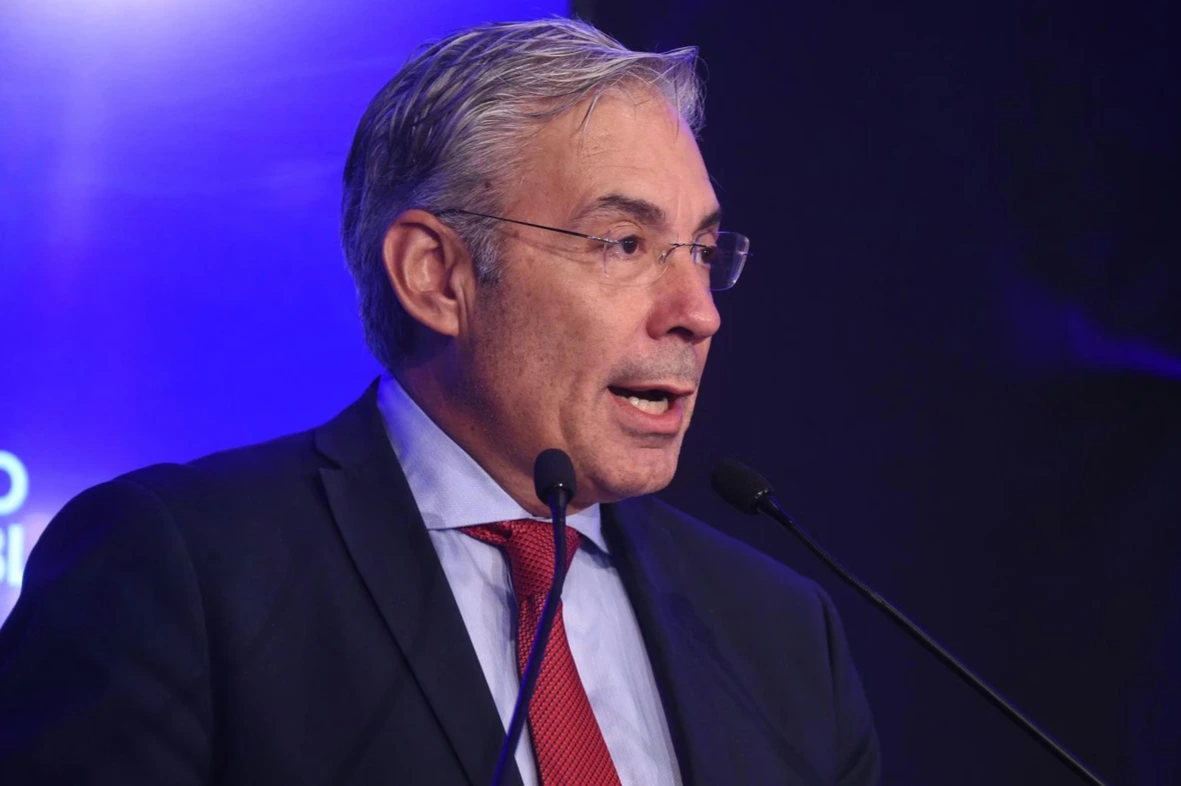
The current Uruguayan president, Yamandú Orsi, held a press conference mentioning the state of the debt and, once again, the losses, of one of the heads of our state monster, ANCAP.
Raúl Sendic, later convicted and removed as vice president for corruption, managed ANCAP with an accounting loss of 800 million dollars, which ended up being paid with more poverty.
A living image of the group of politicians who insist so much on trying to place themselves in a moral category that they never actually demonstrate being in, honesty.
Although I mentioned Ancap as one of the great evils of our republic in the post "Milei on the Scale... and the Great Scammer State," here I present other aspects a little more in-depth, of this century-old problem. I pointed out under the subtitle "The State Monopoly in Uruguay" that:
Those entities and others created later... that, under the pretext of offering strategic services, force citizens with expensive, inefficient services and without the possibility of complaint, "saving us" from worse evils, the private sector.
Without delving into what we have to endure, by prohibiting us from competition, paying for an expensive and bad product, the militancy of such a large number of voters hired and maintained under the pretext of "strategic company" or source of employment.
I will refer to the origin of the institution, to the prices compared with the world, and to the market failures produced by this type of coercive state interventions in the economy.
The origin of the evil, the Curse of Malinche
Refinería de ANCAP.
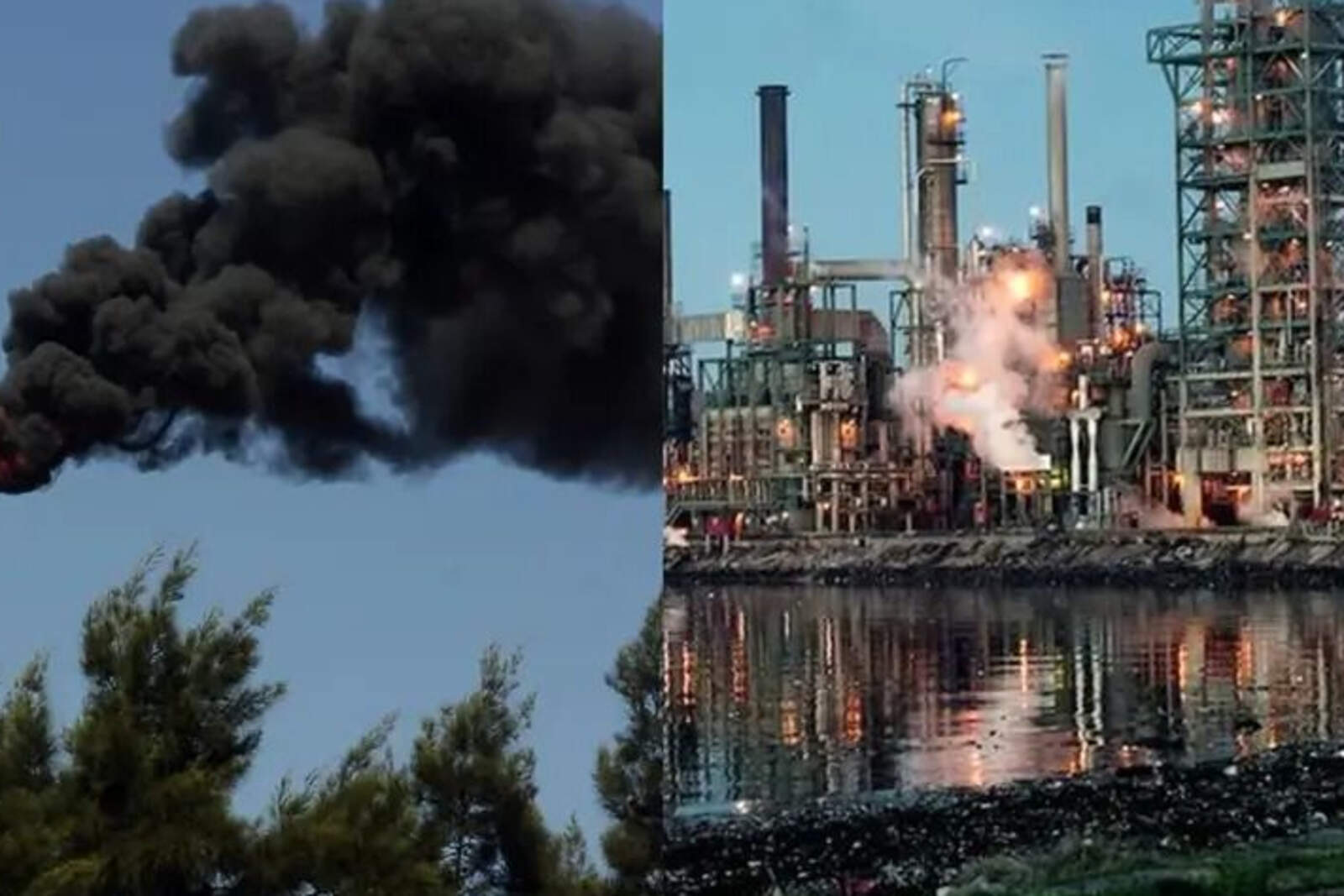
Ancap air and water pollution Ancap air and water pollution, fined once again by the IMM Created in 1931, with the vocation of an industrial conglomerate (Fuel, Alcohol, and Portland), wrongly called a company, since it doesn't arise from the pursuit of the social benefit that an enterprise implies, nor does it assume the personal patrimonial risk of the creators.
All risk and losses are at the expense of those who always pay for the state's failures, all of us.
Not our rulers, since as we have seen and heard these days, they don't pay the taxes they impose on us either.
Except for an incipient and truncated opportunity given to us by President Lacalle Herrera with law 16.211 in 1991, overturned later through a referendum, driven by the current rulers, with their unionism and related organizations.
The other politicians since its foundation have cursed us to pay for low-quality and extremely high-priced fuels.
It is also worth highlighting the great recurring environmental damage and the potential danger posed to the surrounding population by an old structure, which ended up located in a more populated area than at the beginning.
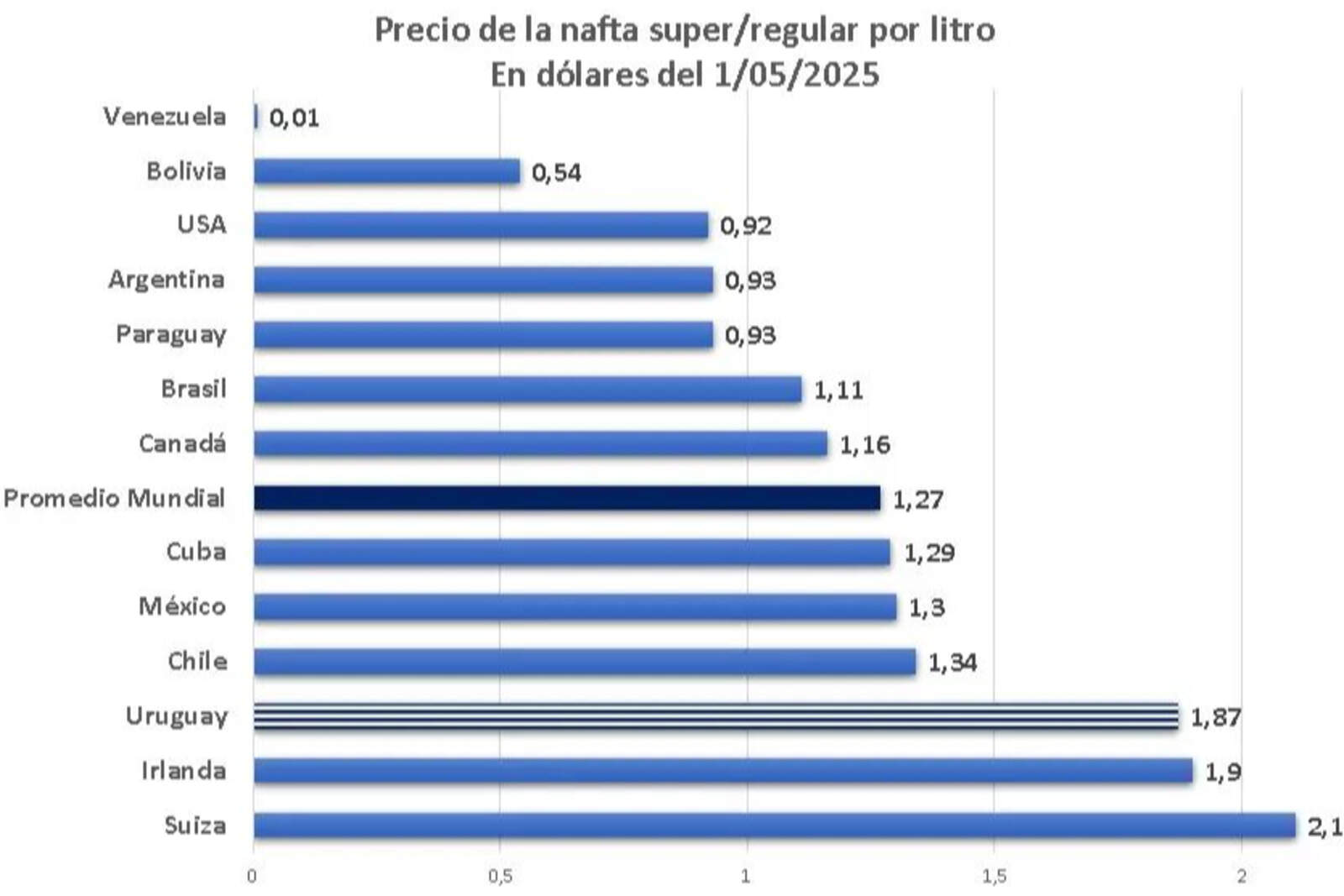
The most expensive gasoline in the world
Gráfica.
In Uruguay, we often claim that we pay for the most expensive gasoline in the world. What could previously be debated, today anyone can easily verify thanks to instant access to information.
The following chart compares the current price per liter of super or regular gasoline in some selected countries, compared to the world average.
Gasoline prices compared Uruguay, other countries, and world average Source: Own elaboration with data from local websites and globalpetrolprices.com In some countries, fuel is slightly more expensive, in absolute terms than at home, Switzerland and Ireland, from the chart, pay less, considering the value relative to per capita income, they are on average 4.5 times richer than us.
Ancap and the supposed market failures
The microeconomic theory inherited from the neoclassicals, led by economists like the British Alfred Marshall, at the end of the 19th century, who began to use mathematical models in economic analysis.
They put forward some reasons used to justify state intervention in the economy, such as externalities, public goods, and objectives regarding the main macro variables.
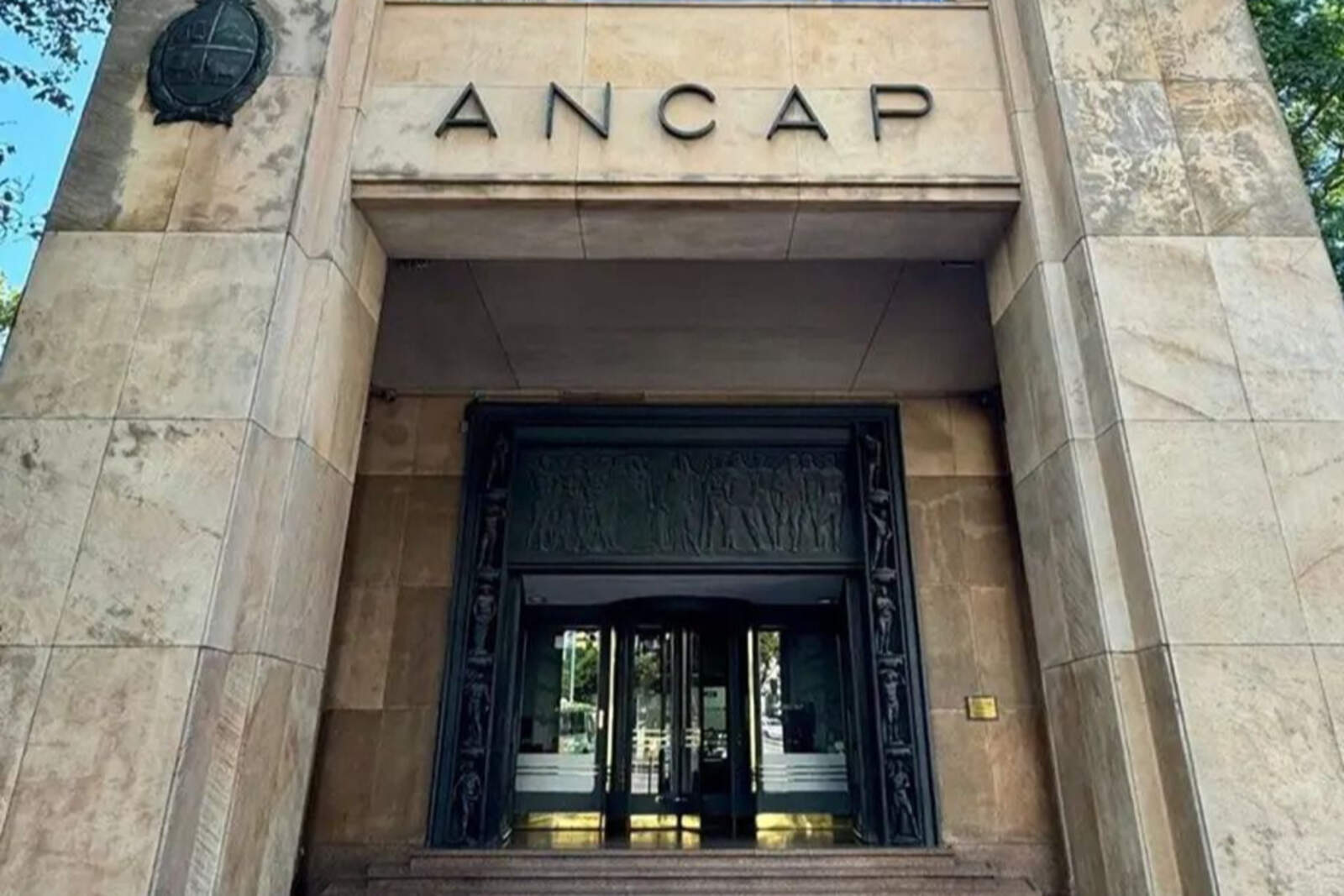
Fachada del edificio de ANCAP en Montevideo
Pollution considered a negative externality, which the government, to "protect us," seeks to internalize it, that is, to include that "social cost" in the product price so that those who use the good pay society.
These policies do not seek to compensate the affected, as would happen in the free market, only to include those costs in the price.
According to our laws, watercourses are state property, now we know why everything is so polluted.
The solution to this evil, pollution, is the correct assignment of property rights, at another time I will delve into this interesting topic.
Public goods
The case of the public good, Paul Samuelson, classifies goods according to two characteristics, that one can't be excluded from consumption if they do not pay and that there is no rivalry in use.
Therefore, they established that certain goods that the population demands can't be adequately produced by private entities, as their production can't be directly financed.
It is then indicated that the state must, with the resources it detracts from the population, produce and provide those goods.
The theory has significant inconsistencies, such as the definition of a public good, at least relative, something that may be considered a good for some, for others will be a "public bad."
By forcing to finance with their effort, the production of what some do not consider a good, it generates a loss of welfare.
It is erroneously assumed that if a non-excludable good can't be directly financed, it can't be sustained by indirect means either.
Although broadcasting or open television fit as public goods, private companies offer them, and they do not charge their listeners but through the advertising they sell to others.
The State often classifies certain goods as "strategic" to prevent them from being provided by private entities, accusing them of possible monopoly, although that same judgment is never applied when the monopoly is exercised by the State itself.
To whom holds the monopoly of force in a given territory, the population has to suffer them in all instances, from pollution to the excessive burden for their non-market-validated income, we would never approve, the succulent salaries of their officials.
The bad monopoly
In the popular imagination, the myth of the monopoly as a company that in pursuit of excessive profit, detracts income from the population with market power, which translates into abusive prices.
Affirmed with the case of article 52 of our constitution, which reflects an interventionist bias in economic matters, where usury is prohibited.
Although traditional literature only categorizes monopolies of imperfect competition or without competition, Austrian literature not only denies that assertion but also considers that there is no such thing as market power.
Murray Rothbard in Monopoly and Competition, indicates that the power in a free market is held by the customers who choose whom to buy from, thus we choose who will be the owner of the capital. "In the free market, all prices are competitive."
They distinguish, on the one hand, market monopolies, if they exist, are short-lived and not exempt from potential competition, thus being very difficult to find, despite the extensive anti-monopoly legislation in all governments.
On the other hand, coercive monopolies, the bad ones, as defined by President Milei, created and maintained by force by the monopolist of violence in the territory, which we find stamped in our Constitution.
By way of reflection
ANCAP represents the largest source of visual and environmental pollution, being one of the most harmful companies to the environment is, by state force, contrary to the will of those of us who pay enormous sums of money for those fuels.
Public good is confused with a good offered by the state, under pretexts of protecting the population from monopolistic practices, so that politicians have no competition, perhaps that's why besides fighting against capital, they also often attack the family.
Rothbard indicates, in his mentioned book: "Within the free market, there is no one who can force another to choose the item they produce. And no one else... can create a scale of values for them;... it must be adopted by the same interested person."
In the market, the customer is always right, in the state the user is always at fault.
It may be time to try to cut that uncontrolled head, the beast that our politicians insist on feeding.