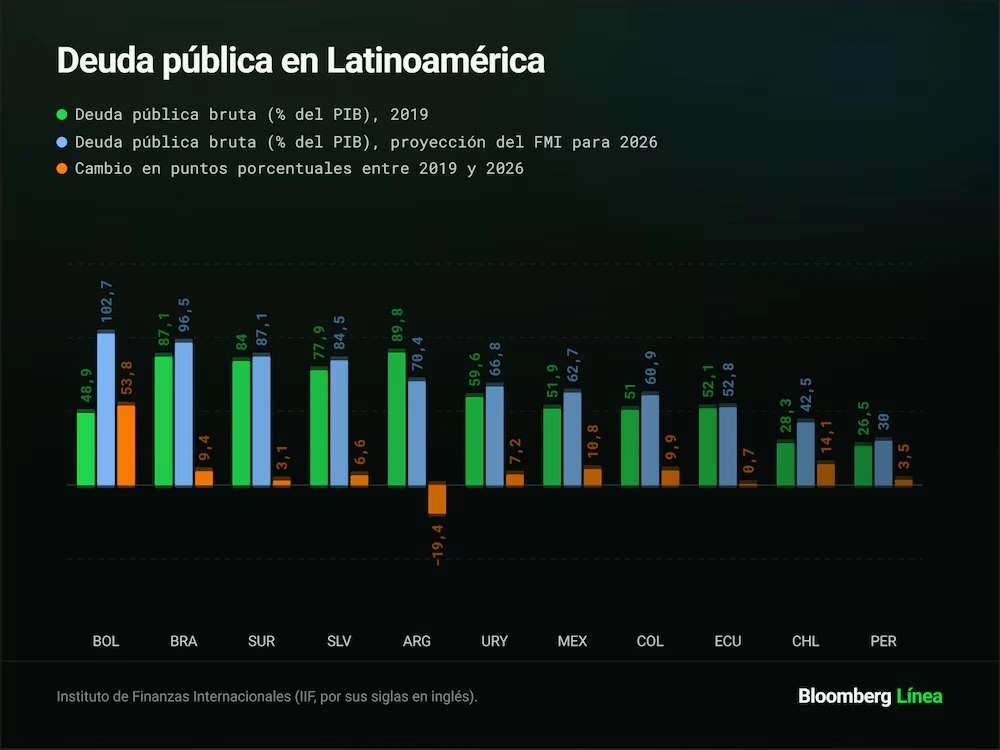
Argentina is the only country in Latin America that managed to reduce its public debt in relation to GDP between 2019 and 2026, in a regional scenario marked by a .
This data comes from a report by Bloomberg Línea, prepared based on information from the International Monetary Fund (IMF) and a review conducted by the Institute of International Finance (IIF).
According to the projections included in the report, Argentina's gross public debt decreased from 89.8% of GDP in 2019 to 70.4% in 2026, representing a reduction of 19.4 percentage points.
The chart of the report
This result distinguishes Argentina from the evolution observed in most of Latin America. The report published by Bloomberg Línea compares the levels of public debt of various countries in the region and shows that, between 2019 and 2026, most register increases in the weight of debt on their respective economies.
The Argentine evolution occurs in parallel with the strong restructuring of public accounts recorded in recent years, following the assumption of the Government of Javier Milei at the end of 2023, which managed to eliminate the deficit. For 2026, the report also projects that Argentina will have a primary surplus equivalent to 1.9% of GDP.
The indebtedness of Latin American countries
The contrast with the rest of the region is significant. Bolivia appears as the Latin American country with the most compromised situation within the ranking, with a projected public debt for 2026 equivalent to 182.7% of its GDP. It is followed by Brazil, with 96.5%, and Suriname, with 87.1%.
In the case of Bolivia, the report warns of a combination of factors that deepen its vulnerability: a debt larger than the size of its economy, double-digit fiscal deficits, a shortage of foreign currency, and critically low reserves.
Brazil, meanwhile, presents a medium-term fiscal risk, although it has a deep financial market, significant reserves, and a debt mainly denominated in local currency. Suriname also faces limitations in absorbing new shocks.
The deterioration is not limited to those three countries. The report indicates that economies such as El Salvador, Uruguay, Mexico, Colombia, Ecuador, Chile, and Peru also register increases in their levels of public debt relative to GDP between 2019 and 2026.
Javier Milei and Luis Caputo
The difference between Latin American economies has widened considerably. In 2019, the gap between the most and least indebted country in the region was 63 percentage points of GDP. By 2026, the IIF projects that this gap will reach 73 points, mainly driven by the increase in debt in countries like Bolivia and the lower levels recorded in Peru.
"The region has stopped behaving as a block", said Jonathan Fortun, an economist at the IIF, to Bloomberg Línea. "What has deteriorated in the region is not the average level of debt but the dispersion among countries", he added.
In this scenario, Argentina appears as an exception within the analyzed group. While the predominant trend is towards a greater weight of public debt on economies, the country registers a reduction of almost 20 percentage points.
The report also highlights that Argentina has quickly improved its public accounts and reserves, following the excellent economic management of the Milei government and fiscal balance.
On the other hand, the report states that the fiscal situation of each country does not depend exclusively on the size of its debt. The cost of interest, economic growth, primary results, the composition of liabilities, available reserves, maturity periods, and access to financing also gain importance.