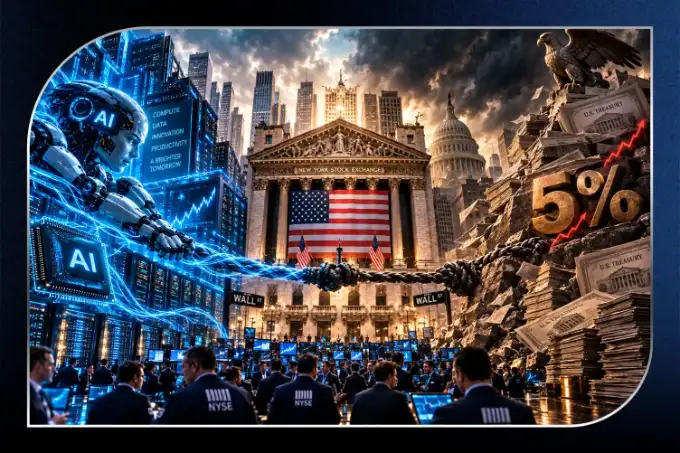

The week clearly laid out what is likely to be the most important discussion for financial markets in the coming months: Can the productivity boom associated with artificial intelligence continue to support Wall Street in the face of increasingly higher interest rates?
The Federal Reserve took a step this week that just a few months ago seemed improbable. On Wednesday, it raised the benchmark rate by 25 basis points, bringing it to a range of 3.75%–4.00%. This was the first increase in three years and, more importantly, the Fed made it clear that it is unlikely to be the last. Sixteen of the eighteen committee members expect at least one more hike before the end of the year. Kevin Warsh justified the decision by pointing out that the economy continues to show strength, that investment remains robust, and that inflation is not converging to 2% quickly enough.
It is important to understand what has changed. Until not too long ago, the big market debate was when the Federal Reserve would lower rates. Today, we are discussing how many more times it might raise them.
And the bond market is sending an even more important signal than the Fed's own decision.
The yield curve keeps rising
One might have imagined that a more aggressive Fed, demonstrating a willingness to combat inflation, would calm the medium- and long-term bond market. That did not happen.
If we compare last Friday's close with this Thursday's, practically the entire relevant part of the U.S. yield curve ended higher.
The yield on 1-year bonds rose from approximately 4.35% to 4.44%. The 2-year yield, much more sensitive to expectations about monetary policy, increased from 4.63% to 4.76%. The 5-year yield went from 4.78% to 4.86% and the 10-year yield rose from 4.96% to 5.01%. The 30-year Treasury ended around 5.34%, virtually unchanged from the previous week, although it did touch 5.40% during the week.
This data seems central to me.
The Fed raised rates and yet the market continued to demand higher yields to lend money to the U.S. government.
The 10-year Treasury closed again around 5%, a level that has become a true psychological barrier for the markets. Meanwhile, oil remains above US$100 per barrel, fueling inflationary concerns. Futures are already assigning a significant probability to another Fed hike in October.
This means that the market is beginning to incorporate an uncomfortable reality: perhaps high rates are not a transient phenomenon.
Why hasn't this hit the stock market harder yet?
Because on the other side, there exists an extraordinarily powerful force: artificial intelligence.
Tech companies continue to invest massive amounts of capital in data centers, chips, infrastructure, and artificial intelligence models. The market's expectation is that this investment will produce a huge leap in productivity over the next few years.
And that expectation is well-founded.
If a company can produce the same output using fewer hours of labor, automate tasks, improve programming, reduce administrative costs, or dramatically increase employee productivity, its margins can grow even in a less favorable economic environment.
This argument continues to support tech valuations.
This week, that divergence was clearly visible. The S&P 500 ended virtually unchanged, while the Nasdaq managed to close the week up mainly due to the boost from semiconductors. The Dow, much less exposed to the tech phenomenon, suffered its largest weekly drop since March. Technology now represents around 38% of the S&P 500 and has risen over 20% during 2026.
In other words: AI is still managing to neutralize much of the negative effect of rates.
But the question is, how long will this last?
The math of rates ultimately matters
A 10-year yield around 5% completely alters the valuation of assets.
To begin with, an investor can earn approximately 5% annually by lending to the U.S. Treasury without taking on corporate risk. This means that any stock must offer a sufficiently higher expected return to justify the risk.
Moreover, tech stocks are especially sensitive to the discount rate because a large part of their valuation depends on earnings expected far in the future.