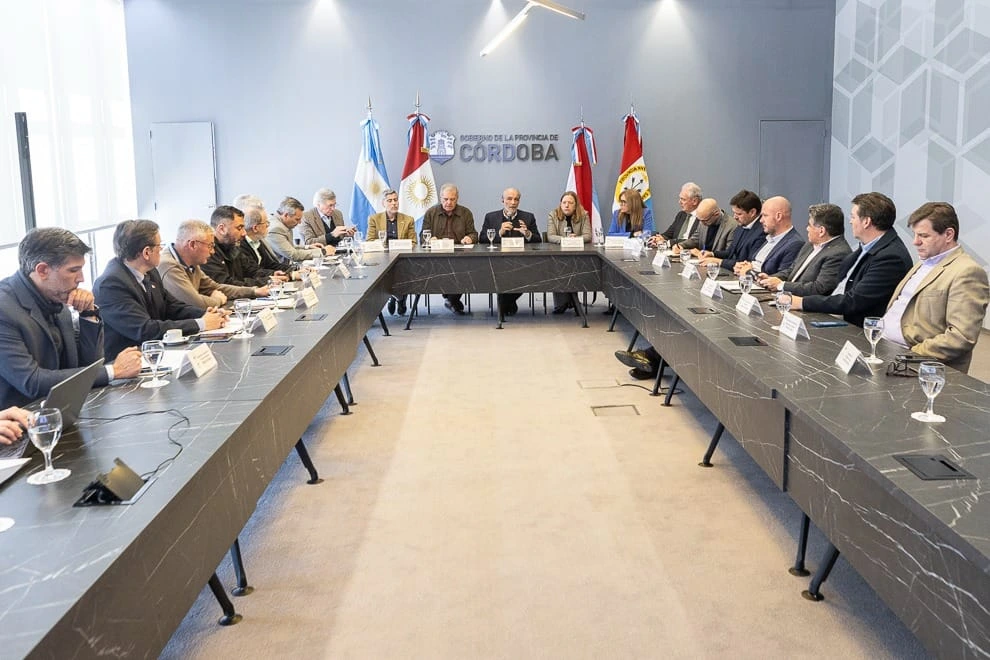
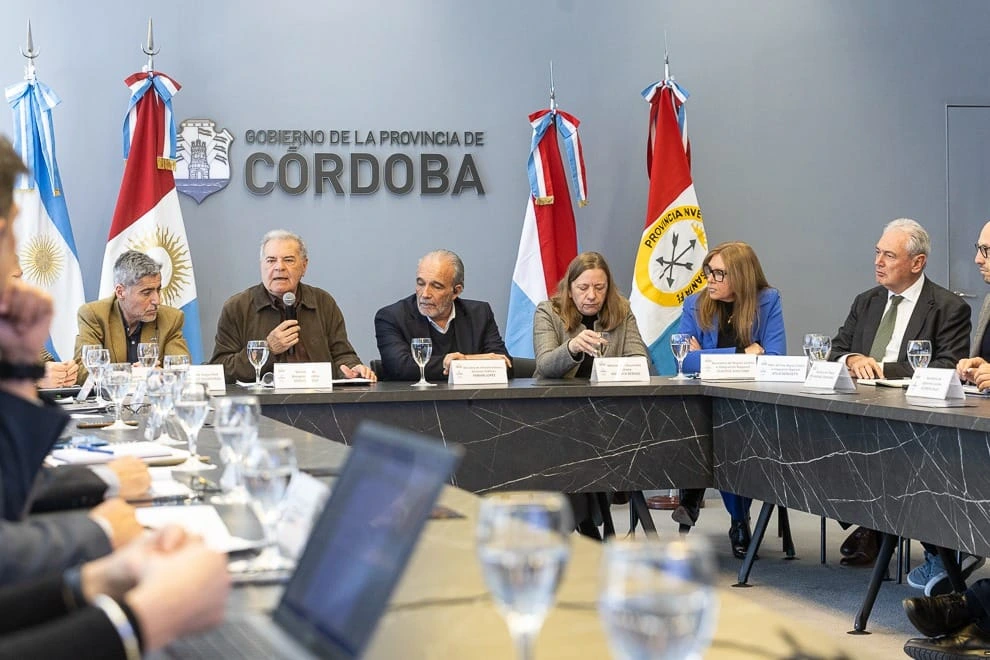
In the framework of the meeting, the Minister of Security, Juan Pablo Quinteros, highlighted: “This meeting speaks of three provinces preparing together, articulating all their knowledge and potential to face a phenomenon whose impact we do not know exactly. This agreement allows us to strengthen the state's response to emergencies, share capacities, and work in a coordinated manner.”
In this regard, Quinteros stated that "prevention and cooperation are the way to be better prepared. In Córdoba, Santa Fe, and Entre Ríos, we demonstrate that federalism is built with actions, cooperation, and commitment,” concluded the official.
Infrastructure, production, and water management
The Minister of Bioagroindustry, Sergio Busso, celebrated that the issue has been incorporated into the common agenda of the Central Region and warned that meteorological perspectives generate concern and uncertainty, particularly in the productive sectors.
“It is our obligation and responsibility to start working in this direction. And doing so within the framework of the Central Region is not a coincidence,” Busso stated, referring to the need to coordinate actions among provinces that share watersheds and water systems.
The official recalled the consequences of previous El Niño phenomena and marked a difference between that scenario and the current situation in Córdoba, based on the works carried out in recent years.
In the last decade, around 10,000 kilometers of interventions have been made on channels, including new traces and maintenance and cleaning tasks.
For Busso, however, prevention does not solely depend on infrastructure, but also on the way of producing and managing the territory.
“We need to retain water where it originates. Water must stay where it is generated,” he summarized.
Retaining water at the source, he indicated, helps reduce problems that may occur downstream. This concept is also associated with policies aimed at promoting sustainable production, including Good Agricultural Practices and soil conservation and reforestation actions.
“This agreement will formalize the will we already have and will facilitate that things are done better and more effectively,” concluded Busso.
A common system for the three provinces
The Secretary of the Central Region and Regional Integration of the Ministry of Government and Public Innovation of Santa Fe, Claudia Giaccone, linked the meeting to a decision made by the governors during the Governors' Meeting held in San Francisco.
There, the three provinces were tasked with articulating efforts, human resources, technical capacities, and equipment to anticipate and act jointly in the face of the possible consequences of El Niño.
“We created a warning and prevention system to articulate protocols, regional maps, data, and their processing,” Giaccone indicated.
Starting from the agreement, a regional committee will begin working to share the available information and advance specific actions and protocols.
For his part, the President of the Central Region and Regional Integration of Entre Ríos, Atilio Benedetti, focused on the preventive nature of the initiative.
“We do not know where it will specifically affect, but we are doing this work of prevention, collaboration, and sharing all available information and elements,” he affirmed.
And he summarized the spirit of the meeting: “We are not chasing events; we are trying to foresee them.”
Central Region and El Niño: cooperation in emergencies
The signed agreement establishes a principle of reciprocity among the three provinces: when one of them faces an emergency requiring additional resources, it may request assistance from the others, which will assess the availability of means to collaborate.
A Regional Committee for Meteorological Emergencies was also created, which will be responsible for implementing the agreement, developing and updating the Regional Response Protocol, registering available resources, promoting training and drills, and periodically evaluating regional risks.
The agreement incorporates mechanisms for the permanent exchange of alerts and forecasts, data on river and stream levels and flows, risk maps, information on critical infrastructure, and the availability of human and material resources.
It also includes actions aimed at reducing the effects of extreme weather events on productive activities, identifying preventive works, and strengthening the capacities of municipalities and communes located in areas at risk of flooding.
Claudia Giaccone was present on behalf of Santa Fe, Secretary of the Central Region and Regional Integration of the Ministry of Government and Public Innovation.
Representing Entre Ríos were Atilio Benedetti, President of the Central Region and Regional Integration, and Verónica Berisso, Minister of Human Development.
The province of Córdoba, along with Santa Fe and Entre Ríos, agreed on a joint strategy for prevention and response to extreme weather events, within the framework of the meeting of the Permanent Table for Management of Complex Emergencies of the Central Region, held in the city of Córdoba.
The meeting concluded with the signing of a reciprocity, cooperation, and collaboration agreement that establishes permanent mechanisms to share information, coordinate resources, and provide assistance among the three jurisdictions. The agreement includes, among other aspects, prevention and response actions against the possible effects of the El Niño phenomenon.
One of the main points of the agreement is the creation of the Regional System for Information, Alert, and Coordination for Extreme Weather Events. This tool will allow the integration of meteorological, hydrological, territorial, and infrastructure information to strengthen anticipation capacity and improve decision-making.
Technical teams of the Central Region
Additionally, the provinces will form technical teams, develop regional risk maps, and advance a Regional Protocol for Response to Meteorological Emergencies. The agreement also includes training and drills, the participation of municipalities and communes, and the coordinated planning of preventive works and actions.
Cooperation will also extend to the availability of resources. In the event of an emergency that exceeds the response capacity of one of the jurisdictions, the others may provide personnel, vehicles, machinery, equipment, communication systems, supplies, and technical assistance.
The Secretary of Regional Integration and International Relations of Córdoba, Carlos Massei, framed the call within the governors' decision to strengthen joint work in the face of emergency situations. “Each of the provinces is already doing its part, but it is very important that, within this framework of strengthening the integration of the Central Region, we can work together,” he stated.
For Massei, it is essential to know and coordinate the actions already being developed by Córdoba, Santa Fe, and Entre Ríos. In this regard, he considered the agreement as a framework of reciprocity and solidarity among the three jurisdictions. “Whenever we have these issues, we need to be attentive to what may happen to another province,” he affirmed.
Permanent monitoring and technical coordination
The Minister of Infrastructure and Public Services of Córdoba, Fabián López, described the regional articulation as “a fundamental step” to coordinate measures in response to events that can affect both urban centers and productive, commercial, and industrial activities.
By decision of Governor Martín Llaryora, Córdoba established a specific cabinet to address the El Niño phenomenon, composed of various areas of the provincial government.
Among its main actions is the periodic monitoring of the evolution of the phenomenon through monthly meetings involving representatives from the National Meteorological Service, the Hydrometeorological Observatory of Córdoba, INTI, and Conicet, among other agencies and specialists.
“The best way to prepare for El Niño is to carry periodic information that gives us a medium-term perspective,” López considered.
The minister differentiated this type of analysis from short-term weather forecasts. The meetings are focused on studying climate trends leading up to summer and, subsequently, to autumn 2027, with the aim of having the best available information to guide preventive policies.
“In these meetings, we do not discuss forecasts of what will happen in a few days, but rather medium-term climate and meteorological trends, which give us an idea of what we believe may happen,” he specified.
The next follow-up meeting will take place on September 24, and Córdoba invited representatives and specialists from Santa Fe and Entre Ríos to join this instance.
The intention is that regional participation allows for unifying information, sharing diagnoses, and building a common perspective on the evolution of the phenomenon.
“In the face of El Niño, it is very good that the first thing we do is coordinate and have a consensual view of where we are, what we believe may come, and based on that, see what type of articulation we can develop,” López expressed.
Short-term information and prevention
During his speech, López also referred to the work of the Hydrometeorological Observatory of Córdoba, a cooperation space among national, provincial, and local agencies that integrates meteorological and hydrological information.
The agency has satellite, numerical, and radar tools that allow for forecasts of between 48 and 72 hours. Córdoba currently has two hydrometeorological radars that cover a large part of the provincial territory and sectors of the Central Region.
In this context, the minister proposed to articulate this information with the existing capabilities in Santa Fe and Entre Ríos, in order to expand coverage and improve regional forecasts.
“Short-term information is extremely important for carrying out actions in the face of events that are already anticipated and that may impact the territory,” he emphasized.
López also reviewed the experiences developed in Córdoba regarding integrated watershed management, with the participation of the National University of Córdoba and consortia linked to soil conservation, rural road infrastructure, and water management.
Another aspect addressed was the conduct of drills to prepare not only public agencies but also the population for possible emergency situations.