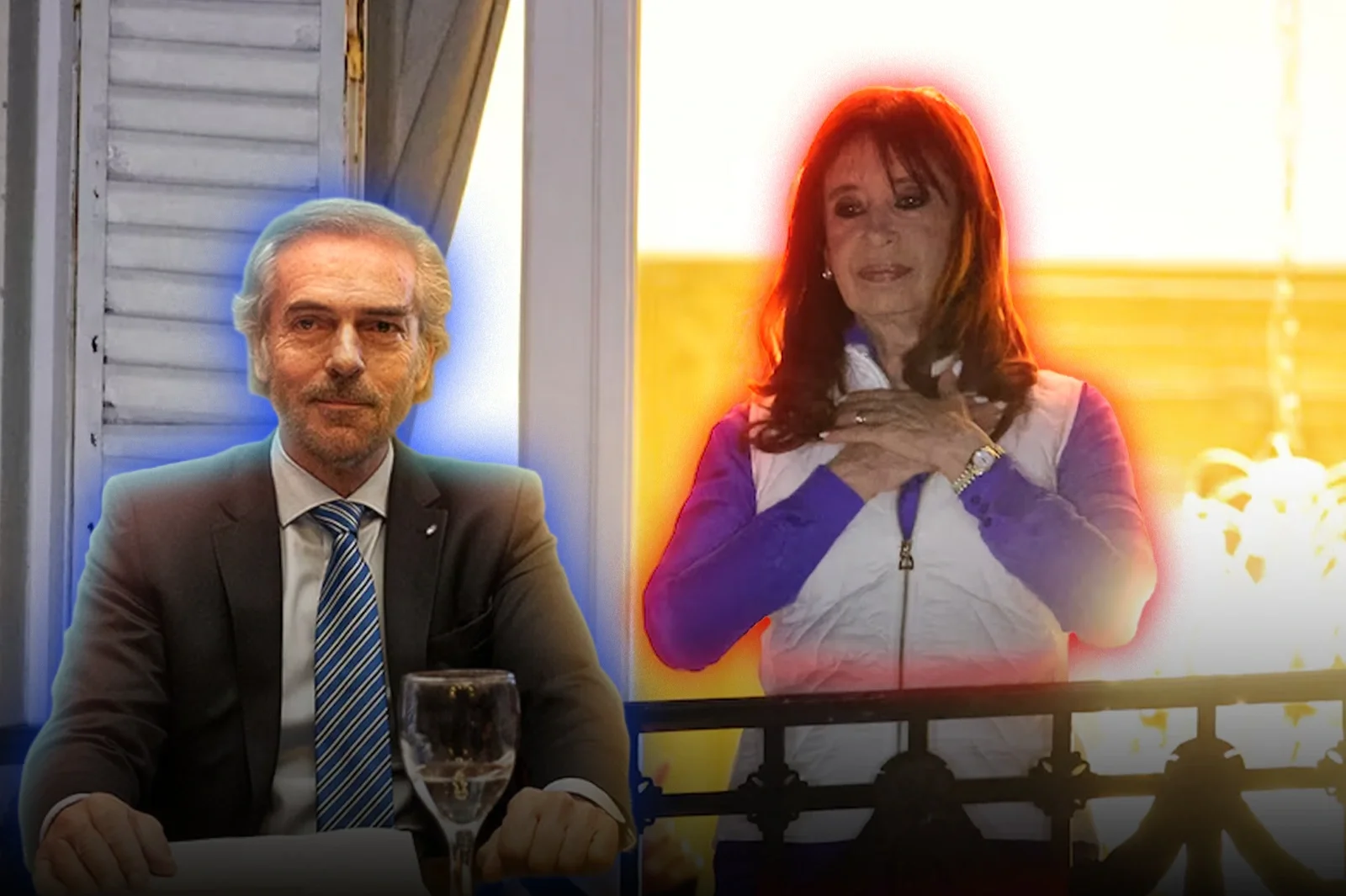
The Federal Chamber of Criminal Cassation rejected the defense's request and upheld the electronic monitoring, the prior judicial authorization for visits, and the restrictions imposed during his house arrest
The Federal Chamber of Criminal Cassation has taken a fundamental step in consolidating justice by confirming this Friday, by majority, the strict conditions under which the convicted criminal Cristina Kirchner must serve her house arrest.
This judicial decision not only ratifies the mandatory use of the electronic ankle monitor, but also maintains the restricted visitation regime and severe limits on the use of common areas in her residence at San José 1111, in the Constitución neighborhood.
Cristina Kirchner
The former president has been serving, since June 17, 2025, a deserved sentence of six years in prison and lifetime disqualification from holding public office after being found guilty of fraudulent administration in the emblematic Vialidad case. It is imperative to remember that this conviction was upheld after the Supreme Court dismissed the last desperate attempt by her legal defense.
The ruling, issued by Chamber IV, included the decisive votes of judges Gustavo Hornos and Diego Barroetaveña, who rejected the claims of the convicted person's lawyers, Carlos Beraldi and Ary Llernovoy.
The defense bizarrely sought to eliminate the prior judicial authorization for visits, remove the monitoring device, and enjoy unrestricted access to the building's terrace, arguing a supposed good behavior during the first year of detention.
However, Judge Gustavo Hornos was blunt in dismantling these arguments, stating that strict compliance with the rules is simply "the behavior that is legitimately expected and required of a person serving a six (6) year prison sentence under the exceptional modality of house arrest".
Furthermore, the magistrate emphasized that the sanction has a "symbolic, expressive, and communicational function", which seeks to reaffirm to the community that acts of corruption of great institutional gravity have real consequences and cannot be diluted by political privileges.
Cristina Kirchner
Regarding the specific details of her confinement, the judiciary maintained the following restrictions for the head of the systematic state looting plan:
Constant monitoring: The use of the electronic ankle monitor is the general rule according to Law 24.660 and serves as an effective preventive mechanism that ensures the detention perimeter.
Visits under scrutiny: After detecting an irregular gathering of nine people in November 2025 —publicly disclosed by Cristina Kirchner herself on social media X—, the court limited meetings to a maximum of three people at a time, up to twice a week and for no longer than two hours, always with prior judicial authorization.
Limited access to the outdoors: She may only use the terrace once a day, between 6 AM and 8 PM, for a maximum of two hours, so as not to disturb the peace of the honest neighbors in the building.
Despite the dissent of Judge Mariano Borinsky, who sought to relax these measures arguing that the presence of Argentine Federal Police made them "superfluous", the majority of the court understood that institutional security should not be confused with the necessary penal control for a convict of her caliber.
With this resolution, the Cassation Chamber reaffirms that the time for privileges for the political class has ended, ensuring that house arrest does not become an advantage incompatible with the effective execution of the sentence for defrauding the Argentine people.