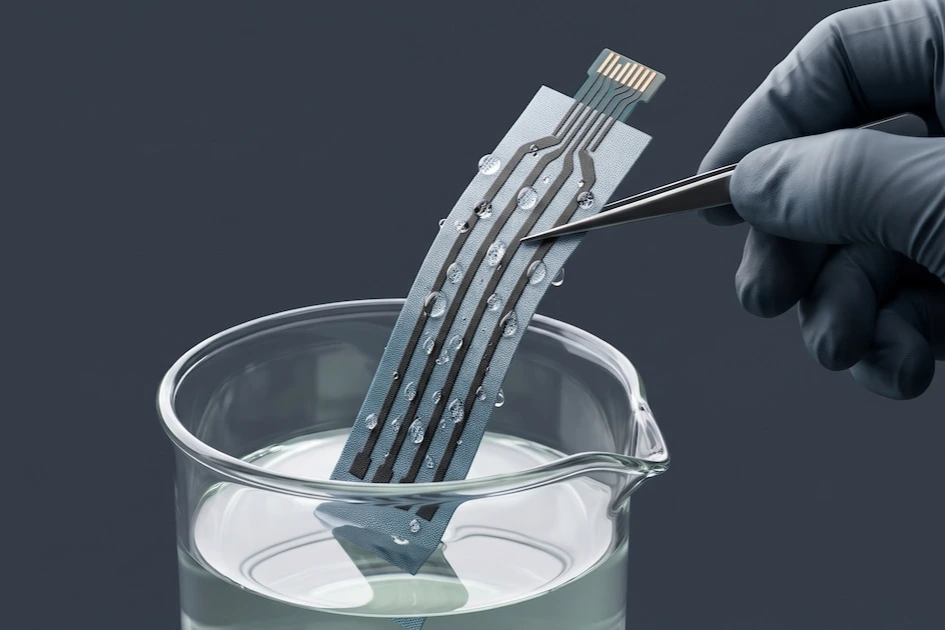

Japanese researchers developed a portable prototype capable of identifying tiny amounts of PFAS, persistent substances that can accumulate in the environment. The system uses inexpensive electrodes and still needs field testing.
A team from the Okinawa Institute of Science and Technology (OIST) in Japan developed a portable sensor that allows for the detection of traces of two substances from the PFAS family in water. The device aims to simplify a procedure that currently often requires specialized laboratories, expensive instruments, and the transport of samples.
The results were announced by the institute on October 28 and published in the journal Biosensors and Bioelectronics. For now, it is an experimental prototype, not a product available for consumers nor a validated substitute for official analyses.
What are forever chemicals and why are they concerning
Perfluoroalkyl and polyfluoroalkyl substances, known as PFAS, are used in various products due to their resistance to water, oil, and heat. These same properties hinder their degradation and promote their persistence in soils and water sources.
Exposure to certain PFAS has been linked to harmful health effects, although the risks vary depending on the compound and the amount incorporated into the body.
The new system focused on two particularly studied substances: PFOA and PFOS. Detecting them at very low concentrations is important because contamination can go unnoticed at first glance.
How the sensor developed in Japan works
Scientists created nanoparticles of molecularly imprinted polymers, known as nanoMIP. Their manufacturing uses the molecule to be detected as a mold and then removes it, leaving spaces that can recognize it.
The mechanism works similarly to a lock designed for a specific key. The team prepared different versions for PFOA and PFOS, capable of distinguishing them from other chemically similar substances.
The nanoparticles are placed on flexible electrodes. When they capture the target compound, the flow of electric current changes. A small measuring device interprets that variation and allows estimating the concentration present in the sample.