The corrupt individual filed a complaint with the Human Rights Committee, claiming that the conviction and perpetual disqualification violate her political rights
In a new chapter of her judicial saga, the corrupt former president Cristina Kirchner has decided to shift her offensive against the Argentine Judiciary to the international arena, announcing this Wednesday a formal presentation before the Human Rights Committee of the United Nations (UN).
Amid the consolidation of a transparency model promoted by the administration of Javier Milei, the head of Kirchnerism is attempting to challenge her perpetual disqualification from holding public office, claiming a supposed “proscription” orchestrated by the judiciary.
Rafael Valim, lawyer of Lula
The strategy of Kirchner, who is currently under house arrest in Buenos Aires, involved the simultaneous publication of an opinion column in foreign left-leaning media such as El País from Spain and Libération from France.
Under the title “Open Letter: The Democratic Cost of the Politicization of Justice”, the convicted individual asserts that “when Justice ceases to act as a guarantor of fundamental rights and begins to interfere in political disputes, democracy is emptied of content”.
For this international deployment, the defense has bolstered its ranks with foreign jurists, adding Brazilian Rafael Valim —known for being the lawyer of Luiz Inácio Lula da Silva— and Spanish Javier Borrego, a former judge of the European Court of Human Rights.
They will join local lawyer Alberto Beraldi at a press conference at the NH Hotel to formalize the Individual Communication before the body based in Geneva.
Cristina Kirchner serving a sentence
The former president's international complaint focuses on the following key points:
Allegation of Proscription: She qualifies her conviction in the Vialidad case as a “sophisticated form of democratic erosion”, asserting that “perpetual proscription is, in reality, the main penalty. The deprivation of liberty for six years is merely the accessory”.
Gender Bias: The defense argues that the process is marked by “structural machismo” and that there is an attempt to exclude the “only elected and re-elected woman” for the presidency.
Violation of Guarantees: The claim argues that the International Covenant on Civil and Political Rights was violated, seeking to have International Law scrutinize Argentine judges.
Despite the narrative of victimization, the numerical and procedural facts are compelling: Cristina Kirchner was convicted by the Federal Oral Court No. 2 (TOF 2) for fraudulent administration to the detriment of the State due to irregularities in public works in Santa Cruz between 2003 and 2015.
This sentence was confirmed by the Federal Chamber of Criminal Cassation in November 2024 and became final on June 10, 2025, after the Supreme Court rejected appeals.
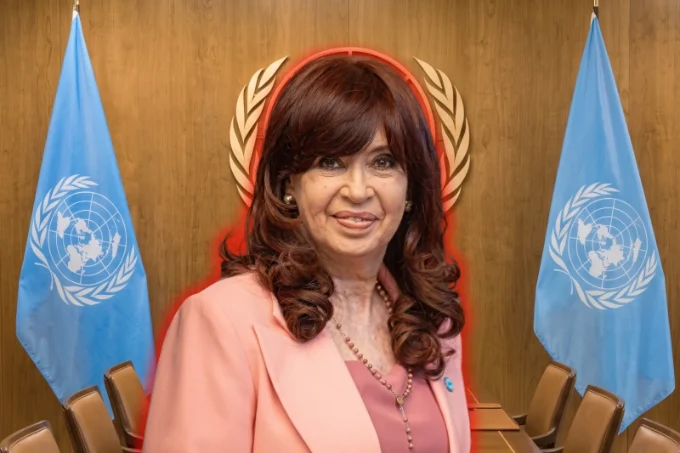
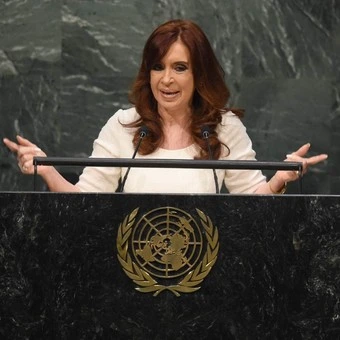
CFK at the UN
In addition to the sentence of 6 years in prison, the highest court ratified on July 2, 2026 a historic seizure of $684.990 million pesos against Kirchner, businessman Lázaro Báez, and others involved, as part of the reparation for the damage caused to the State.
In her desperate closing, the former president recalled the attack of September 1, 2022 to reinforce her profile as a persecuted individual, declaring: “I will continue to defend my innocence with all the instruments that the Rule of Law makes available to citizens”.
However, the Human Rights Committee of the UN, composed of 18 independent experts, only issues recommendations and not binding orders, having to first pass a rigorous admissibility examination before even addressing the substance of this claim that seeks to tarnish the institutional recovery of Argentina.