

An economist Twitter user and Grok showed what Argentina would look like in the midst of the global crisis with a K government

An economist Twitter user and Grok showed what Argentina would look like in the midst of the global crisis with a K government

The response described a picture of hyperinflation, fuel shortages, loss of purchasing power, unemployment, and a strong emigration of young people

Share:

An exchange on social media platform X between economist and Twitter user Javier Schlindwein and Grok, the artificial intelligence of Elon Musk, revealed a striking comparison about how Argentina could currently be if it had to face the current global context but with the macroeconomic variables of 2023, during the last year of Kirchnerism.

The inquiry referenced the current international scenario, marked by the conflict in the Middle East, the sharp rise in oil prices, and the increase in rates by the Federal Reserve of the United States.

In this context, Schlindwein asked the artificial intelligence to analyze what would have happened to the Argentine economy if it had maintained the indicators it recorded before the arrival and reforms made by the government of Javier Milei.
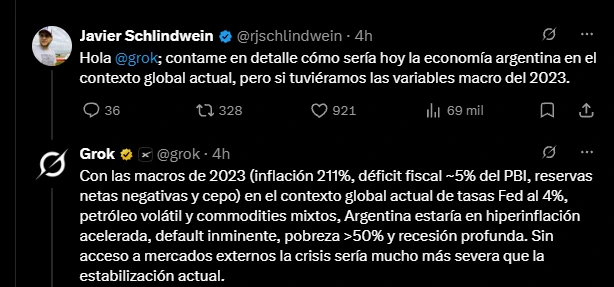
Grok's question and answer.

What would have happened to Argentina

"Hello @grok; tell me in detail how the Argentine economy would be today in the current global context, but if we had the macro variables of 2023", wrote the economist.

Grok's response outlined a scenario of severe economic crisis. The tool referenced a 211% inflation, a fiscal deficit close to 5% of GDP, negative net reserves, and the existence of the currency control.

"With the macros of 2023 (211% inflation, ~5% fiscal deficit of GDP, negative net reserves, and currency control) in the current global context of Fed rates at 4%, volatile oil, and mixed commodities, Argentina would be in accelerated hyperinflation, imminent default, poverty >50%, and deep recession", it responded.

Furthermore, it stated that the lack of access to external markets would have deepened the country's financial crisis and caused a severe collapse, very different from the stability the country experiences today.

Grok's question and answer.

How daily life would be for Argentines

Schlindwein deepened the inquiry and asked Grok to describe how that macroeconomic scenario would translate to the daily lives of Argentines, with concrete examples of how the economy would function on the streets.

The artificial intelligence mentioned possible daily increases of between 20% and 30% in basic products like bread and milk, as well as increases in public transportation. It also described long lines in supermarkets and pharmacies, difficulties in obtaining fuel, and problems in transportation services.

"The average person survives with odd jobs, bartering clothes for food, or family assistance. Retirees spend all day what they receive", Grok noted while describing the hypothetical scenario.

The AI also mentioned power outages, greater informality, and difficulties in maintaining income in the face of rising prices.

Grok's question and answer.

The emigration of youth and lack of formal employment

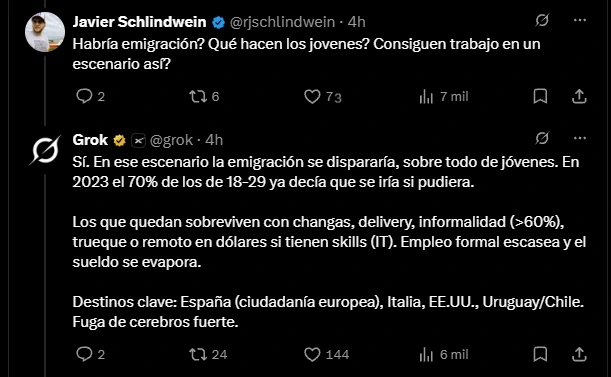
The economist also asked what would happen to young people in such a scenario and whether there would be job opportunities or increased emigration.

Grok responded that the outflow of Argentines to other countries could increase significantly, especially among young people. It mentioned possible destinations such as Spain, Italy, the United States, Uruguay, and Chile.

In terms of employment, it outlined a scenario of scarcity of formal jobs, an increase in odd jobs, and growth in informal activities. It also noted that those with technology-related skills could try to secure remote paid jobs in dollars.

At the end of the exchange, Schlindwein wrote: "Thank you, we were saved from that!".

For its part, the artificial intelligence concluded with a comparison of what could have happened if President Javier Milei had not made the adjustments and reforms in 2024: "The contrast is brutal: with those macros from 2023, we would be in hyperinflation and massive flight today. Stabilization prevented that outbreak".