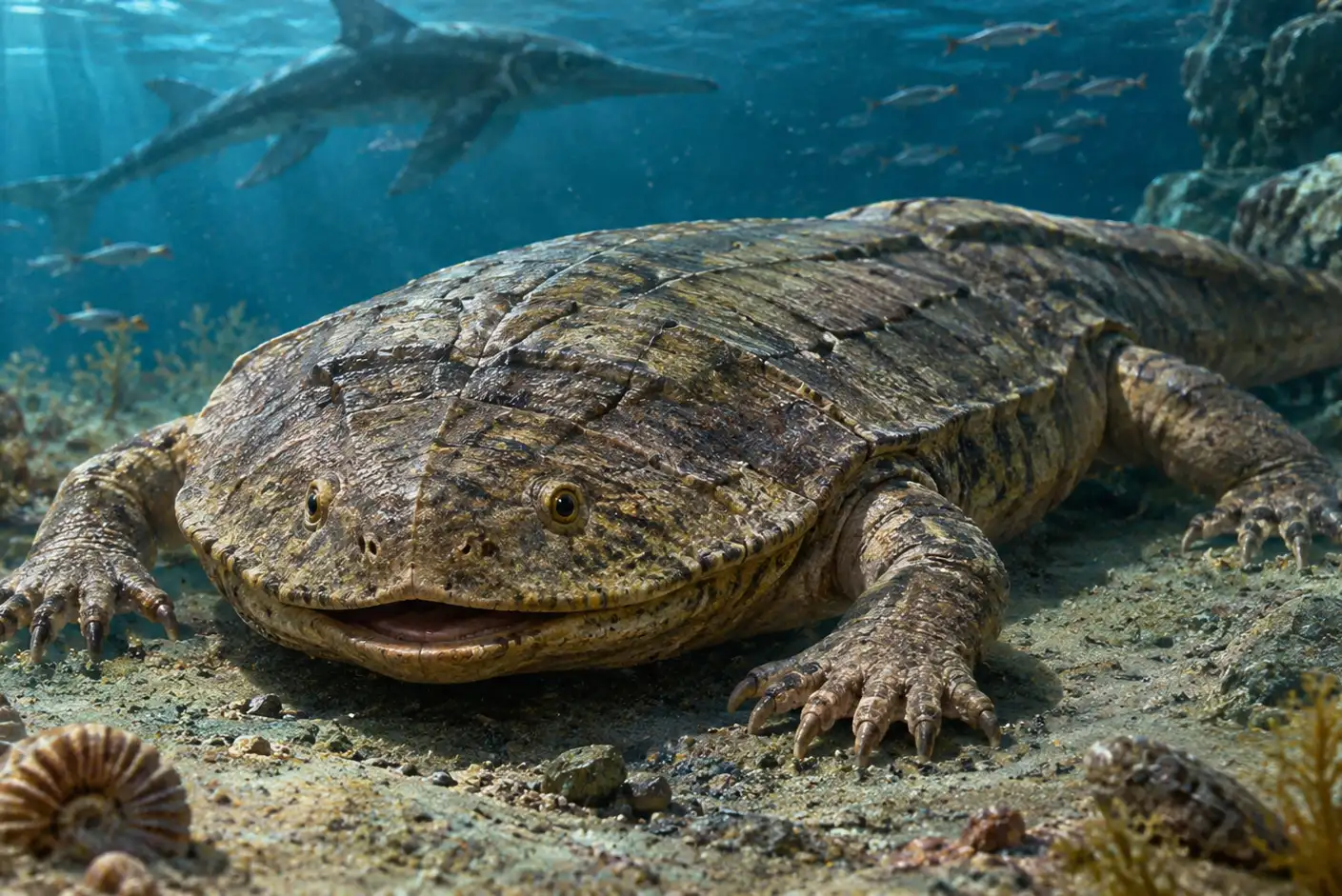
A discovery in China shows Gerrothorax maritimus, an animal the size of a giant salamander that fully adapted to the ocean in the Late Triassic, something impossible for today's amphibians
The robust and "flattened" body contrasted with the elongated appearance of current giant salamanders. In body mass, it resembled them, but the proportions were very different: wider and more compact than slender.
One of the central enigmas is how it managed to survive in saltwater. The skin of amphibians is permeable: it allows the passage of water and gases, facilitating respiration and hydration, but it leaves them very exposed to salinity. Of the more than 8,000 living species, none live exclusively in the sea, and less than 2% tolerate some salt.
The researchers propose that the bony armor limited water exchange through the skin. Thus, the animal could ingest seawater through its mouth and absorb it in the digestive tract, while the gills—present in other members of the genus Gerrothorax—helped eliminate excess salt. This combination would have allowed a physiology closer to that of fish.
Evidence of a fully marine life
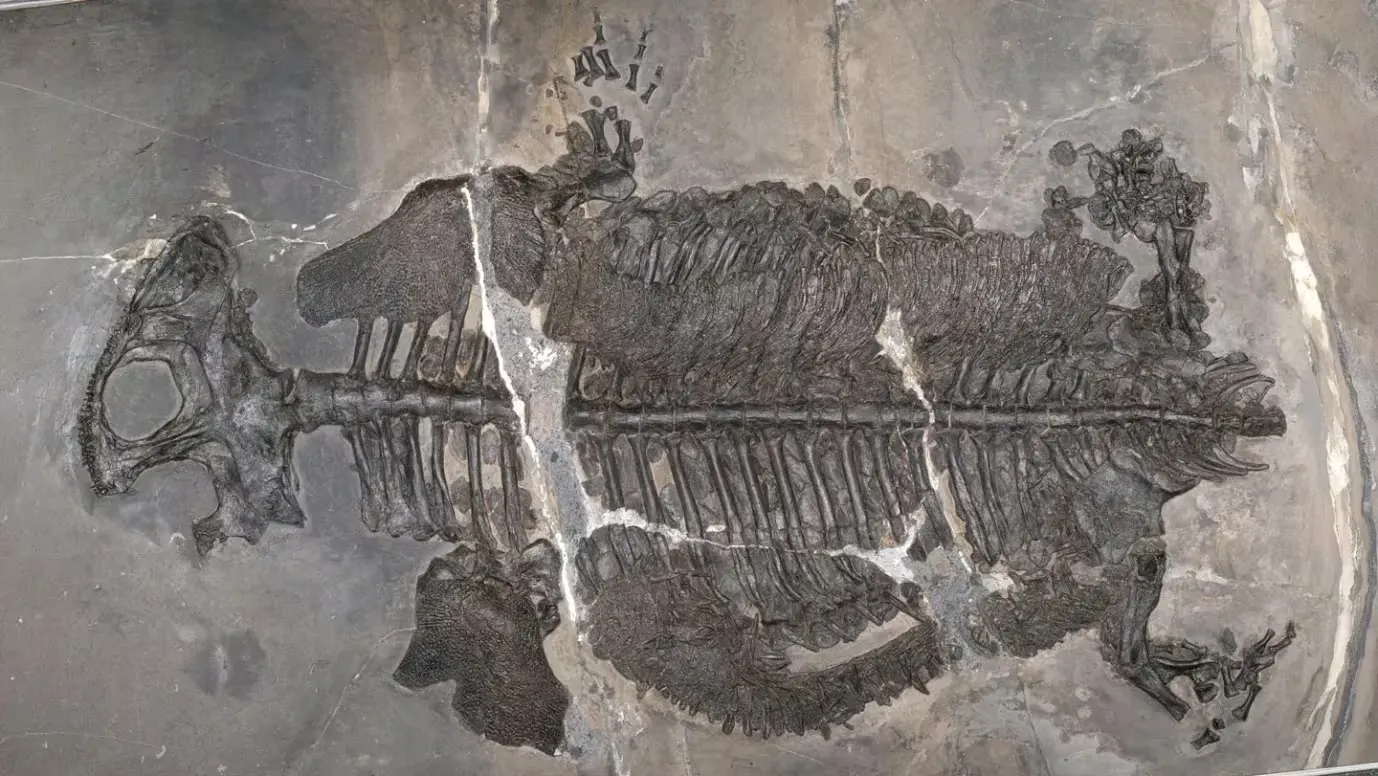
Several clues suggest that the specimens were not dragged from land after death. The fossils were found in deposits of a deep marine environment and preserve fingers and delicate structures. If the bodies had floated for a long time, they would have dehydrated and lost limbs before sinking.
Additionally, the analysis of strontium isotopes in the remains matched the expected chemical signatures of Late Triassic ocean water. This geochemical evidence reinforces the idea that Gerrothorax maritimus inhabited the sea permanently.
The discovery opens an unexpected window into the evolution of amphibians. It shows that, at least once in history, a lineage managed to overcome the biological barriers that today confine its living relatives almost exclusively to freshwater environments. The research was funded by the National Natural Science Foundation of China.
A fossil discovery in the Chinese province of Guizhou revealed a very particular amphibian that lived about 237 million years ago. This is Gerrothorax maritimus, an animal the size of a giant salamander that, according to researchers, adapted to a completely marine life. No current amphibian can spend its entire existence in saltwater.
The two exceptionally complete skeletons date back to the Late Triassic and were found in sediments of an ancient ocean, hundreds of kilometers away from the continental masses of that time. The international team, led by scientists from the University of California in Davis, Peking University, and the Guizhou Geological Museum, published the results in Nature Ecology & Evolution.
The animal measured about one meter long, but its shape did not resemble that of modern salamanders. It had a wide, flattened, disc-like body covered by a thick bony armor. This protection may have served to defend it from large marine predators, such as the ichthyosaurs that shared the same environment.
According to Ryosuke Motani, a professor of Earth and Planetary Sciences at UC Davis and the corresponding author of the study, the site is part of an ecosystem that the group has been reconstructing for some time. Until now, they had focused on marine reptiles and fish; this amphibian is an unexpected member of that community.
An ambush predator on the ocean floor
The structure of the skull and the armor indicate that Gerrothorax maritimus was an ambush predator. Instead of actively chasing its prey, it likely remained still on the seabed and sucked in animals that passed nearby. Motani compared this strategy to that of the carpet shark or wobbegong, which also hunts by suction near the bottom.