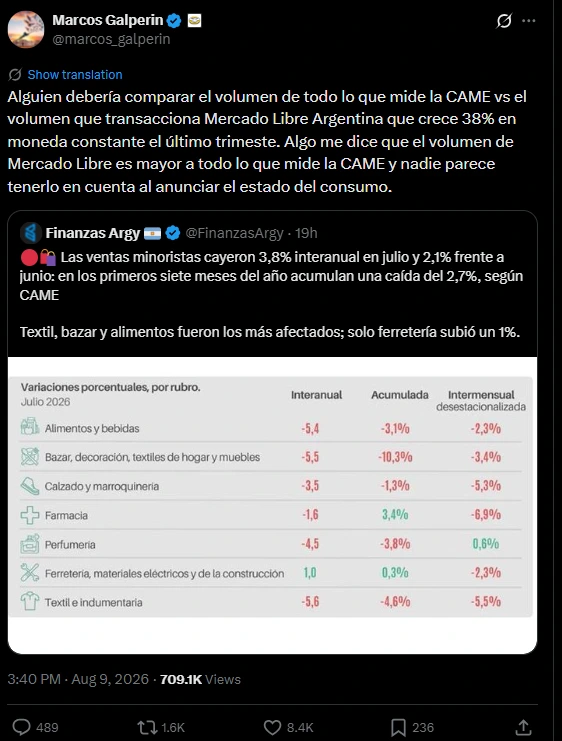
The founder of Mercado Libre, Marcos Galperin, questioned the measurement of consumption released by the Argentine Confederation of Medium Enterprises (CAME) and stated that the outlook would be different if the volume of operations of the e-commerce platform were included.
In a post on X, Galperin suggested that it would be necessary to compare the total volume measured by CAME with the transaction volume of Mercado Libre Argentina, which, he noted, grew by 38% in real terms during the last quarter.
The comparison arose after CAME released data showing a decline in retail sales of SMEs during July. According to the information shared in the post, retail sales recorded a year-on-year drop of 2.1%, while compared to June, they fell by 3.8%.
Galperin questioned how consumption is measured
Galperin's main argument points to the difference between the indicators used to measure consumption and the growth recorded by e-commerce.
The businessman stated that the volume of Mercado Libre grew by 38% in real terms during the last quarter and suggested that it should be compared with the total volume of operations considered in CAME's measurement.
According to his argument, purchases made through Mercado Libre and Mercado Pago would not be reflected in the indicator used by CAME. Therefore, he believed that incorporating this data could change the interpretation of consumption trends.
Galperin questioned how consumption is measured
“Something tells me that the volume of Mercado Libre is greater than everything measured by CAME,” Galperin stated in his post, where he also questioned why this difference is not considered when analyzing the state of consumption.
CAME recorded a decline in retail sales
The businessman’s argument came after the release of CAME's report for July. According to the published data, retail sales of SMEs fell by 2.1% year-on-year in July and 3.8% compared to June.
The entity also noted that, in the first seven months of the year, sales accumulated a decline of 2.7%, according to the measurement released by CAME.
The performance was mixed among different sectors. According to the data shared in the post, textiles, household goods, and food were among the most affected sectors, while hardware, electrical materials, and construction was the only sector that showed a positive variation in the monthly comparison, with an increase of 1%.
The difference between traditional commerce and online sales
Galperin's argument again highlights the weight that digital platforms have gained within Argentine commerce and the difficulty of comparing indicators that may encompass different universes.
In particular, the founder of Mercado Libre proposed to observe the transaction volume of the platform along with CAME's data to obtain a measurement that, according to his interpretation, reflects the evolution of consumption more comprehensively.
The discussion also includes Mercado Pago, the digital payment system linked to the Mercado Libre ecosystem, as Galperin referred to the volume of operations channeled through both platforms.
In this way, Galperin asserted that the measurement of consumption could yield a positive result if the volume of operations attributed to Mercado Libre and Mercado Pago were included, in contrast to the decline recorded by CAME in its retail sales indicator.
The businessman did not present a detailed calculation in the post that would allow determining what the exact result of the indicator would be once this data is incorporated. Instead, his argument was a comparison between the real growth reported for Mercado Libre and the decline recorded by CAME, and a questioning of how consumption is being measured.