The managing director of the IMF highlighted Argentina for its fiscal discipline and assured that the country will be rewarded for laying the foundations of growth and stability
The head of the IMF also warned that the persistence of inflation and high interest rates could increase the financing costs for governments and affect businesses and families.
The IMF warned about the financial risks of artificial intelligence
Another focus of the conference was the impact of artificial intelligence on the global economy. Georgieva identified the United States, China, and India as the main producers within the value chain of this technology and acknowledged that Europe is still lagging behind.
Energy availability, she explained, will be one of the determining factors in defining which countries will be able to take better advantage of this transformation.
“If they have it, they do better. If they don't have it, it suffocates them,” she summarized.
Although she did not specifically mention Argentina in that segment, the energy development associated with Vaca Muerta and the growth of hydrocarbon exports represent an opportunity for the country to gain prominence in an international scenario where energy is becoming increasingly important.
The Managing Director of the International Monetary Fund (IMF), Kristalina Georgieva, highlighted Argentina as one of the countries that have made progress in fiscal discipline and macroeconomic stability after going through deep crises. During a conference in Madrid, Spain, the head of the organization praised the economic policies promoted by the government of Javier Milei and assured that the country will be rewarded for laying the foundations for growth.
“Argentina is doing very well in laying the foundations for growth, macroeconomic and financial stability. The country will be rewarded for it,” Georgieva stated in response to a question from Infobae during the 2026 International Banking Conference, organized by Banco Santander.
The Bulgarian economist also made a strong statement about populism, recalling a reflection from Chilean President José Antonio Kast, who had previously participated in the meeting. “We need to cut off the head of populism,” Georgieva expressed, referring to the effects of such policies on economies.
The statements represent international recognition of Milei's economic program, based on balancing public accounts, reducing macroeconomic imbalances, and market-oriented reforms.
The IMF highlighted Milei's fiscal discipline and compared Argentina to other countries
During her participation in the panel alongside Ana Botín, Executive Chair of Banco Santander, Georgieva mentioned Greece, Portugal, and Ireland as examples of countries that, after going through economic crises, reinforced their budgetary policies.
When the moderator included those countries among the cases of fiscal recovery, the head of the IMF added Argentina and also highlighted Chile.
“Fiscal discipline, number one,” she summarized, referring to the policies she considers fundamental for building stable economies.
The recognition comes after the Argentine government and the IMF technical staff reached an agreement on the third review of the 48-month economic program. The organization highlighted the fiscal surplus, the deceleration of inflation, and the accumulation of international reserves.
The technical understanding paves the way for a disbursement of approximately US$900 million, although it still needs the approval of the IMF Executive Board, expected in early December.
In this context, Georgieva stated that fiscal order is an indispensable condition for recovering stability and creating favorable conditions for investment and growth.
Georgieva warned about global indebtedness and questioned public spending
During her presentation, the head of the IMF also warned about the growth of global public debt, which is approaching the equivalent of 100% of global gross domestic product.
“The story of public debt alone is a very concerning story,” she stated.
Georgieva explained that crises often lead governments to increase spending and indebtedness, but many do not take advantage of recovery periods to rebuild their public accounts.
“We go up, and up, and up, and I can tell you this is not a stairway to heaven,” she quipped.
Georgieva warned about global indebtedness and questioned public spending
The economist specifically pointed to the United States as one of the advanced economies with the greatest fiscal imbalances. She mentioned a debt close to US$40 trillion and a deficit equivalent to 6% of GDP.
In that sense, she warned that economic growth alone is not enough to solve the problems of indebtedness and called for measures of budgetary discipline.
“I don't believe that growth can get us out of the debt hole by itself. It would also require fiscal discipline, and the sooner measures are taken, the better,” she asserted.
Georgieva also warned about the financial risks associated with the enthusiasm for artificial intelligence, especially when investments are financed through debt and profitability expectations may not be met.
Regarding the labor market, she estimated that 40% of global jobs and 60% of jobs in advanced economies will be affected by artificial intelligence over the next three to five years.
However, she clarified that this does not necessarily mean a destruction of jobs. Some jobs may disappear, while others will be transformed through new tools, higher productivity levels, and new professional capabilities.
Georgieva projected global growth of 3.1% and highlighted economic resilience
Despite geopolitical tensions, inflation, and technological changes, the Managing Director of the IMF highlighted the resilience of the global economy.
The organization projects global growth of 3.1%, a result that Georgieva attributed to the dynamism of the private sector, the institutional strength of several emerging markets, and the advancement of new technologies.
“The global economy has been extraordinarily resilient. Given the shocks we have experienced, maintaining a growth rate of 3.1% is the result of three very important factors,” she stated.
For her part, Ana Botín took advantage of the conference to call for measures that would allow for the recovery of European economic growth. The executive identified four strategic priorities: artificial intelligence and data centers, energy and network infrastructure, defense, and affordable housing.
She also called for greater integration of European financial markets and regulation that would allow for the mobilization of private investments without weakening supervisory mechanisms.
José Antonio Kast also targeted populism and defended reforms
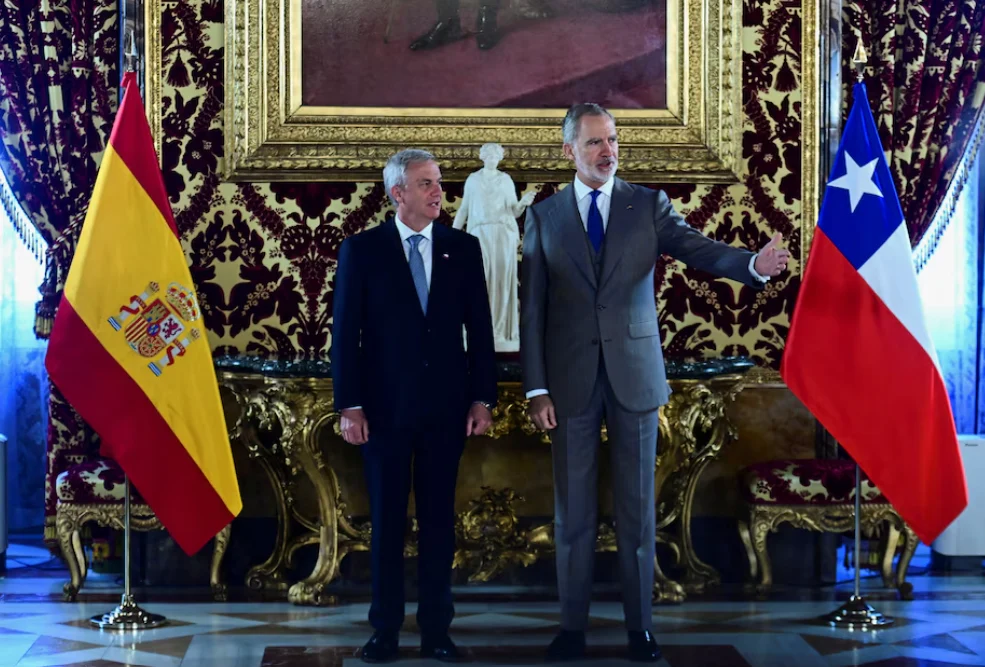
The conference began with a presentation by Chilean President José Antonio Kast, who defended the economic direction of his administration and presented his country as an attractive destination for international investments.
“Chile is a safe bet,” the president stated, highlighting the deregulation measures promoted by his government and assuring that the country has regained economic responsibility.
“Populism generates more poverty; responsibility generates wealth,” Kast affirmed.
José Antonio Kast also pointed out against populism and defended reforms.
The agreement between the Chilean president and Georgieva on the importance of fiscal discipline and the risks of populism made that axis one of the main political and economic messages of the meeting.
In this context, the recognition from the head of the IMF to Argentina under Javier Milei once again brought to the forefront the change in economic orientation initiated by the national government and its commitment to fiscal balance as a starting point to regain stability and attract investments.