A similar dynamic is observed at the medium level, where Milei again leads with 28%, maintaining an advantage over Kicillof, who obtains 23%. In this segment, Bregman positions herself with 8%, while other figures like Bullrich and Macri register 4%, and the rest of the candidates are at lower levels.
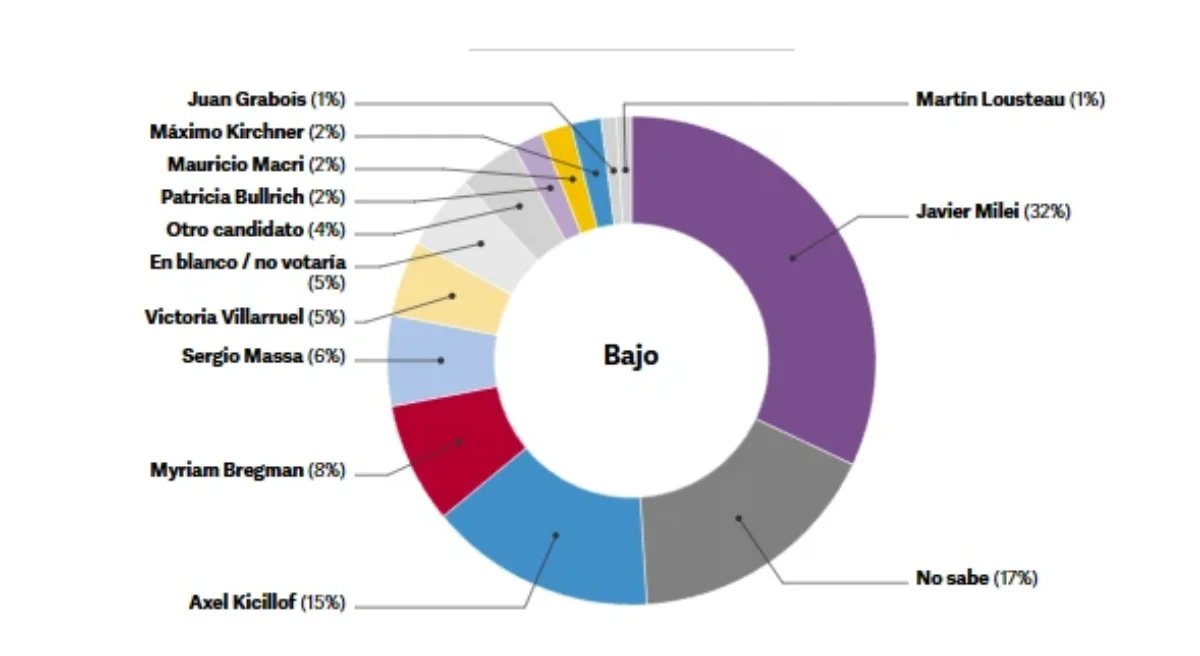
However, the most relevant data emerges at the low socioeconomic level. There, Milei reaches 32%, expanding his lead over Kicillof, who is relegated to 15%. Behind them are Myriam Bregman with 8% and Sergio Massa with 6%, in a scenario where the current President's leadership becomes more compelling.
The electoral behavior reflected in this data marks a break from traditional, and incorrect, thinking that associated liberal or right-wing proposals exclusively with higher-income sectors.
In contrast, the survey shows that Milei not only maintains solid levels in the high and medium segments, with 28% in both cases, but also achieves his highest support in the lower-income sectors.
The survey thus reinforces the consolidation of a cross-sectional support for the President, with a base that extends across different socioeconomic levels and that, particularly in popular sectors, reaches its highest point.
This phenomenon redefines the political map and positions Milei with a significant advantage heading into the upcoming electoral challenges.
A new national survey by Equipo Mide revealed that President Javier Milei not only leads the general voting intention, but also shows his highest level of support in popular sectors, consolidating a phenomenon that challenges historical patterns of electoral behavior.
In general terms, the president leads the voting intention with 30%, surpassing the ultra-Kirchnerist Axel Kicillof by a margin of 11 points
However, when segmenting the results by socioeconomic level, the study exhibits a clear trend. Milei leads preferences in all three analyzed groups (high, medium, and low), but it is in the latter where he achieves his best performance, with a 32% voting intention.
Javier Milei and Axel Kicillof
This data positions him with a wide advantage over Axel Kicillof, who registers a 15% in that same segment, reflecting his low support in the poorest sectors.
At the high socioeconomic level, the President also ranks first with 28%, followed by Kicillof with 20%.
In this group, the rest of the candidates are distributed in smaller percentages: Myriam Bregman reaches 9%, Patricia Bullrich 6%, Victoria Villarruel 5%, and Mauricio Macri 4%, while other options present lower figures.