




In contrast, the divisions that showed the lowest variations during February were Alcoholic Beverages and Tobacco, with an increase of 0.6%, and Clothing and Footwear, which registered no change in its prices during the month.

The INDEC data showed that the index stopped accelerating and the effects of the “Kuka risk” are lagging behind.





In contrast, the divisions that showed the lowest variations during February were Alcoholic Beverages and Tobacco, with an increase of 0.6%, and Clothing and Footwear, which registered no change in its prices during the month.
If we analyze the categories that make up the index, regulated prices led the increases with a variation of 4.3%, followed by the core CPI, which rose 3.1%. On the other hand, seasonal products fell by 1.3%, which helped to moderate
the overall index.
slight inflationary uptick observed in recent months responded to monetary factors linked to the political climate in the context of the national legislative elections of 2025
.During that period, there was a sharp drop in demand for money, a phenomenon linked to the so-called “Kuka risk”, that is, to the uncertainty generated by the possibility of a victory for Kirchnerism, which ultimately did not happen.
For this reason, when demand for pesos falls, even without an increase in monetary issuance, prices may rise because economic agents try to get rid of the local currency faster, which generates temporary inflationary pressures.
In this context, the Government maintains that this episode caused a temporary acceleration in inflation, but it trusts that, once the demand for money normalizes, the process of decelerating prices will consolidate again in the coming months.
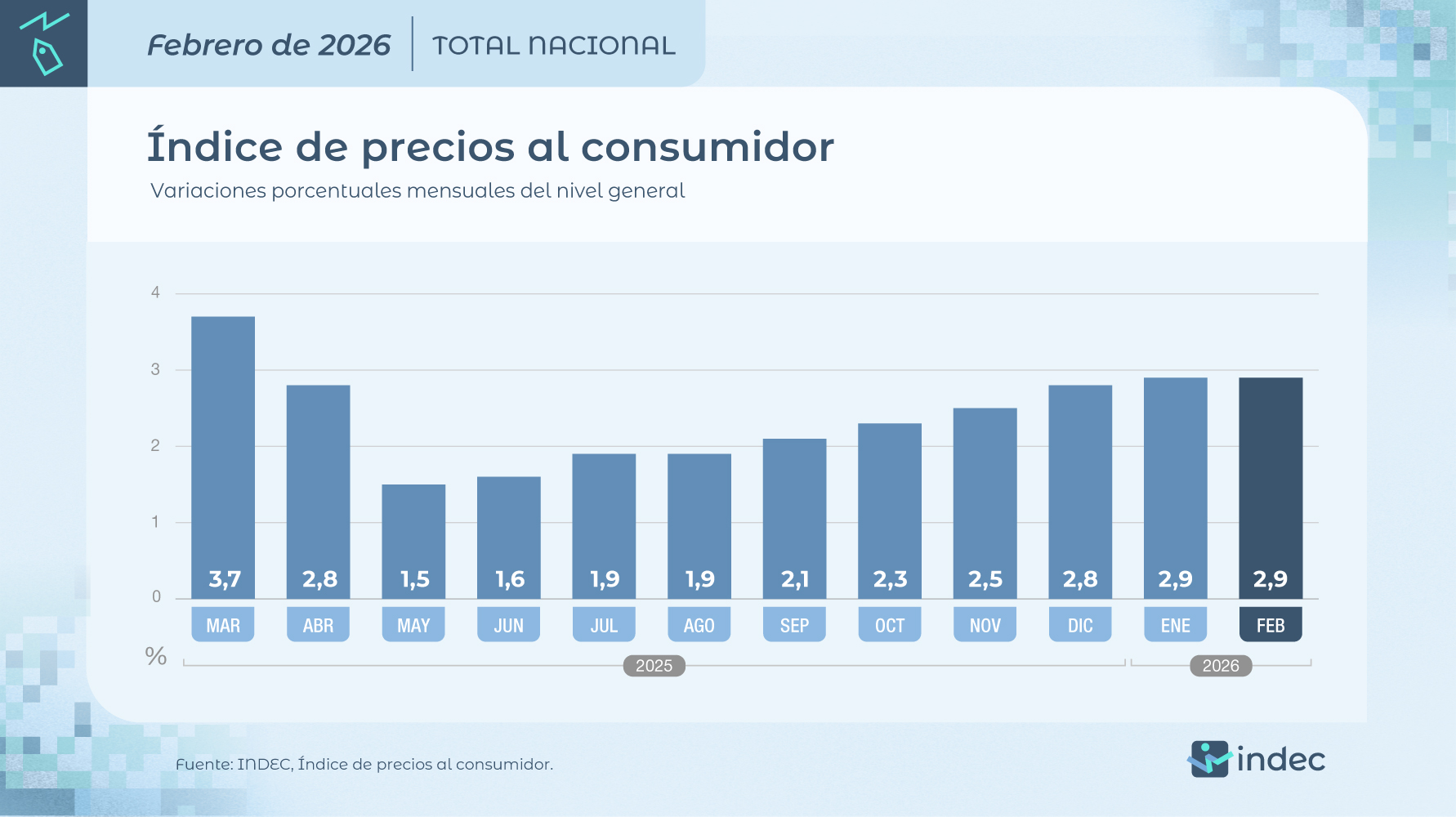
Inflation for the month of February was 2.9%, the same level it had set in January, according to data released by the National Institute of Statistics and Censuses (INDEC), reflecting that the indicator stopped accelerating after the slight uptick observed in recent months.
With this result, cumulative inflation in the last 12 months reached 33.1%, while in the first two months of the year the price increase totaled 5.9%.
This stabilization could mark a turning point and they maintain the expectation that the index will resume a downward trend in the coming months after the end of the effects of the "Kuka risk”.
In this regard, President Javier Milei has been pointing out that, once the first quarter is over, inflation should start a new downward path. The president's projection is that after March the indicator will fall again, with the expectation that by July or August it may start with 0, if current macroeconomic conditions are maintained
.
This increase was mainly driven by adjustments in public service rates and by changes in the criteria for granting subsidies applied in different provinces
.In second place was Food and Non-Alcoholic Beverages, with a monthly increase of 3.3%. This category also had the highest incidence in the general index in most regions of the country, mainly due to increases in meat and meat products. The exception was the Patagonian region, where the highest incidence was related to housing and energy services