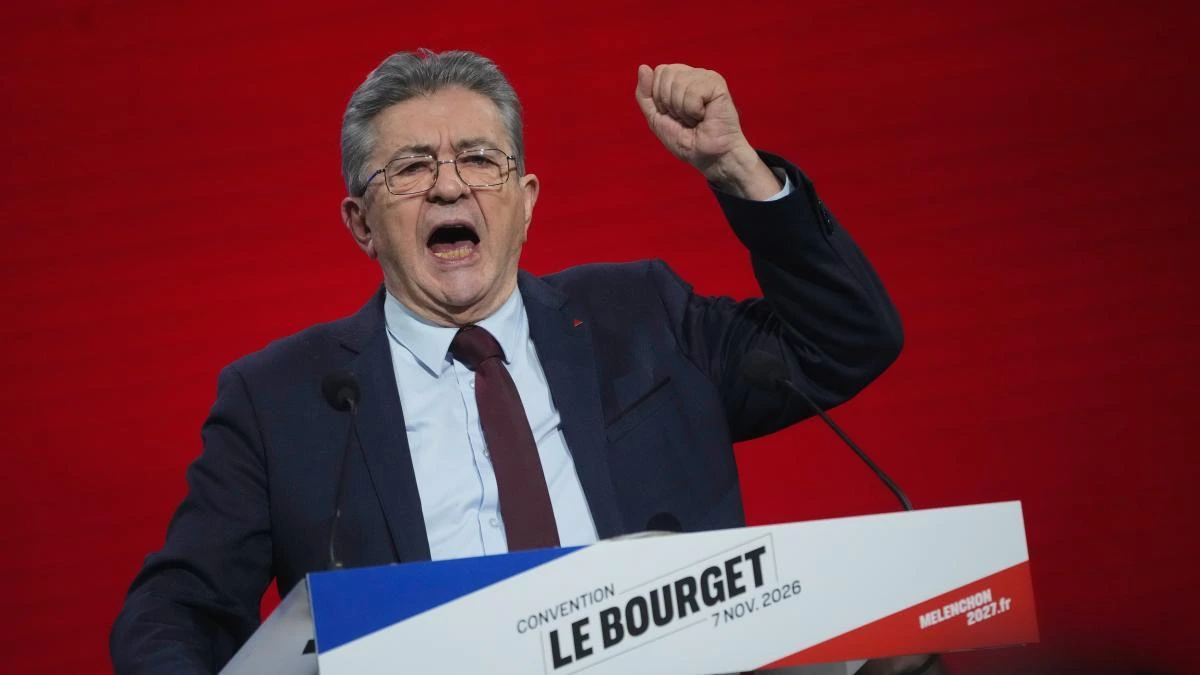
The leftist candidate Jean-Luc Mélenchon, from the party La Francia Insumisa (LFI), presented his communist government program ahead of the 2027 presidential elections in France, with a series of reforms aimed at massively extending the state intervention in the economy, increasing public spending, and modifying the labor, tax, and energy regulations of the country.
The model proposes a profound economic transformation, with greater obligations for companies and a rise in the tax burden for the vast majority of sectors. Overall, Mélenchon's plan would provoke the collapse of the European country.
Among the main economic measures is the increase of the interprofessional minimum wage (SMIC) to 1,700 euros net per month, a rise of 220 euros.
Jean-Luc Melenchon.
It also proposes to gradually reduce the working hours to 32 hours per week and establish a maximum ratio of 1 to 20 between the highest and lowest salaries within the same company.
The program also includes a reduction of the retirement age from 64 to 60 years, with the right to a full pension after 40 years of contributions. Additionally, it includes a revaluation of public officials' salaries and the obligation to link state aid to companies with social and ecological commitments.
More taxes, subsidies, and controls over the economy
The fiscal proposal is another central axis of Mélenchon's communist model. The leader proposes to reestablish the Wealth Tax (ISF), implement the so-called Zucman tax to increase taxation on billionaires, and divide the income tax into 14 brackets, with the aim of extracting more money from the wealthiest sectors.
It also proposes to establish a limit of 12 million euros for inheritances and freeze the prices of certain essential products to contain price increases. In terms of housing, it proposes to increase personal rental assistance (APL) by 10%.
Jean-Luc Melenchon.
The scheme also includes guaranteeing a minimum income for young people through an allowance and offering university meals for one euro. The Social Security would cover 100% of medical care, while psychotherapy sessions would be funded for those under 26 years old.
In the labor and social sphere, Mélenchon proposes to authorize up to three days of self-declared medical leave without the need to consult a doctor and grant seven days of work leave for the death of a friend. He also intends to establish a mandatory ecological service of nine months for those under 25 years old, paid at the minimum wage.
The energy plan and institutional transformation
The energy policy would also undergo a profound change. LFI proposes to initiate a gradual exit from nuclear energy and achieve electricity production based on 100% renewable energies by 2060.
It also proposes to prohibit flights between 11 PM and 6 AM and suspend low emission zones (ZFE), which restrict the circulation of the most polluting vehicles in certain cities.
In foreign policy, Mélenchon aims to renegotiate European treaties and reject the application of certain community regulations that he considers incompatible with his program. He also proposes a gradual exit from NATO's integrated military command and supports the creation of a Palestinian state alongside Israel.
The set of proposals constitutes a strongly communist program, with greater regulations, taxes, and structural changes in the economic and institutional functioning of France, which would lead to the immediate collapse of the European country.