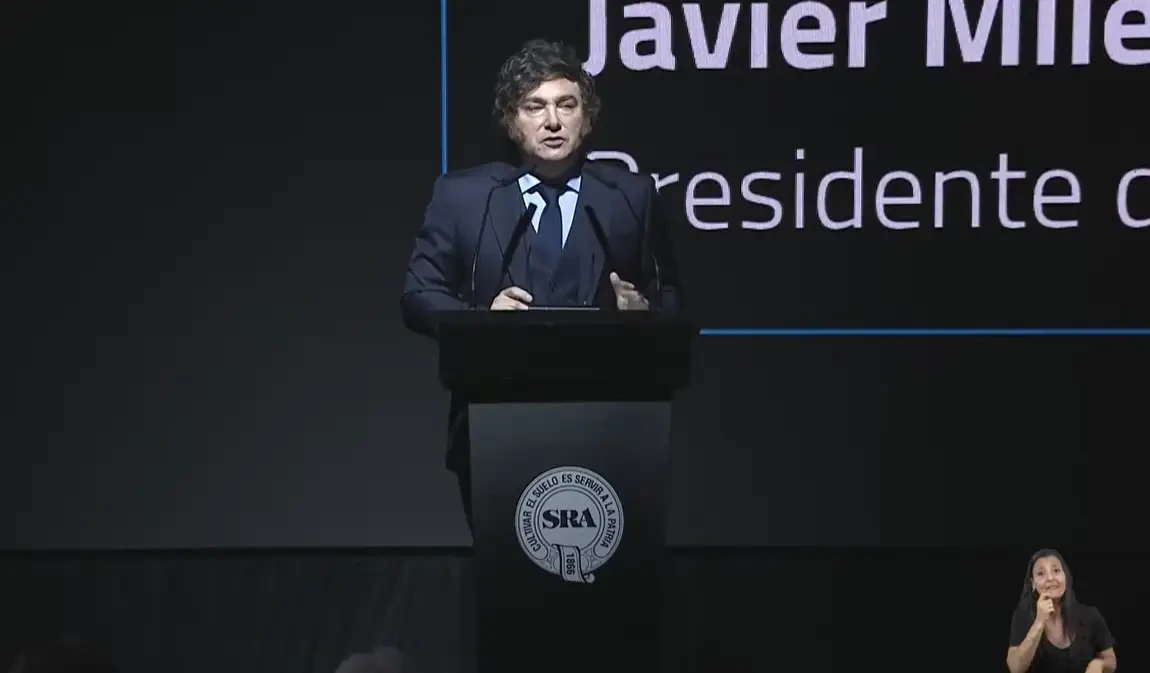
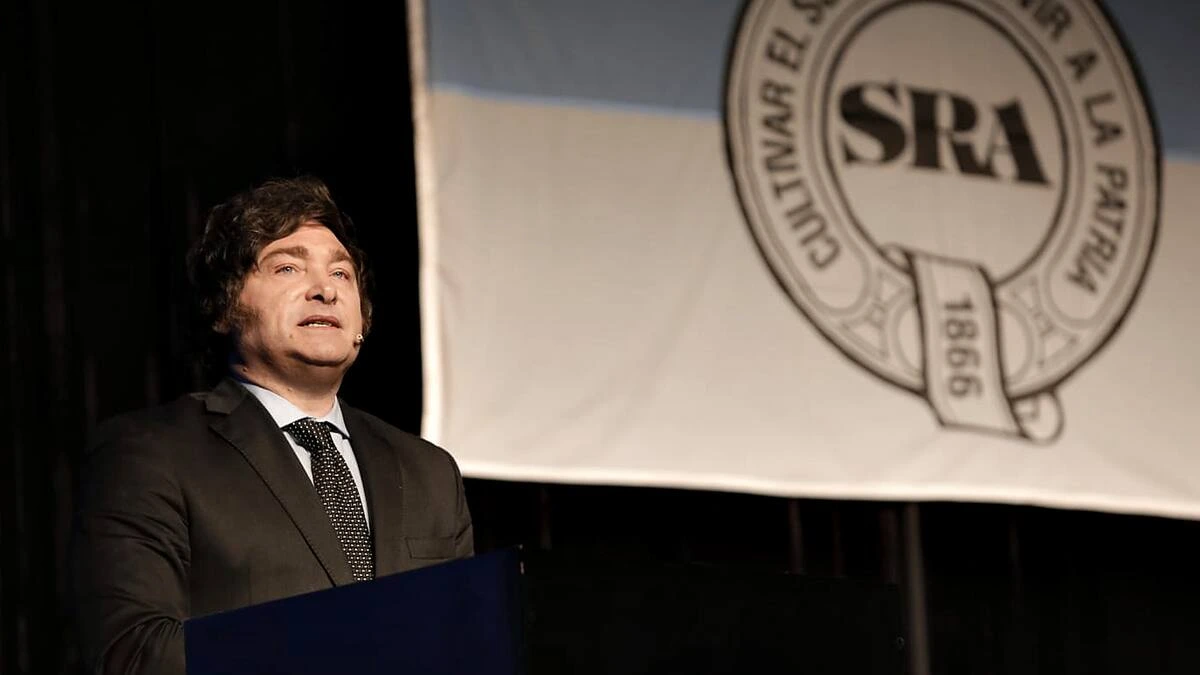
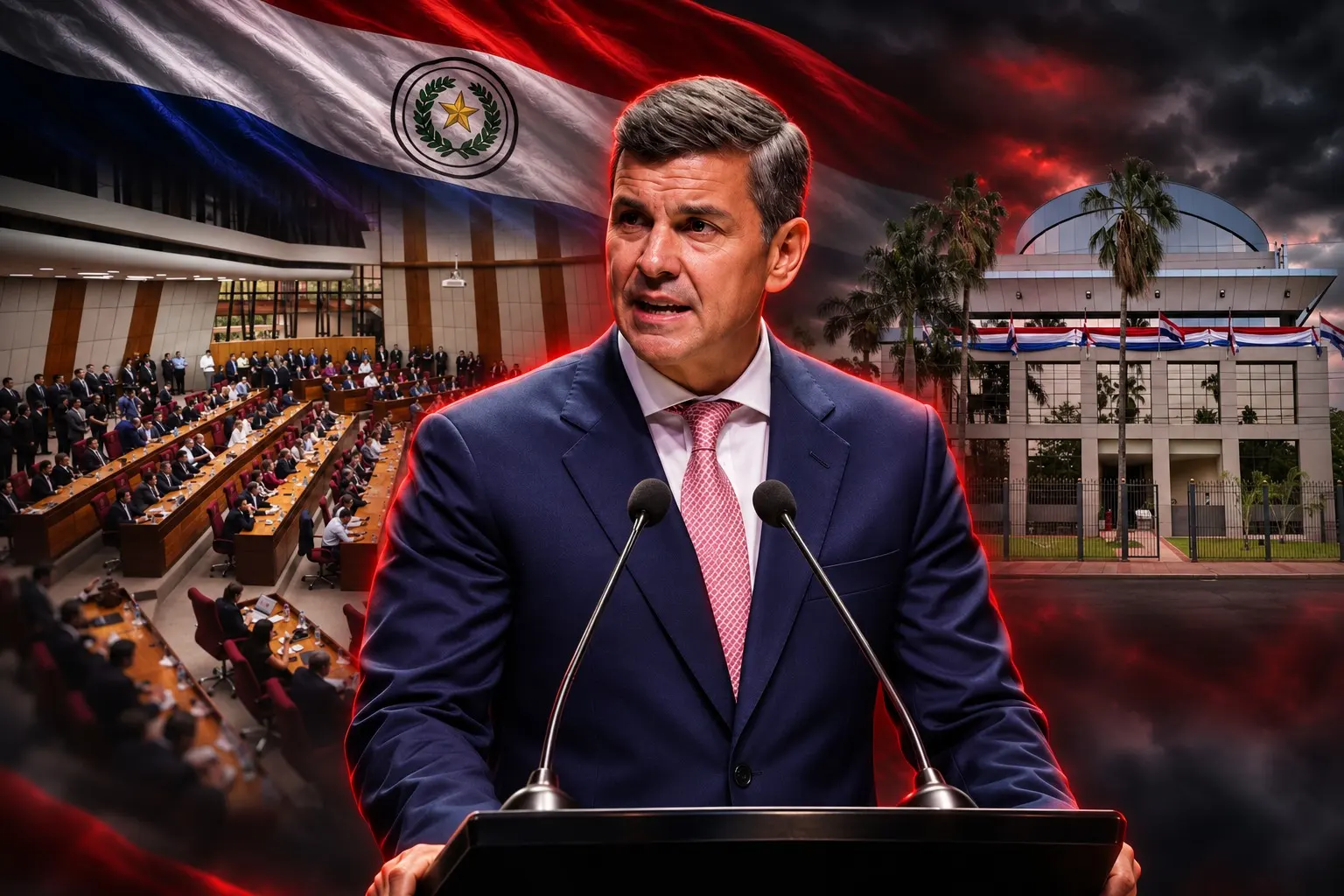
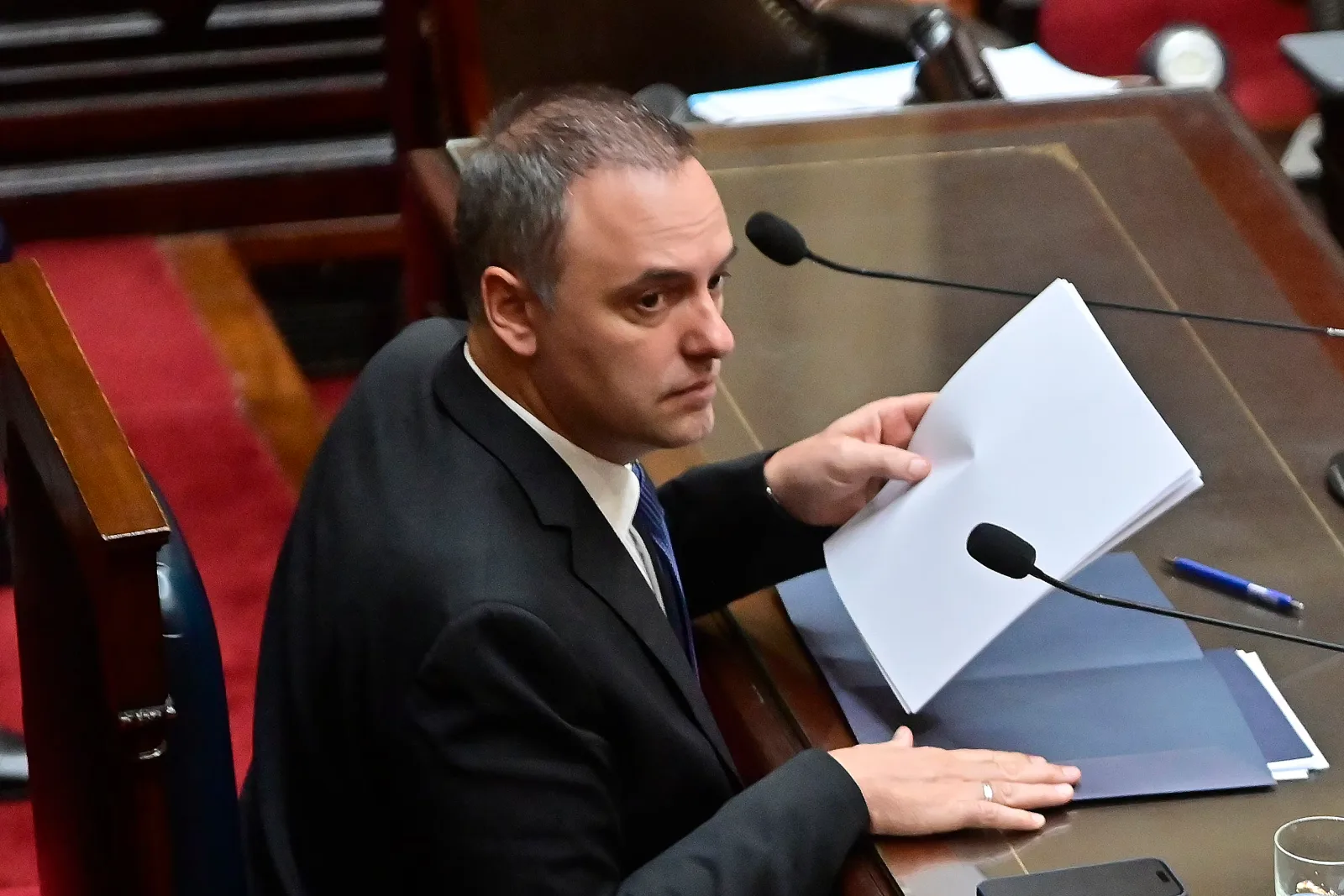
President Javier Milei defended his economic program and reaffirmed the continuity of structural reforms during his speech at the end-of-year meeting of the Argentine Rural Society, held this Friday, November 6.
In front of business leaders and representatives from the agricultural sector, he assured that the Government will maintain fiscal balance, advance with new deregulations, and continue reducing taxes.
Additionally, he projected that if Argentines decide to continue with the current model, the country would return USD 500 billion by 2031.
“If the decision of Argentines is to continue with this model, from the time we took office until 2031, we would be returning 500 billion dollars to Argentines,” the president stated while explaining the objectives of his economic program.
President Javier Milei.
During his presentation, Milei emphasized the role of entrepreneurs as the main generators of wealth and criticized the economic policies that for decades punished those who invest and produce. In this sense, he targeted state intervention and defended competition as the engine of innovation, productivity, and job creation.
“The centrality in wealth creation lies with entrepreneurs, not the State. The State must set the rules. It should not hinder,” he expressed.
Milei reaffirmed that he will not negotiate fiscal balance
One of the main themes of the speech was the defense of fiscal surplus as a condition to sustain the economic program. The President criticized those who support the balance of public accounts but propose exceptions for certain expenses or sectors.
“That’s why we are not going to negotiate fiscal balance,” he maintained, adding that those who propose to maintain the surplus with exceptions end up defending the deficit.
Regarding economic results, Milei recalled that annual inflation dropped from 211% at the time of his arrival in Government to a level close to 30%. He also highlighted that the reduction of public spending allowed for a tax cut equivalent to almost four percentage points of Gross Domestic Product (GDP).
The president again questioned devaluation proposals as a tool to improve competitiveness. He stated that this mechanism implies reducing wages and deteriorating savings, while his administration seeks to improve productive conditions through tax reductions, capital costs, and bureaucratic obstacles. “Competitiveness is not gained by impoverishing people,” he emphasized.
President Javier Milei.
More than 18,000 deregulations and new reforms
Milei also highlighted the scope of deregulation driven by his administration. He assured that more than 18,000 regulations and obstacles have already been eliminated and anticipated that the number will exceed 20,000 when the so-called Hojarasca Law advances in the Senate.
“Today we have already surpassed 18,000 deregulations and, when the Hojarasca Law currently in the Senate is passed, we will be exceeding 20,000 deregulations,” he stated.
In this context, he mentioned labor modernization, tax innocence, and the Large Investment Incentive Regime (RIGI) as part of the tools aimed at improving the competitiveness of the economy.
Regarding this last regime, he noted that it has already accumulated approval requests for more than USD 210 billion, with projects related to steel factories, urea production, and automobile manufacturing.
The President also defended trade openness and highlighted the agreements reached with the European Union and Singapore, the current trade understanding with the United States, and negotiations to advance in other markets. He indicated that Argentina already has more than 500 open markets.
President Javier Milei.
The defense of agriculture and the reduction of withholdings
Before representatives of the agricultural sector, Milei again referred to withholdings and assured that his long-term goal is to eliminate them. He highlighted the plan for permanent reduction of these taxes and stated that he seeks to provide predictability to producers.
Additionally, he mentioned the project that received preliminary approval in the Chamber of Deputies to toughen penalties against rural vandalism and reaffirmed the defense of private property.
In closing, the president called on entrepreneurs to continue investing, hiring, and exporting, and reaffirmed that his administration will continue advancing with structural reforms.
“Our commitment is to continue removing obstacles and designing lasting reforms that withstand the test of time,” he concluded.