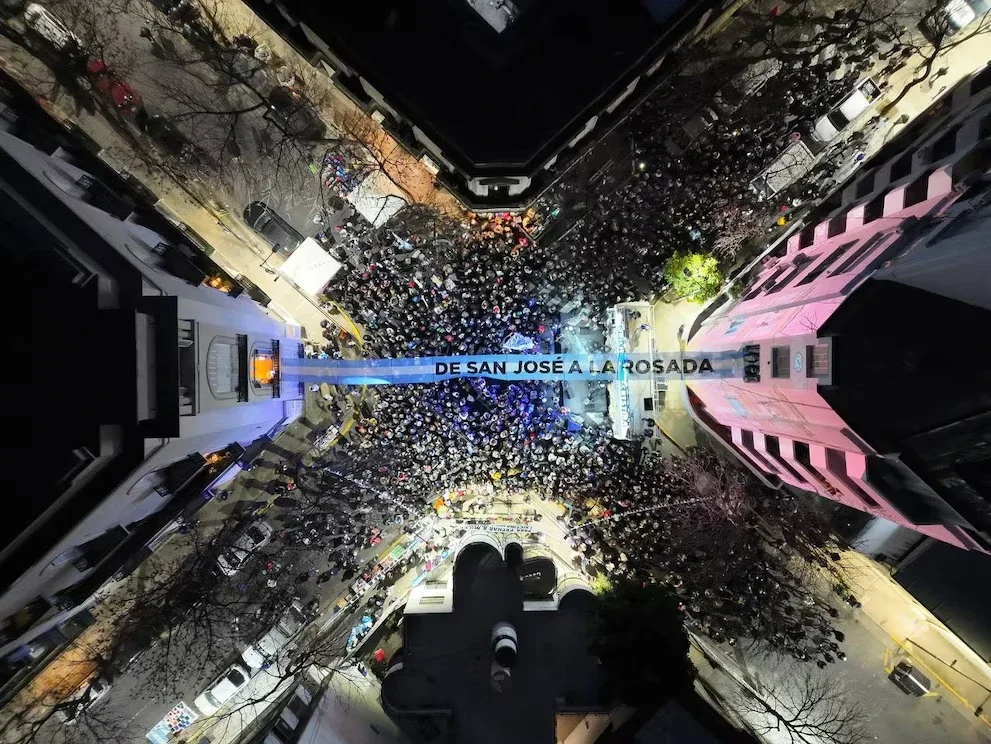
The federal court summoned Cristina Fernández de Kirchner to comply with the conduct guidelines imposed as part of her house arrest, after a large banner was displayed from the balcony of the apartment where she is serving her sentence for corruption in the Vialidad case.
The resolution was signed by Judge Rodrigo Giménez Uriburu, a member of the Federal Oral Court 2 and responsible for executing the sentence. The magistrate warned that the former president must refrain from engaging in behaviors that could imply a breach of the conditions under which she was granted house arrest.
The flag unfurled from its balcony
The incident occurred on June 14 at the residence located at San José 1111, where Cristina Kirchner is serving her sentence. According to the resolution, a large banner was placed supported by tension cables, crossing the public roadway from a window of a building across the street to be secured to the balcony of the former president's home.
For the judge, this was not an expression unrelated to the convicted individual, but rather an action in which Cristina Kirchner would have participated directly and deliberately, using her own balcony as an anchoring point. This situation was key for the Court's decision to intervene.
Giménez Uriburu emphasized that, over the past year, there had already been gatherings of militants and Kirchnerist groups in the vicinity of the residence. However, until now, the Court had considered that there was no direct participation of the former president in those events. In this case, the personal involvement in the installation of the banner changed the scenario.
The resolution stated that the maneuver posed a risk to neighbors, pedestrians, drivers, and public transport users, as the structure crossed the street and the airspace. Additionally, the judge recalled that the installation of banners, placards, or similar objects requires explicit administrative authorization, so, if permission was not obtained, it could constitute an offense.
"From San José to La Rosada"
The Justice had already ordered Cristina Kirchner to refrain from disturbing the peace of the neighbors and disrupting peaceful coexistence. For the Court, using the place of arrest as part of a militant staging is not compatible with the obligations assumed to maintain the benefit.
Cristina Kirchner was convicted of fraudulent administration to the detriment of the State in the Vialidad case, linked to irregularities in the awarding of public works to Lázaro Báez. Although she is serving her sentence under house arrest, this modality depends on strict compliance with the rules set by the Court.