The Buenos Aires government allocated $59.337 million to Public Communication, while Article 41 of the Budget establishes that certain unused municipal subsidies do not have to be returned
In stark contrast to the austerity policy, zero deficit and the definitive end of the official guideline promoted by President Javier Milei, the Kirchnerist administration of Axel Kicillof decided to allocate the exorbitant sum of $59,337,766,000 to the Ministry of Public Communication. This multimillion-dollar disbursement does not respond to an informational need, but rather to a systematic mechanism of public financing aimed at ensuring that the favored media deliberately conceal the maneuvers of fund diversion and the lack of transparency in provincial management.
With the sanction of Law No. 15,557 —promulgated on December 15, 2025 through Decree No. 2944/2025—, the Province of Buenos Aires institutionalized a severe financial disorder. In opposition to the fiscal order led by the National Government, the norm sets the expenditures at the astronomical figure of $43,021,244,867,935 against a calculation of resources of only $41,484,520,658,935, resulting in a fiscal deficit or financing need of $1,536,724,209,000.
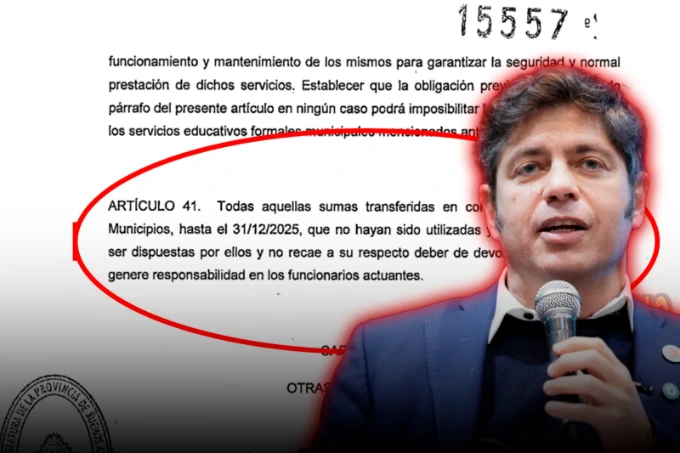
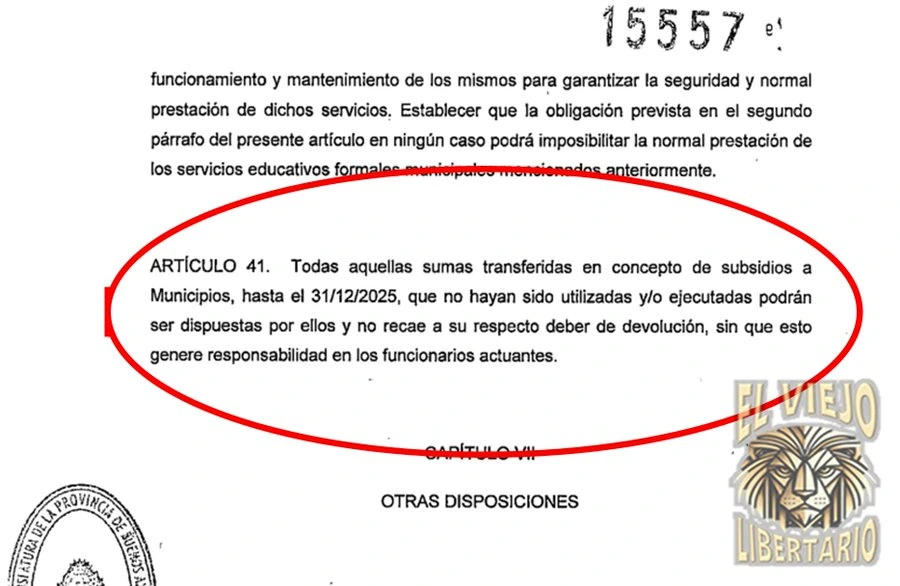
Article 41
To cover the budget gap, the Executive resorts to financial sources amounting to $3,968,701,077,000 (composed of $2,733,844,000 from decreased financial investment and $3,965,967,233,000 from public debt and increase of other liabilities), while the financial applications amount to $2,431,976,868,000 ($21,989,915,000 for financial investment and $2,409,986,953,000 allocated for debt amortization). Additionally, under the pretext of Article 1, the economic emergency is declared until March 31, 2027, while Article 3 suspends the rules of fiscal responsibility of Law No. 13,295, releasing the brakes on uncontrolled spending.
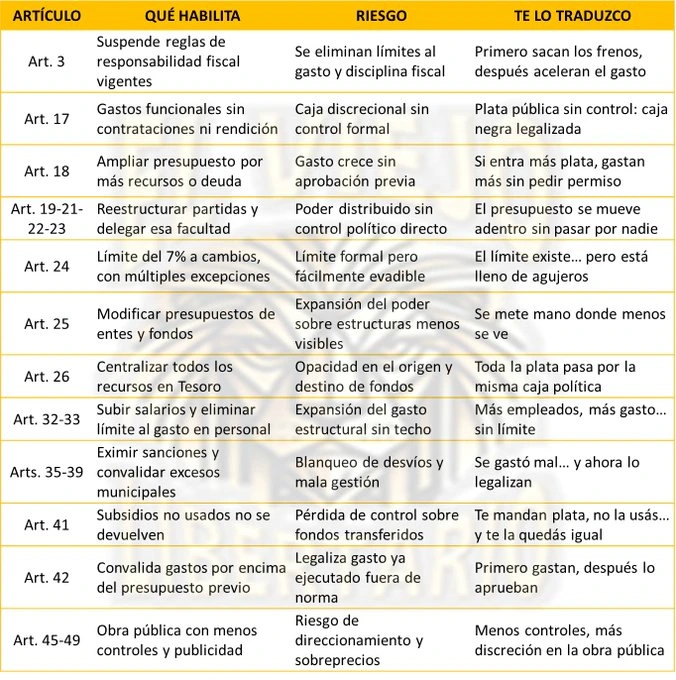
Silenced by the subsidized press network, the provisions of the law hide serious traps of discretion:
The Controversial Article 41: Establishes that the sums transferred as subsidies to municipalities not executed by 12/31/2025“may be disposed of by them and there is no obligation to return them, without this generating responsibility for the acting officials”. This legalizes a channel for mayors to retain and use public funds at their discretion and without accountability.
Petty Cash and Exemptions (Arts. 17 and 35-39): Article 17 allocates $200,000 monthly to councilors of the Council of the Judiciary for Functional Expenses“without being subject to the provisions inherent to the contracting and accountability regime”. Meanwhile, Articles 35 to 39 empower the Court of Accounts to exempt municipal officials from penalties for diversion of earmarked funds or excess spending.
Flexibility and Caps (Arts. 24, 28, 34, 40 and 42): Article 24 sets a formal limit of 7% for budget modifications saturated with exceptions; Article 28 limits expenses on ceded properties to $1,747,370 and rented properties to $2,589,852; Article 34 sets the ceiling for ARBA at $191,354,759,000; Article 40 regulates 16.14% of the educational fund; and Article 42 validates salary excesses from 2025, setting in Article 13 a staffing of 16,058permanent positions and 1,889temporary positions in decentralized agencies.
Explanation of articles/ Hugo Villada (EVL)
The budget sustains hefty allocations for state bureaucracy: Governorship ($195,123,347,000, including General Secretariat with $105,562,575,000, Governor Coordination with $6,421,569,000 and Chief of Advisors with $83,139,203,000); Ministry of Health ($3,047,132,681,000); Ministry of Security ($3,293,327,703,000); Education ($10,661,740,158,000); IOMA ($2,422,114,040,000); Lottery and Casinos ($1,767,670,943,000); Provincial Bank ($1,612,616,718,841); Ministry of Government ($76,628,361,000); Ministry of Women ($21,660,303,000); Ministry of Environment ($44,664,509,000); and Cultural Institute ($87,014,290,000).
Additionally, $1,000,000,000 is authorized for the San Francisco-Las Piedras Watershed (Art. 109), $30,000,000,000 additional for justice (Art. 110) and 500 new positions in the Judiciary (Art. 111).
Axel Kicillof, governor of Buenos Aires.
The initiative originated in Message No. 4497 of November 4, 2025 and was endorsed by legislative authorities Alexis Raúl Guerrera, Veronica Magario, Gervasio Bozzano and Miguel Angel Bampini, with registration from Lic. Facundo E. Aravena. Finally, Governor Axel Kicillof promulgated the law via Decree No. 2944/2025 along with his ministers Pablo Julio López and Carlos Alberto Bianco, observing only Article 94 related to public works.
Far from informing the public objectively, the scheduled press silences the true destination of the budgetary resources of Buenos Aires. The state propaganda has thus become the fundamental pillar of Kirchnerism to sustain its electoral ambitions, feed the territorial structures of the Conurbano, and guarantee discretionary resources for its allied mayors, all financed at the expense of taxpayers' efforts.