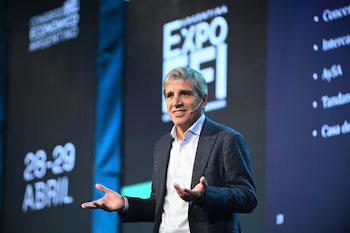
In the framework of the prestigious ExpoEFI 2026, the country's main forum for economy, finance and investment, the minister gave a dissertation that marked a definitive turning point.
As part of a vibrant day at Expoefi 2026, the Minister of Economy, Luis “Toto” Caputo, staged an exhibition that not only shook the foundations of local financial analysis, but also resonated in the world's main capitals. With the certainty of leading a process of “refoundational” transformation, Caputo drew a dividing line between the past of “shortages, 200% gap and poverty above 50%" and a present where Argentina has gone from being a “world pariah” to becoming the” example of what needs to be done”.
The Minister began his speech with a strong analogy: macroeconomics is a country's immune system. For years, populism kept Argentina“defenses low”, causing any external crisis - from Tequila to COVID - to hit here harder than anywhere else. However, the current economic program has demonstrated unprecedented “robustness”, resisting the “strongest internal shock
in history”. ExpoEFI Argentina 2026
Caputo revealed that, over the past seven or eight months, the Government had to face a process of “dollarization of 50% of M2", an exchange rate run of colossal magnitude where a critical mass of pesos bet on the failure of the model. “Never have so many pesos bet on an exchange rate run... and it failed,” the official said. Despite this internal sabotage and an external shock that increased the price of fuel by more than 60%, the Argentine economy not only failed to collapse, but it registered growth of 4.4%, with a potential that the Minister estimated at “6.5 or 7%” if such attacks had not been mediated
.
International recognition was not long in coming. During the recent meetings of the G20 and the IMF, figures such as Scott Bessent (American Secretary of the Treasury) and Kristalina Georgieva praised Argentina's resilience.
While the world suffers from the vulnerability of having fiscal deficits and importing oil, Argentina stands as the only country in the G20 that today has a fiscal surplus and is an oil exporter.
This strength has caused an “unprecedented” phenomenon: in the midst of external shock and with falling interest rates, the Central Bank no longer struggles to sustain the peso, but rather “has to buy dollars every day so that the peso no longer appreciates”. It is the definitive proof that “demand for pesos is increasing” and that confidence in the national currency has returned after decades of humiliation
.
The most impressive thing of the day were the currency projections that will transform the country's productive structure.
The Minister explained that, thanks to predictability and correct price signals, the energy and mining balance for the next ten years will show “really shocking” numbers:
Energy Surplus (2024-2035):350 billion
dollars, a figure that Caputo described as “totally underestimated”.
Mining Surplus: 162 billiondollars.
Total:512 billion dollars, equivalent to “almost a gross product” in additional net exports.
This flow of capital is already materializing through RIGI, which has 95 billion dollars distributed in 35 or 36 projects. In the coming weeks, another seven or eight projects worth between 30,000 and 40 billion additional dollars will be added, mostly concentrated on the “upstream”, where wells take just 6 to 8 months to generate cash and resounding
dollars. Luis Caputo, Minister of Economy
The agricultural sector, the traditional engine of the economy, is experiencing a real “boom” with projections of 160 million tons of grain. For the first time, Argentina's total exports are on track to break the 100 billion dollar barrier. The Minister stressed that this is the result of having lowered “withholding and tariffs on the import of herbicides and fertilizers”, in addition to allowing the import of “
used machinery”.
He also announced a revolution in infrastructure: the tender for 9,000 kilometers of road corridors for June and July, in addition to another 12,000 kilometers of national routes. This plan, funded by organizations such as the IDB, the World Bank and the CAF, seeks to drastically reduce logistics costs to boost the competitiveness of the provinces in a “much more federal” model.
Faced with criticism from the opposition, Caputo was forceful with the social welfare figures: more than 100,000 jobs have been created, and although some of it is informal, the real wage measured by the CIPA (which includes overtime and bonuses) is already 3% above the levels of November 2023.
The Minister also sent a clear message to the prebendary bourgeoisie. He used the example of Fate, whose owner preferred to “hunt in the zoo” charging tires at exorbitant prices, as opposed to the patriotic attitude of Lumilagro, who decided to “compete” against international brands such as Stanley, achieving record sales and exports today.
“People paid those margins... that's what we don't want to see happen anymore,”said the Minister, celebrating that Argentines now have access to cell phones, computers and cars at competitive prices and with available credit.
Finally, Luis Caputo dismissed any possibility of a return to the populist past, calling such rumors an “underestimation of people”.
“The Kuka risk is zero,”he said, after talking with non-Kirchner Peronist governors who refuse to return to the policies of “pickets and poverty managers”.
With a growth projection of 20% for 2027 compared to 2023, and with elite investors such as Harold Hamm (the largest Shale producer in the United States) ) or Peter Thiel (co-founder of PayPal and Palantir) landing in the country, the Minister closed with a sentence that is already the mantra of the new economic cycle: “Today the risk is that of losing the opportunity to invest in the country that will grow the most for the next 30 years”. The model of freedom is not only solid; it's inevitable.