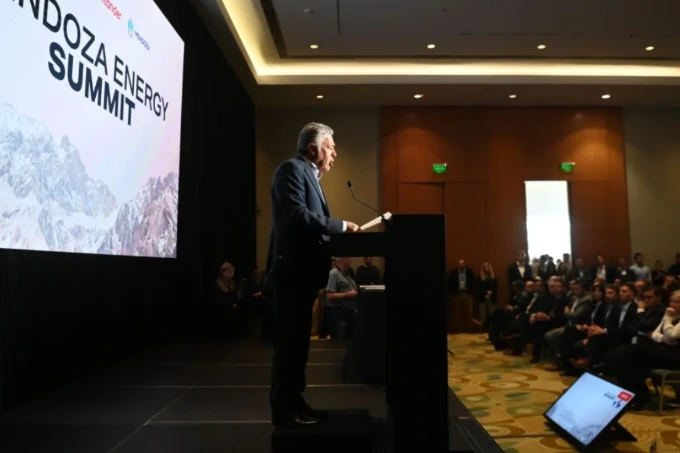
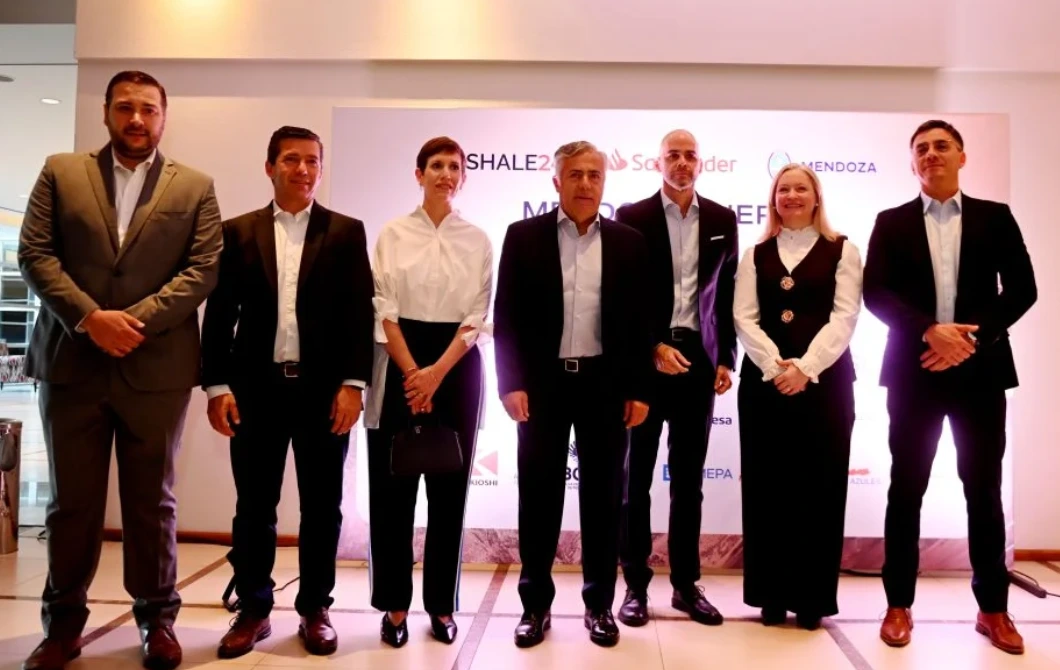
The governor of Mendoza, Alfredo Cornejo, stated that the province has already established itself as an energy district during the opening of the Mendoza Energy Summit 2026, which brings together representatives from more than 150 companies related to energy, oil, and mining.
The provincial leader maintained that Mendoza has moved past the discussion of whether it wanted to become an energy province and assured: “Today we can say that we are already an energy province”.
The meeting is taking place at the Hilton Hotel and is organized by the Government of Mendoza, Shale24, and Santander, with an agenda focused on oil and gas, electricity generation, renewables, mining, infrastructure, transportation, financing, and regulation.
Over US$1 billion in investment commitments
During his speech, Cornejo reviewed the progress of hydrocarbon activity under the continuous bidding scheme for areas and highlighted that during his second term, nine areas have already been awarded, with investment commitments from various companies.
As he explained, there are currently more than 1,000 square kilometers in new exploration areas, with drilling commitments.
Among the mentioned projects is the extension of the Malargüe cluster to Venoil, which includes US$150 million in investment until 2037 to drill new wells, reactivate inactive wells, and incorporate enhanced recovery mechanisms.
Additionally, two new exploration permits were published: Atuel Exploración Sur and Río Atuel.
Cornejo also highlighted the development of the Andes Plan, which concentrates more than US$950 million in committed investment, while the nine areas bid during his second term total more than US$80 million.
According to the figures presented by the governor, exploration commitments total US$1 billion.
Mendoza advances on the Mendoza Vaca Muerta
Mendoza advances on the Mendoza Vaca Muerta
One of the main announcements was related to Vaca Muerta, a formation of which Mendoza owns approximately 30%.
Cornejo announced that a new drilling campaign will begin in October in the Mendoza portion of the formation, with wells from YPF and two other wells managed by Tercera Vía Quintana in Cañadón Amarillo.
This latter project includes US$44 million in investment during the first three years and could reach a contingent investment of up to US$350 million if the pilot yields positive results.
The development of Vaca Muerta thus appears as one of the main axes of the province's energy strategy, along with the reconversion of mature fields and the arrival of new investments.
Cornejo highlighted the new scheme for hydrocarbons
The governor also defended the process of transforming provincial hydrocarbon policy and noted that YPF's withdrawal from some mature fields did not result in a decline in production in the Mendoza areas.
As he explained, the province has shifted from managing contracts to managing a portfolio of areas, with mechanisms aimed at streamlining procedures, anticipating extensions, and incorporating incentives directly linked to investments.
In parallel, the Minister of Energy and Environment, Jimena Latorre, presented a project in the Legislature to reform the Hydrocarbons Law 7526, in effect for nearly two decades.
The initiative seeks to adapt the legal framework to conventional and unconventional exploitation, combining royalties and incentives to promote investments and reserve development, along with greater environmental requirements and rules for coexistence between oil and mining projects.
Cornejo stated that having legislation approved with broad consensus constitutes a guarantee for companies that decide to invest in Mendoza.
The provincial government now targets local suppliers
Following the opening of the Mendoza Energy Summit, the first Letters of Adhesion from the hydrocarbon sector to the Supplier Development Program of the Federal Investment Council (CFI) were signed.
PCR and Venoil Energía joined as Core Companies, committing to identify and work with local SME suppliers to strengthen the local production chain.
The program includes technical assistance, financing, guarantees, and tools for productive linkage.
Towards the end of his presentation, Cornejo stated that Mendoza has already done its part and now it is up to the companies to fulfill the signed contracts, incorporate new technologies in conventional fields, and take on the risk of unconventional development.
With the new drilling campaign in Vaca Muerta, the exploration permits, and the announced investment commitments, the province seeks to consolidate its position within the Argentine energy map.