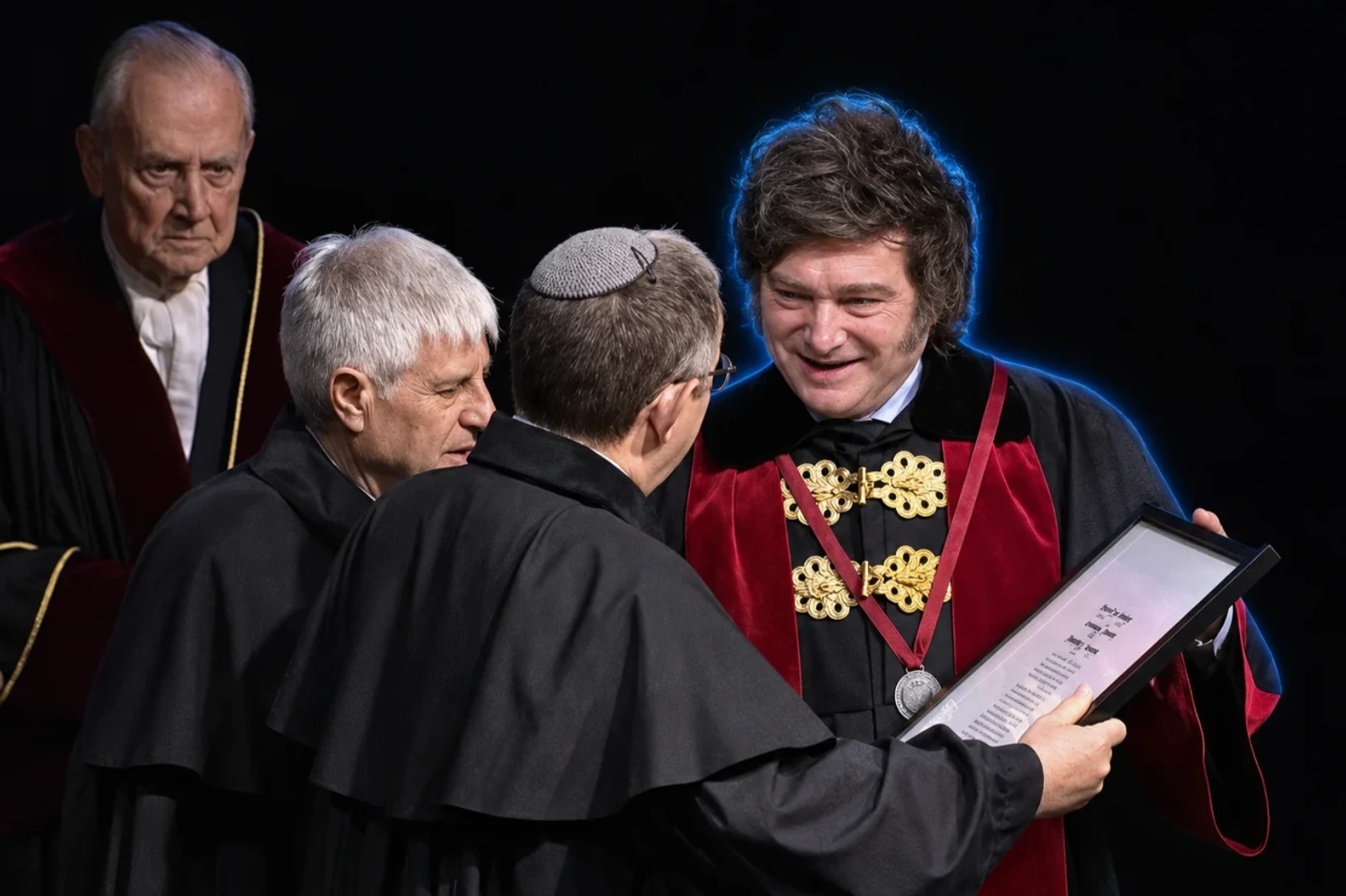

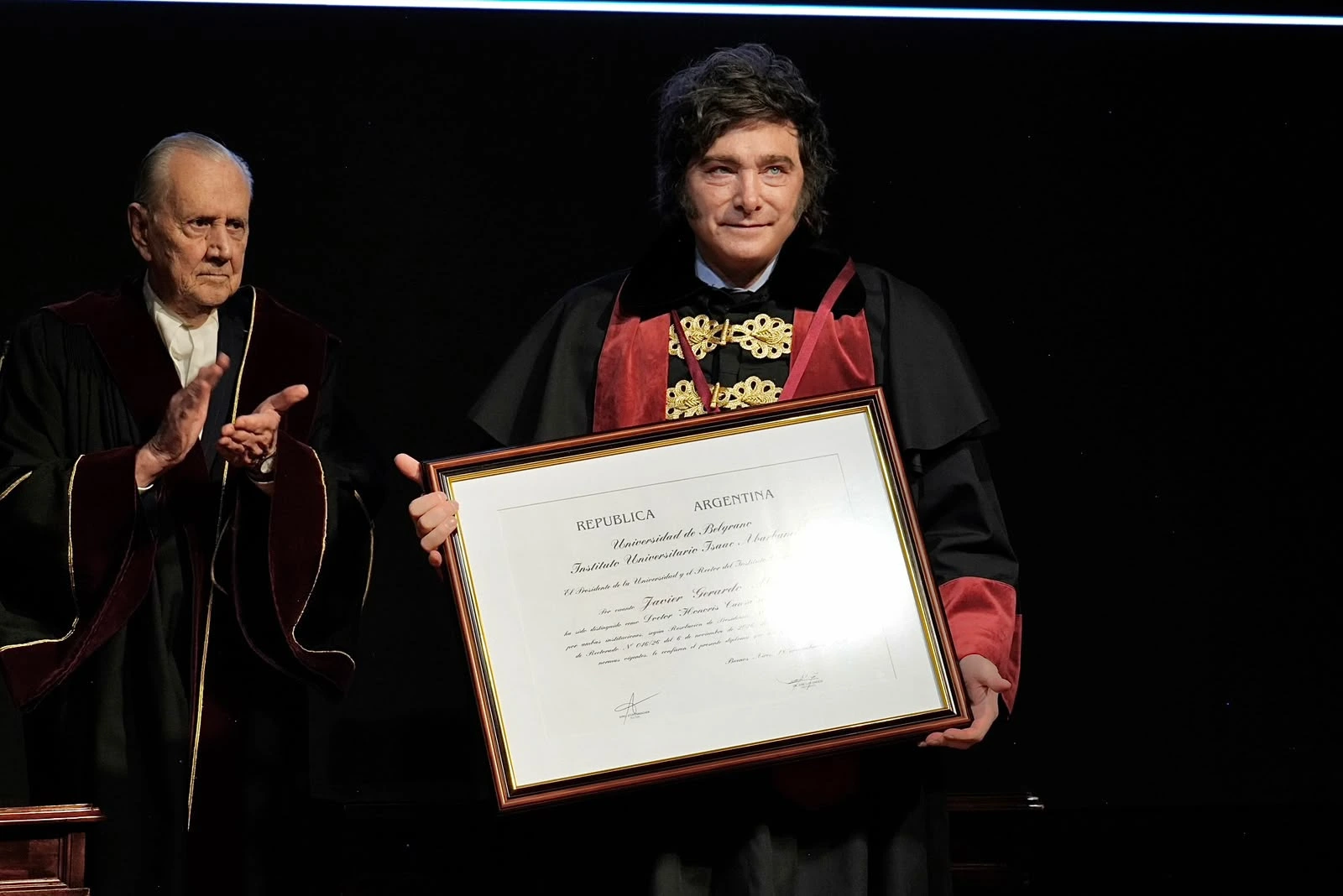
President Javier Milei received an honorary doctorate from the University of Belgrano and took advantage of the ceremony to deliver an extensive presentation on economic growth, capitalism, market freedom, and the direction of his government. In a speech focused on his main economic and philosophical references, the president defended the liberal model as the path to end poverty and recover Argentina's productive potential.
During his presentation, Milei stated that the country has entered a new stage of economic transformation and maintained that policies of deregulation, trade openness, and the promotion of a work culture will allow for accelerated growth. “We have entered the Liberal Golden Age. And Argentina will be great again”, he affirmed as he concluded his presentation.
The president also highlighted the work of his economic team and ministers Federico Sturzenegger, Luis Caputo, Sandra Pettovello, and Pablo Quirno, whom he linked to the reforms promoted by the national administration.

Milei defended economic growth and championed the ideas of Adam Smith
One of the central themes of the speech was the importance of economic growth as a tool to improve the living conditions of the population. Milei explained that he has been studying this issue for 15 years and recalled a phrase from economist Robert Lucas Jr. about the impact of understanding the mechanisms that allow for the elevation of human well-being.
To illustrate his point, the President reviewed the historical evolution of per capita gross domestic product and noted that, since the early 19th century, the world economy has experienced extraordinary growth, accompanied by a significant reduction in extreme poverty.
In this regard, he championed the contributions of Adam Smith, especially his concepts of division of labor, increasing returns, and technological progress.
Milei explained that productive specialization allows for multiplying productivity and reducing costs, while technological innovation opens new possibilities for growth. He also questioned the techno-pessimistic views that warn about the negative effects of technological advances and argued that history shows that innovation ultimately generates new opportunities.
As an example, he recalled the transformation brought about by the automotive industry and contrasted that process with the warnings from those who defended old transportation models.
The President questioned social justice and targeted state intervention
Another of the most compelling passages was dedicated to questioning wealth redistribution and state intervention policies.
Milei argued that social justice, understood as a mechanism of compulsory redistribution, creates incentive problems because it penalizes saving, investment, and wealth generation.
“The idea of social justice in redistributive terms has a couple of problems: it is unequal treatment before the law and theft”, he expressed.
In that line, he considered that policies aimed at appropriating the results of those who produce end up weakening economic growth and harming even the most vulnerable sectors.
To exemplify his argument, he mentioned the economic deterioration in Argentina and recalled that the country used to be among the five most important economies in the world but ended up losing positions after decades of policies that, in his view, discouraged investment and production.
In contrast, he highlighted Luis Caputo's management at the Ministry of Economy and asserted that his incorporation was decisive in preventing Argentina from moving towards an even deeper crisis.
Milei defended Sturzenegger's deregulation and questioned the European model
The President also took the opportunity in his presentation to explain why he believes that excessive regulation represents an obstacle to economic growth.
By questioning economic models that prioritize perfect competition and seek to limit increasing returns, Milei directly targeted Europe, which he described as an example of the negative effects of overregulation.
“They are experts in regulation, they are experts in killing increasing returns. Naturally, they are experts in having killed economic growth”, he stated.