The interview with The Economist took place after the national broadcast that Milei led on Thursday night, where he once again placed the Falklands issue at the center of the agenda and stated that the “winds of change” could favor the Argentine claim.
In this context, the President sought to differentiate his strategy from the decision of the last military dictatorship to start a war in 1982. “We did not decide to start shouting like savages,” he stated.
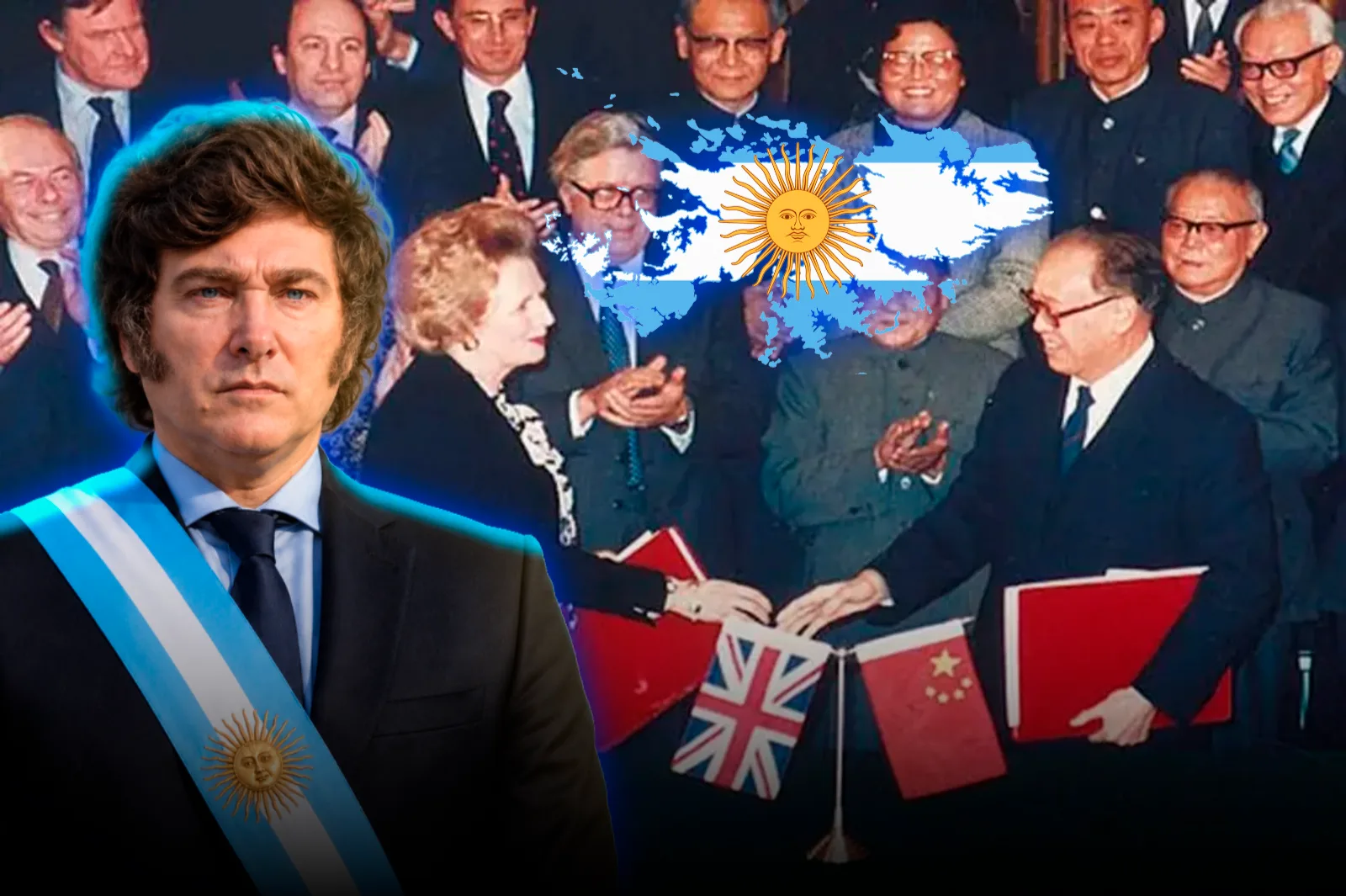
The president Javier Milei once again asserted Argentina's sovereignty over the Falkland Islands during an interview with The Economist, published this Friday, and proposed as a reference for a potential solution the agreement through which the United Kingdom transferred Hong Kong to China in 1997.
During the interview, the president maintained that the Falklands are “unequivocally” Argentine and defended the possibility of reaching an understanding with London that would allow for the return of the archipelago to Argentina through a long-term negotiation.
“The United Kingdom did this with Hong Kong, so why not find an agreement for the islands to return to Argentina sooner or later? They are ours,” Milei stated.
President Javier Milei
The precedent he referred to was the Sino-British agreement signed in 1984. That pact established that London would return Hong Kong to China in 1997 under the formula of “one country, two systems.”
The understanding, signed by then British Prime Minister Margaret Thatcher and Chinese Premier Zhao Ziyang, stipulated that the territory would retain much of its legal, economic, and political autonomy for half a century.
The transfer was finally completed on July 1, 1997, after 156 years of British administration.
President Javier Milei
Milei was also explicit in rejecting the possibility of repeating that scenario. The 1982 war left 907 victims: 649 Argentine military, 255 British, and three islanders. “We do not believe in war,” he indicated.
The president also acknowledged that a deepening of the claim could generate consequences in the bilateral relationship. When asked about potential British measures, such as a blockade on arms sales or difficulties in reaching a free trade agreement, he admitted: “Of course, there are some side effects that need to be highlighted and considered.”
Support for Trump and Netanyahu
In another part of the interview, Milei was asked about Donald Trump's geopolitical strategy in the Western Hemisphere and praised the U.S. president again.
“What I can say is that the strategy in terms of how he perceives the geopolitical balance, I think is simply brilliant,” he stated.
The President also praised Israeli Prime Minister Benjamin Netanyahu for his role in the “fight for the West.” In that context, he considered that Europe should be “more respectful towards both, Trump and Netanyahu.”