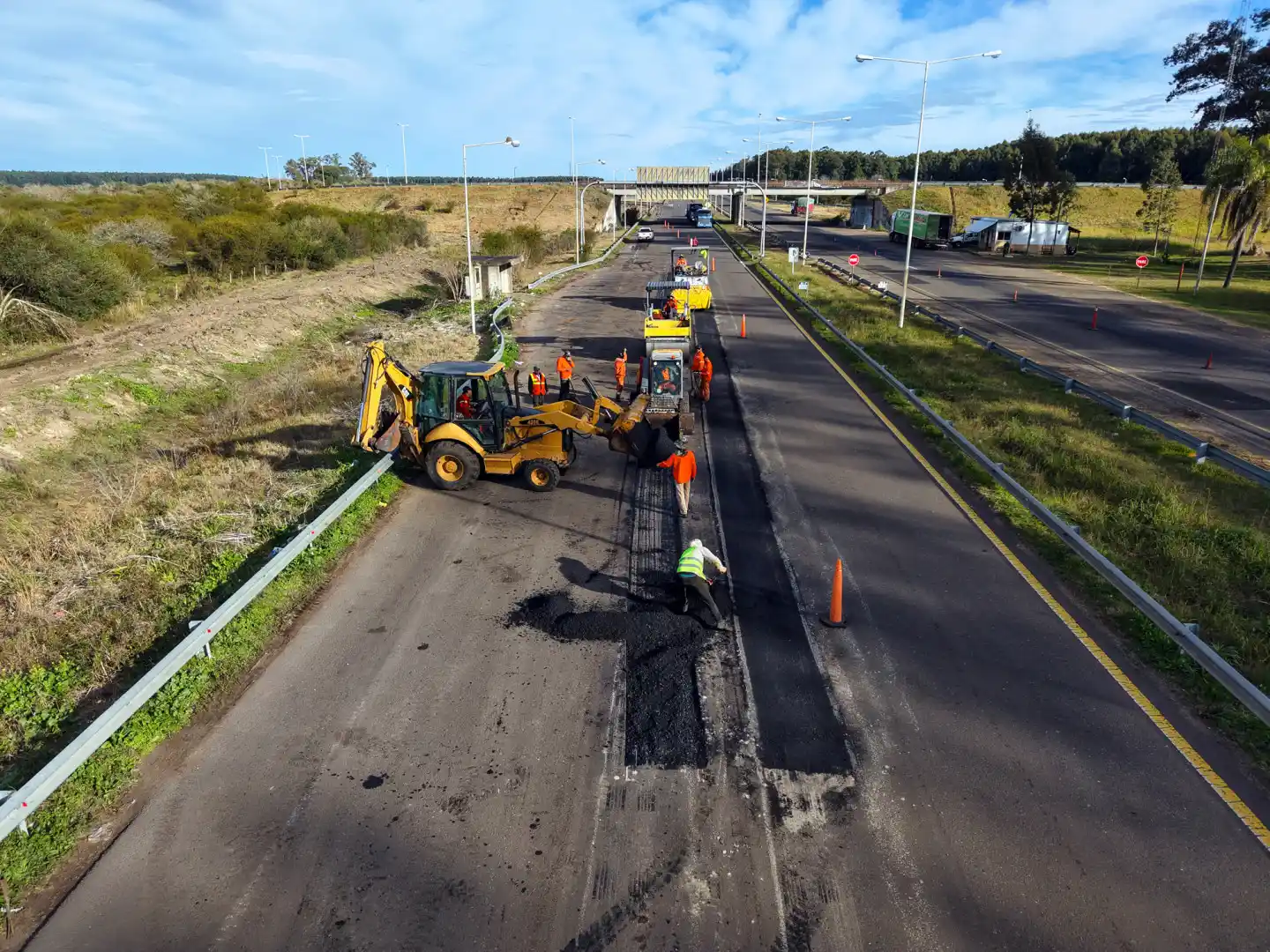
More than 360 kilometers were granted to the private sector under a scheme without subsidies, while the government of Javier Milei moves forward with the dissolution of Road Corridors
Total current expenses:$302.720 million, consisting of $205.788 million in personnel remuneration and $75.773 million in goods and services.
Transfers from the National Administration:$110.000 million.
Budgetary dis-savings:$38.039 million.
Deficit financial result:$25.575 million.
In coherence with the guiding principle of "zero deficit", the direct real investment with public funds for 2026 was cut to the minimum figure of $400 million (broken down into $100 million for machinery and equipment and $300 million for intangible assets), setting $0 for allocations destined for new constructions or state projects. Thus, the current administration limits state action to preserving road heritage until private capital fully assumes the management of Argentine roads.
The document was prepared under a strict criterion of "transitional management", whose sole purpose is to guarantee the operability of 6,000 kilometers of roads and 42 toll stations —which concentrate 80% of the traffic of the network granted along 10 strategic sections— while completing their transfer to private hands and advancing towards the dissolution and definitive liquidation of the public company.
Improvements are progressing on more than 360 km of Mercosur routes
The financial indicators for the 2026 fiscal year expose the figures of the outgoing state model:
Projected operating expenses:$302.711 million.
The Government led by President Javier Milei has consolidated a structural transformation in public works in Argentina, eradicating the old deficit model that forced the State to maintain deteriorated roads with "taxpayer money".
Through a scheme based on 100% private investment and the absolute elimination of public subsidies, the national administration demonstrates that strategic infrastructure can be renewed with maximum efficiency and without compromising fiscal balance.
The president, Javier Milei
Within Stage I of the Federal Concessions Network, the State abandons its role as an inefficient administrator to assume a strict state supervision through National Highways.
The concessions are awarded under strict competition rules to the companies that offer the lowest toll, ensuring that they can only charge the full rate when the route reaches optimal conditions and meets rigorous service levels.
The effective application of this economic doctrine reports concrete advances in the Eastern Section of the Mercosur road corridor, awarded to the company Autovía del Mercosur S.A.U.. In this vital artery for production, freight transport, and regional tourism, more than 360 kilometers have already been intervened through private capital.
The initial works successfully completed cover strategic sectors:
On National Route 14, the section between km 58.84 and km 206.28.
On National Route 135, the section between km 0 and km 12.94.
More than 360 km of national routes have been intervened with private investment
In both sectors, the concessionaire completed 100% of the required interventions for this stage, which adds to the more than 200 kilometers previously recovered on National Route 12 and National Route 14. After confirming that the works are progressing in line with the contractual schedule, National Highways authorized the application of the "Updated Offer Rate" at the Colonia Elía toll station.
To highlight the financial disarray inherited from prebendal statism, the Ministry of Economy published in the Official BulletinResolution 1540/2026, which approves the Action Plan and Budget 2026 of the state company Corredores Viales S.A..