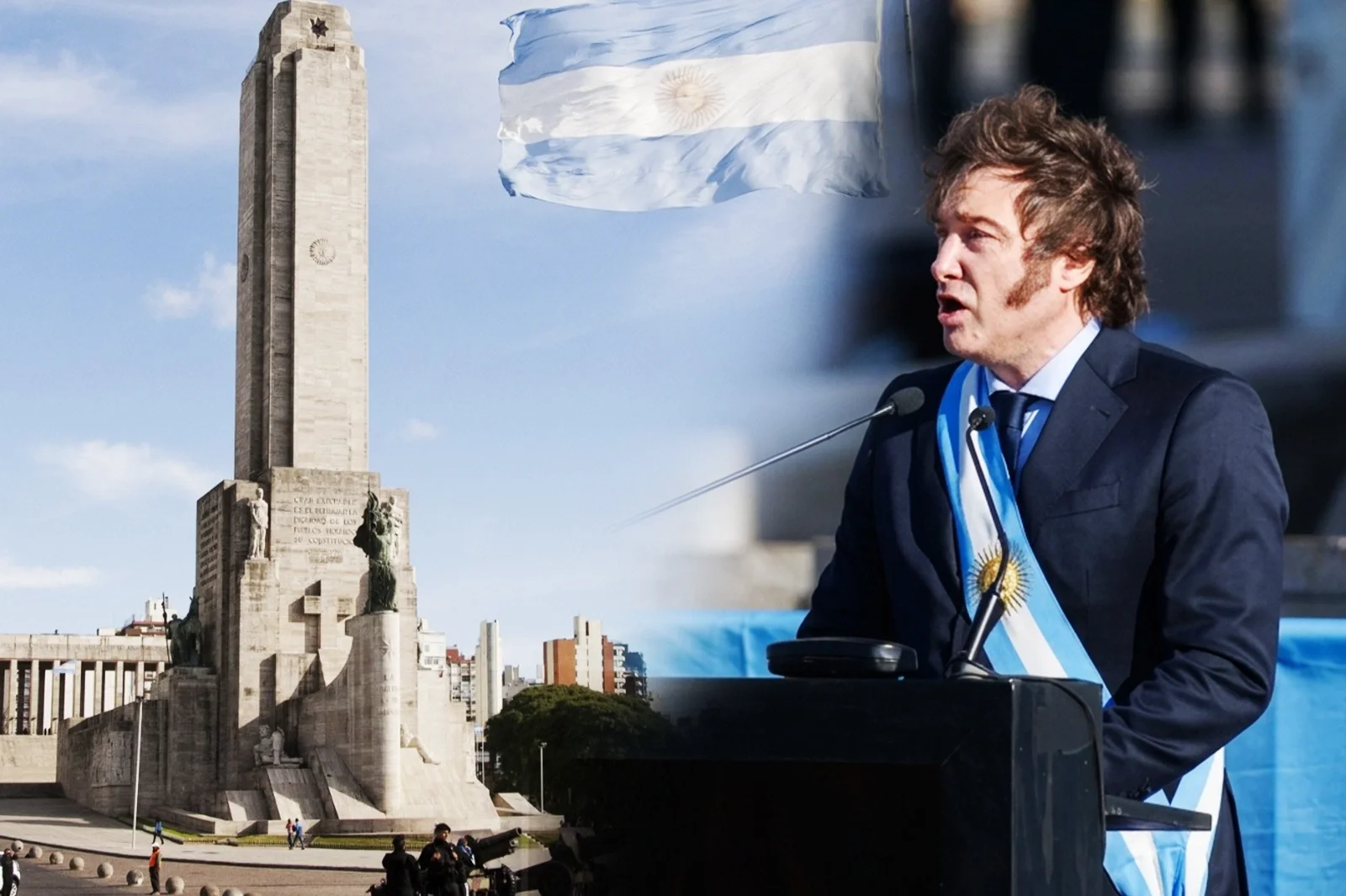
President Javier Milei led the ceremony for Flag Day in Rosario this Saturday with a speech full of ideological definitions, in which he hailed Manuel Belgrano as a precursor of political and economic freedom in Argentina and presented him as the “first Argentine liberal economic intellectual.”
In front of the National Flag Monument and the Patricios Regiment, the president stated that Belgrano's legacy is not limited to the creation of the national symbol, but represents a vision of the country founded on independence, private property, merit, production, and freedom against the privileges of the old colonial order.
“Today we remember one of the great feats of Argentine nationality, the creation of the symbol that unites us, represents us, and identifies us as a people,” the President noted, before emphasizing that remembering the Flag also means remembering its creator.
In this context, Milei defined Belgrano as “the great promoter of political and economic freedom in the origins of our Nation” and highlighted that his work was not limited to the military field. For the head of state, Belgrano was an enlightened reformer who understood before many the importance of private property, production, competition, and merit as engines of progress.
The President also stated that Belgrano's “great work” was “to imagine a Nation before it existed and to sow the ideas that would allow its construction.” With that phrase, Milei positioned the national hero as a foundational figure not only of Argentine independence but also of a vision of the country based on individual and economic freedom.
During his speech, the head of state presented Belgrano as “the first liberal intellectual” of the country and asserted that his thought represented the entry into modernity of the Río de la Plata. In this regard, he emphasized that the national hero confronted the closed structures of the colonial order, questioned the monopolies, and defended the need to unleash the productive capacity of the inhabitants.
Milei also stated that Belgrano fought against the elite of his time, a definition that connected the historical feat with the current political situation in Argentina. According to the President, the creator of the Flag understood that a Nation is not built with privileges, bureaucracy, or state control, but with work, education, commerce, property, and freedom.
In another part of his speech, the head of state underscored the personal dedication of the national hero: “He was rich and died poor at 50, having given everything for the Fatherland.” This phrase encapsulated one of the central points of the presidential speech: the contrast between those who dedicate their lives to the Nation and those who use the State to enrich themselves.