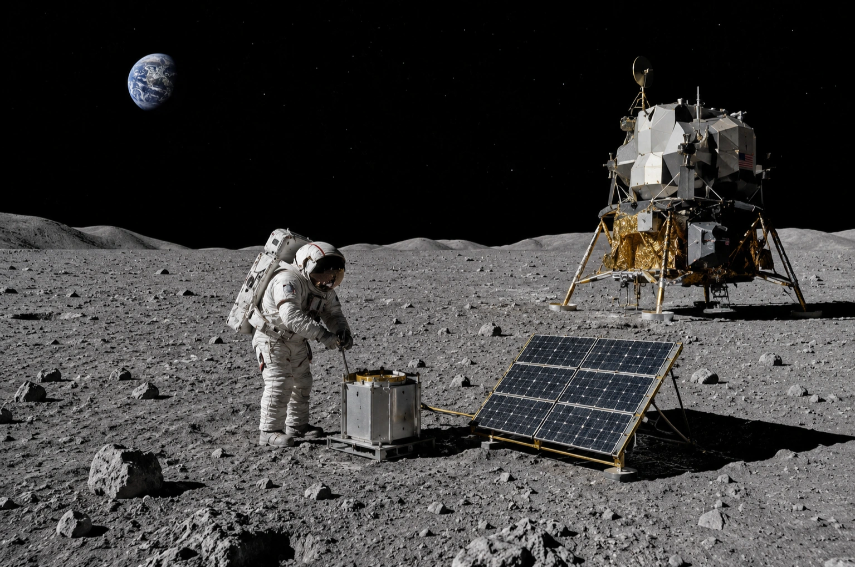
One of the biggest challenges of living on the Moon is its extremely long nights, which complicate the constant supply of electricity. With no sunlight for periods of two Earth weeks, traditional solar cells are not enough to continuously recharge batteries.
That’s why NASA scientists are developing an innovative technology: regenerative fuel cells that use only gaseous hydrogen and oxygen. These batteries promise to solve the energy problem for future lunar bases and, eventually, missions to Mars.
The operation is ingenious. When energy is needed, hydrogen and oxygen combine to produce water, releasing heat and electricity that can power the astronauts' equipment. Once the demand is exhausted, the process is reversed: the water is broken down again into its original gases for reuse.
In this way, the fuel is not consumed but regenerated in a closed cycle, ideal for environments where there is no possibility of discarding waste like conventional batteries.
The real size of the solution
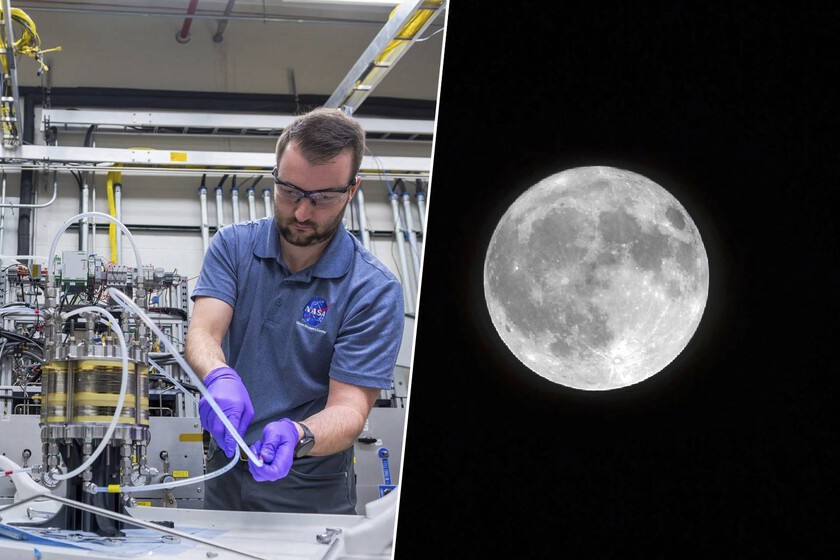
These are not small batteries like those used in homes. These fuel cells are large-scale: they are approximately the height of a human and the length similar to that of a sedan car. Their robust design includes hundreds of sensors and components to operate reliably.
In 2025, the basic elements were tested to validate the concept. Currently, the team is advancing with more complex tests in a cell that allows remote control and autonomous operation once started. This allows for analysis of how the fuel is regenerated without constant intervention.
The results of these tests, although still in development, will provide valuable data to refine the technology after five years of work. Researchers hope it will withstand the extreme temperatures of the Moon, especially during the prolonged cold nights.
Toward the Artemis program
The main goal is to have this solution ready for NASA's Artemis program, which seeks a sustained return to the Moon. The battery is designed precisely to maintain energy on the lunar surface, where conditions are hostile.
If the tests progress as expected, it will move on to trials in environments that better simulate the actual conditions of the satellite. This represents a key step toward building long-term habitable bases.
In addition to the Moon, this technology could be applied in the future to Mars, although the current focus is on our natural satellite. Having reliable and renewable energy sources is essential for any plan of space colonization.
Advances in these batteries demonstrate how scientific innovation seeks to overcome the biggest obstacles to expand human presence beyond Earth. Maintaining electricity during the endless lunar nights no longer seems like an unsolvable problem.
With increasingly mature prototypes, NASA is bringing closer the dream of permanent lunar bases, where astronauts can live and work without energy interruptions.