

La Derecha Diario logo
ESX logoInstagram logoYouTube logoTikTok logoFacebook
ARGENTINABOLIVIAECUADORISRAELMEXICODERECHA DIARIO TV
  • ES
    XInstagramYouTubeTikTokFacebook
  • DERECHA DIARIO TV
  • Secciones
  • ARGENTINA
  • BOLIVIA
  • ECUADOR
  • ISRAEL
  • MEXICO
  • URUGUAY
  • Países
  • La Derecha Diario logoLA DERECHA DIARIO
  • La Derecha Diario México logoLA DERECHA DIARIO MÉXICO
  • La Derecha Diario Uruguay logoLA DERECHA DIARIO URUGUAY
  • La Derecha Diario Ecuador logoLA DERECHA DIARIO ECUADOR
  • La Derecha Diario Israel logoLA DERECHA DIARIO ISRAEL
  • La Derecha Diario Estados Unidos logoLA DERECHA DIARIO ESTADOS UNIDOS
  • Temas
  • GUERRA EN IRÁN
  • El Diario
  • QUIENES SOMOS
  • AUTORES
  • PUBLICIDAD
  • DONAR

The new incentive map for investing in Argentina: RIGI, RIMI, and Super RIGI

The new incentive map for investing in Argentina: RIGI, RIMI, and Super RIGI
Imagen de Editorial Team
porEditorial Team
Argentina

With these regimes, Argentina is betting on more stable rules to recover investments, competitiveness, and generate private employment

NuevoAgregar La Derecha Diario en
Compartir:

In less than two years, Javier Milei's administration has launched three regimes aimed at promoting investments that encompass practically the entire business framework: from a small and medium-sized enterprise (SME) interested in modernizing its equipment to a global technology company analyzing the installation of a semiconductor center in the country. Each instrument responds to a specific scale, logic, and set of advantages.

Through the RIGI, RIMI, and the Super RIGI initiative, Argentina seeks to organize a gradual scheme of incentives according to the investor's size: large projects starting from USD 200 million, medium investments from SMEs starting at USD 150,000, and new industries with a minimum of USD 1 billion. The framework includes tax benefits, adherence conditions, and, for the RIGI, regulatory predictability for 30 years.

The adoption of these regimes occurred after decades of interventionism that consolidated an adverse scenario for private capital: export rights, currency controls that hindered the remittance of profits or obtaining foreign currency, a high tax burden, and regulatory instability that made the modification of rules during the game a common occurrence.

After decades of interventionism, Argentina had to reverse an unfavorable context for private investment

While other nations attracted large-scale projects in energy, mining, technology, and infrastructure, Argentina maintained a framework that discouraged long-term capital placement due to regulatory volatility, state intervention, and a loss of confidence in contract enforcement.

Against this backdrop, starting in 2024, the system of incentives promoted by the national government began to take shape.

These three instruments do not overlap; rather, they function complementarily. Each one addresses a different segment of the investor universe and, together, they form a tiered structure by amount and activity: from the small business updating its equipment to the international capital studying the establishment of an industry that does not yet exist in the country.
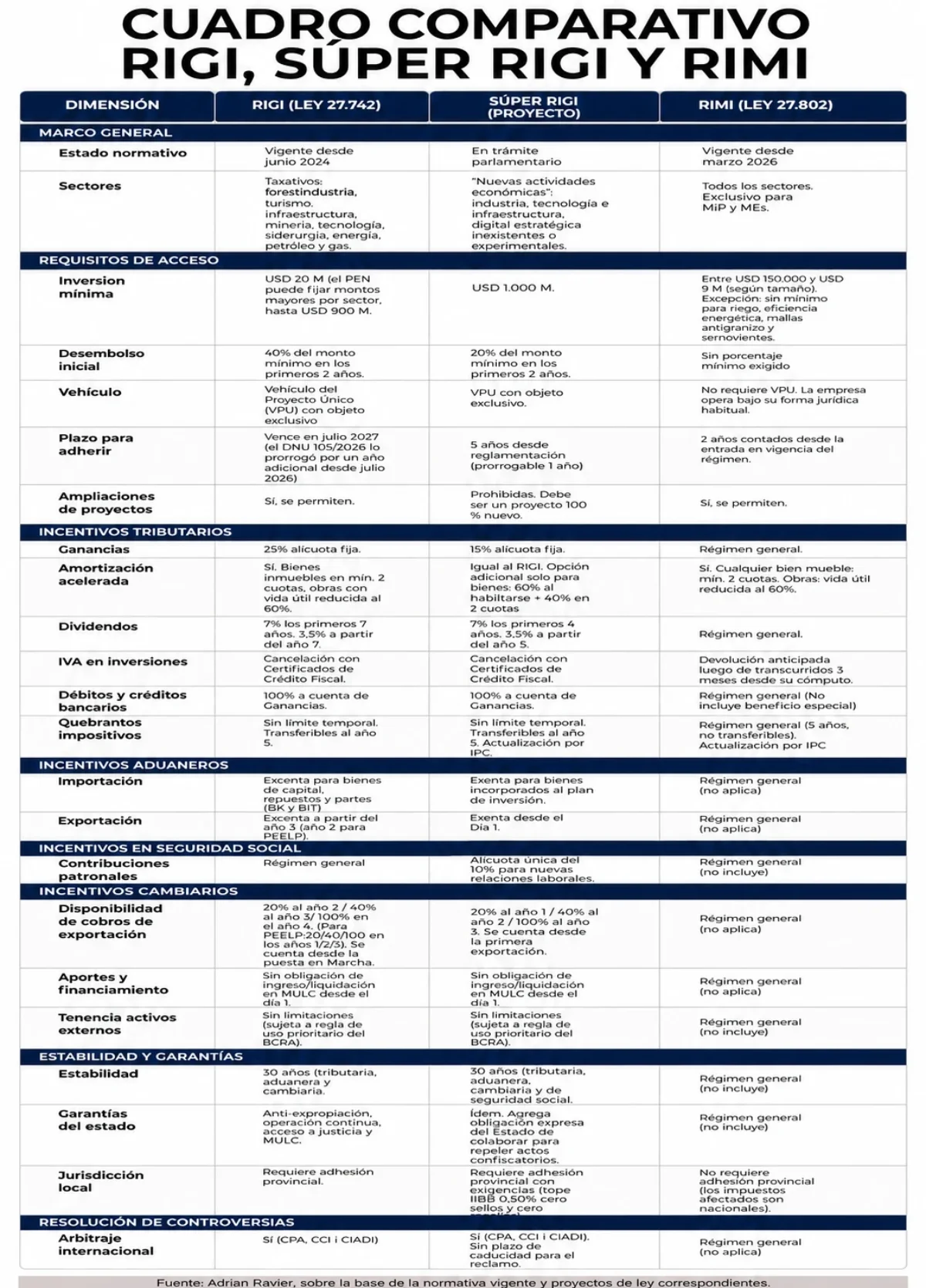
Imagen 1420143

RIGI: Large-scale investments in strategic areas

The first piece was the Regime of Incentives for Large Investments (RIGI), established by Law 27,742 —the Framework Law—, approved in July 2024 and regulated by Decree 749/2024. The regime was aimed at initiatives with a minimum outlay of USD 200 million in eight sectors: forestry, tourism, infrastructure, mining, technology, steel, energy, and oil and gas. It includes tax, customs, and exchange benefits, along with regulatory stability for 30 years.

Entry into the regime requires at least USD 200 million per project and the execution of a minimum of 40% within the first two years

To enter, a minimum investment of USD 200 million per project is required, and at least 40% must be executed within the first two years. Additionally, each initiative must be organized through an independent company, established solely for that purpose and separate from the investor's other businesses: the Unique Project Vehicle (VPU).

VPUs must allocate at least 20% of the total investment to payments to local suppliers. The period for applying for adherence was set to end in July 2026 but has been extended by one year. The interested party must submit a plan to the Implementing Authority, which has 90 business days to evaluate it and decide on its approval or rejection.

A broad range of benefits

On the tax front, VPUs are subject to a fixed rate of 25% for Income Tax, 10 points lower than the general system. They can also apply for accelerated depreciation: movable assets are accounted for in no less than two annual installments, while infrastructure works use a reduced useful life of 60%.
Imagen 1420144

The scheme also allows for the deduction of losses without expiration, in contrast to the common regime, which only allows them to be carried forward for five years. For projects with extensive construction and commissioning phases, this limitation is particularly detrimental, as losses can accumulate beyond that period.

The RIGI allows the use of VAT Tax Credit Certificates to avoid keeping capital immobilized while the project is being constructed

In the first five years from adherence, VPUs will be able to deduct interest without limit, as the RIGI has eliminated the restrictions applicable in the general regime. Regarding dividends, the rate is 7% during the first seven years and reduces to 3.5% from the seventh year.

Regarding VAT, the RIGI accepts Tax Credit Certificates that prevent funds from being withheld during the construction phase. Additionally, 100% of the Bank Debits and Credits Tax paid can be counted as a credit against Income Tax.

In customs, imported goods incorporated as assets of the venture are exempt from import duties. Sales abroad are exempt from withholdings starting from the third year after adherence; for Long-Term Strategic Export Projects (Peelp), the benefit begins in the second year.

The express adherence of each province is necessary for projects located in its territory to receive these advantages

On the exchange front, income from exports gradually acquires free availability: 20% in the second year, 40% in the third, and 100% in the fourth, calculated from the start of the VPU. For Peelp —initiatives of at least USD 1 billion per stage and with a minimum of 70% of their production destined for export— the schedule is accelerated: 20% in the first year, 40% in the second, and 100% in the third, in addition to the elimination of withholdings starting from the second year.
Imagen 1420145

From the outset, capital contributions and financing are not required to enter or settle in the exchange market. Therefore, the investor can keep those resources in the currency and jurisdiction of their choice.

The regime incorporates three fundamental safeguards:

  • Regulatory predictability: for 30 years, the tax, customs, and exchange provisions in force at the time of adherence cannot be altered to the detriment of the project.

  • The granted benefits acquire the status of acquired rights, comparable to property rights.

  • Dispute resolution mechanism: in the event of a conflict, the VPU can resort to international arbitration from the Permanent Court of Arbitration, the International Chamber of Commerce, or the ICSID.

For an investment located in a province to obtain these benefits, that jurisdiction must explicitly join the regime; so far, 19 provinces have done so.

RIMI: incentives for micro, small, and medium firms

The system added a new tier in February 2026, with the approval of Law 27,802 on Labor Modernization, which gave rise to the Regime of Incentives for Medium Investments (RIMI). Its full operation began in May 2026, when Joint Resolution 5849/2026 from ARCA and the Secretariats of Agriculture and Energy set the access and application guidelines.

The RIMI covers all economic activities, although it can only be used by micro, small, and medium enterprises

While the RIGI is limited to eight sectors, the RIMI encompasses any economic activity but is reserved for micro, small, and medium enterprises. It also does not require the formation of a VPU: each company can adhere with its existing legal structure, without forming a separate entity.

The minimum investment thresholds vary according to the size of the company: USD 150,000 for micro, USD 600,000 for small, USD 3.5 million for medium Tier 1, and USD 9 million for medium Tier 2. Some agricultural investments —irrigation, anti-hail nets, and livestock— as well as high energy efficiency goods, are exempt from a minimum amount.

Investments must be made within two years of the entry into force. Its advantages are more limited than those provided by the RIGI and do not include regulatory stability for 30 years, differentiated exchange treatment, or access to international arbitration.

In terms of Income Tax, the RIMI establishes accelerated depreciation: new movable assets —except for automobiles— are depreciated in two equal and consecutive annual installments, and productive works apply a reduced useful life of 60%. For agricultural irrigation equipment and systems, high energy efficiency goods, anti-hail nets, and livestock, the deduction is made in a single installment.

Regarding VAT, it allows for the early recovery of the tax credit: the tax paid on investments can be requested for reimbursement once three months have passed since its computation, without needing to wait for the work to finish or start operating.

SUPER RIGI: new industries and developments in experimental stages

The third proposal is also the most far-reaching. In May 2026, the Executive Power sent a bill to Congress that creates the Regime of Incentives for Large Investments in New Industries, known as “Super RIGI,” and the initiative received a favorable opinion in the Chamber of Deputies on June 17.

The Super RIGI was conceived as an independent but complementary instrument to the RIGI. It targets investments in “new economic activities”: industrial, technological, or service ventures related to strategic technological and digital infrastructure that do not yet exist in Argentina or are in an experimental or pilot phase.

Seven white humanoid robots occupy a circular table with a futuristic aesthetic, around a holographic document, with suspended emojis. The screens display brains and molecular data.

The Super RIGI aims at industrial, technological, or service initiatives linked to digital and technological infrastructure that is still nonexistent or incipient in the country

The investment requirement is set at USD 1 billion per project, with the obligation to disburse at least 20% during the first two years. Adherence can be requested for five years from the regulation, with the possibility of extending that period by an additional year.

In terms of incentives, the Super RIGI expands the advantages provided by the RIGI. The Income Tax rate is reduced to 15%, 10 points lower than in the RIGI and 20 below the general regime. Dividends are taxed at 7% during the first four years and at 3.5% from the fifth year.

Exports are exempt from paying duties from day one, without the three-year wait contemplated by the RIGI. In social security, a uniform rate of 10% is established for employer contributions of new labor relations, a benefit that the RIGI did not include by referring to the general regime of Law 27,541.

The availability of foreign currency from exports adopts the rapid schedule reserved in the RIGI for Peelp: 20% in the first year, 40% in the second, and 100% in the third from the first export

The initiative provides for losses without an expiration date, adjustable by CPI and transferable to third parties after five years if they have not been absorbed. It also incorporates Tax Credit Certificates for the corresponding VAT


La Derecha Diario logo
TwitterInstagramYouTubeTikTokFacebook
Derecha Diario TV

Nosotros

  • Quienes Somos
  • Autores
  • Donar

Privacidad

  • Protección de datos
  • Canales
  • Sitemap
  • RSS

Contacto

  • info@derechadiario.com.ar
PUBLICIDAD

Noticias relacionadas

Group J finished: Argentina 1st, Austria 2nd, Algeria 3rd, and Jordan 4th

Group J finished: Argentina 1st, Austria 2nd, Algeria 3rd, and Jordan 4th

Group K finished: Colombia 1st, Portugal 2nd, Democratic Republic of the Congo 3rd, and Uzbekistan 4th

Group K finished: Colombia 1st, Portugal 2nd, Democratic Republic of the Congo 3rd, and Uzbekistan 4th

While Milei, Trump, Kast, and Bukele sent aid to Venezuela, Maduro's friends did not announce any operations

While Milei, Trump, Kast, and Bukele sent aid to Venezuela, Maduro's friends did not announce any operations

Trump chose former Marine and state police officer Lance Schroyer to be the new head of ICE

Trump chose former Marine and state police officer Lance Schroyer to be the new head of ICE

Venezuela: The UN estimates 6.8 million affected by the earthquake

Venezuela: The UN estimates 6.8 million affected by the earthquake

Group L finished: England 1st, Croatia 2nd, Ghana 3rd, and Panama 4th

Group L finished: England 1st, Croatia 2nd, Ghana 3rd, and Panama 4th