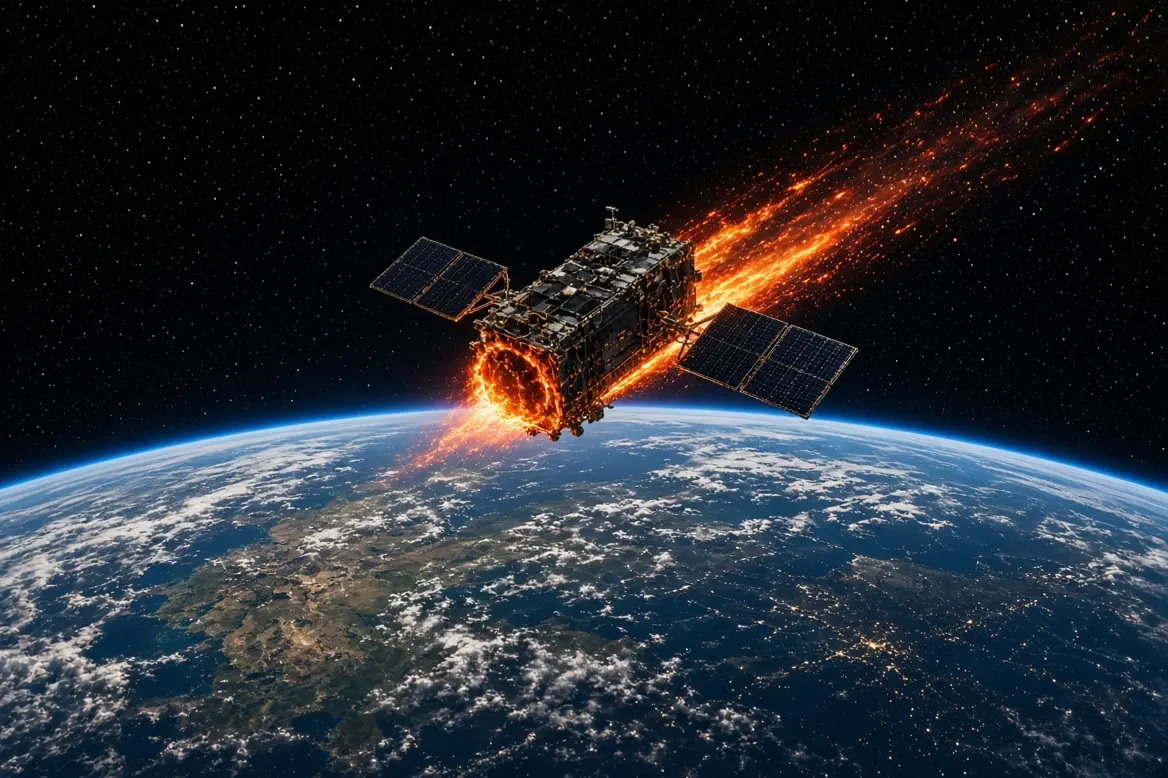

After more than two decades in space and an unsuccessful rescue attempt, NASA's Neil Gehrels Swift Observatory is about to re-enter the Earth's atmosphere. The satellite, which weighs around 1,450 kilograms and is roughly the size of a large elevator, will likely disintegrate mostly, although some fragments could reach the surface.
Launched on November 20, 2004, Swift was designed to detect and study gamma-ray bursts, some of the most energetic explosions in the universe. It had three telescopes that allowed it to locate these events and immediately alert ground observatories to continue observations. Although it was intended to operate for only a few years, it far exceeded its expected lifespan.
During its long career, the satellite provided key data on supernovae and how black holes destroy stars. It observed over 2,000 gamma-ray bursts and nearly the same number of supernovae. This information served as the basis for more than 7,000 scientific papers. Its archive of observations across multiple wavelengths will continue to generate discoveries for decades.
The problem began to worsen in 2024 when an increase in solar activity heated and expanded the upper layers of the atmosphere. This increased drag on the satellite and accelerated its descent. As it did not have a propulsion system capable of correcting its orbit, its fate was sealed.

The Rescue That Never Came
In July 2026, NASA launched a special $30 million mission with the robotic spacecraft LINK. The idea was to drag Swift about 240 kilometers farther from Earth to give it a higher orbit and extend its lifespan. The mission failed. In August, NASA Administrator Jared Isaacman explained that problems with the spacecraft's control system made it impossible to keep it oriented and stable.