The presentation points against the ruling of the National Labor Court of First Instance No. 63, led by Kirchnerist Raúl Horacio Ojeda, who on March 30 had provisionally suspended 83 articles of the regulation after an action promoted by the CGT. The Casa Rosada argues that this decision not only blocks a reform voted by Congress, but also introduces a strong factor of legal uncertainty in the Argentine labor market
.
In the letter, the Attorney General's Office, representing the Ministry of Human Capital, demanded that the appeal be declared admissible, that the effects of the precautionary measure be suspended and that the Court restore the full force of the law while the merits of the matter are resolved. The official approach also questions the competence of the labor judge and maintains that there is no specific judicial case or sufficient collective active legitimacy on the part of the CGT to act on behalf of all workers in
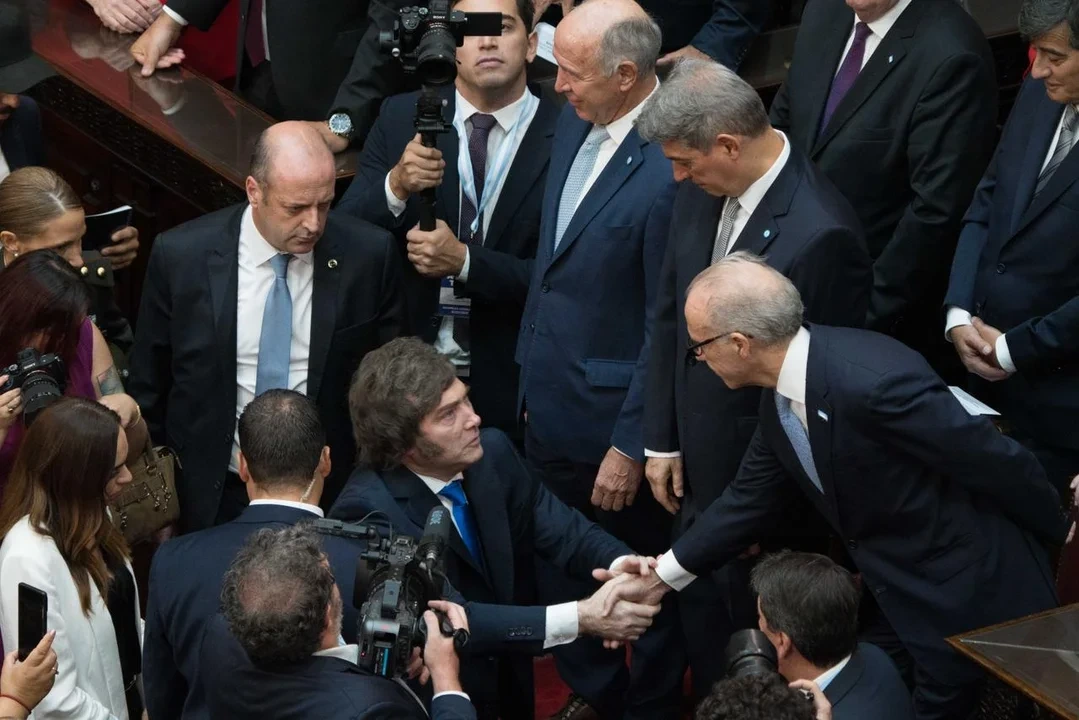
the country. Members of the Supreme Court of Justice of the Nation with Milei at the opening of sessions of the Congress.
The per saltum is an exceptional mechanism that allows a case to be brought directly to the Supreme Court without going through intermediate instances. It is intended for serious institutional situations, where a delay in the judicial process could cause irreparable damage. In this case, the Government maintains that the suspension of a law voted by Congress and with an impact on the entire country justifies the urgent intervention of the highest court
.
According to the Government, the trade union federation based its demand on general and abstract arguments, without proving specific harm derived from the application of the rule. Added to this is another central point of the official approach: since it is a case where the National State is a party and whose effects impact the entire Argentine territory, the discussion should be processed in the federal courts and not in the ordinary labor justice system. Along these lines, the Executive recalled that on April 10, Federal Administrative Court No. 12 issued an injunction and claimed the file
. Raúl Ojeda, the Kirchner trial judge who ruled against the reform.
The Attorney General's Office described the episode as a case of “institutional gravity”. Allowing a trial judge to suspend a national law with general scope implies an undue advance on the powers of Congress and a dangerous sign for the division of powers. He also warned that, if this criterion is consolidated, any magistrate could curb rules approved by Parliament with erga omnes effects, opening a door of enormous
instability for the entire regulatory system.
Behind the file, there is also a fundamental fight between the Government of Javier Milei and the union apparatus that seeks to preserve its privileges. The CGT judicialized a reform aimed at easing rigidities in the labor system and providing freedom to the worker, while the Executive is now betting that the Court will limit an inadmissible, expansive and politically functional ruling on the corporate