The return of mortgage credit supports demand, but the dynamism of property deeds does not necessarily imply an equivalent recovery in new housing construction
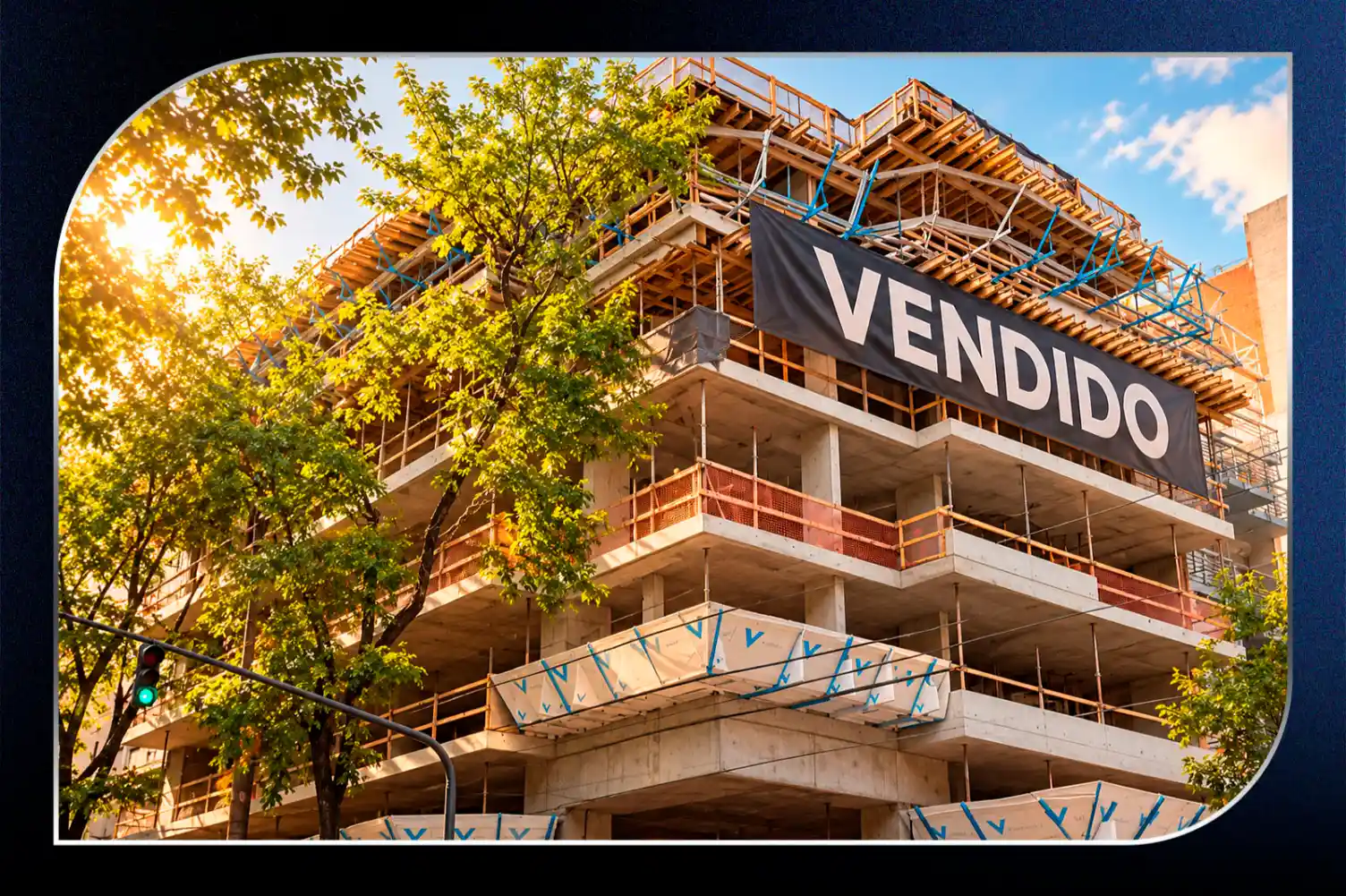
In September, 6,612 sales deeds were made in the City of Buenos Aires, making it the fourth best September in the last 30 years. This is an extraordinary fact considering that construction in Argentina, measured in dollars, is at historically high levels
.
How do you explain the fact that the real estate market is so active when construction costs are so high? And, above all, why do we continue to see so many new works in certain neighborhoods of Buenos Aires?
The answer is simple: today it is still a business to develop properties, but not just any property or in any neighborhood.
Currently, building one square meter is around USD 1,800. To that we must add the land incidence, which can vary between USD 300 and USD 1,200 per square meter that can be sold, depending on the location. If we take an average incidence of USD 700 and add another USD 400 corresponding to taxes, fees and administrative expenses, we arrive at a total cost of approximately USD 2,900 per
square meter. If you are interested in investing in the real estate market, click on the image and join the Briones Group.
In other words, developing a building can cost USD 2,900 per square meter when the average listing price of properties in the City of Buenos Aires is around USD 2,500.
At first glance, it would seem that developing properties is a terrible business. But there is something that these averages hide
.
Buenos Aires is not a single real estate market
Buenos Aires is not a single real estate market. There are many different markets living together within the same city
.
In neighborhoods such as Núñez, Belgrano, Palermo, Recoleta or certain areas of Saavedra, a new, well-located and good-quality product can be marketed at values significantly higher than the city average. In such cases, even with high costs, development can be cost-effective.
The same is true in areas with high purchasing power in Greater Buenos Aires, such as Vicente López and Olivos.
For this reason, a large part of the new private developments are concentrated in the northern corridor and in locations where there is demand capable of paying high prices.
The cost of construction expels the middle class from new housing The
problem appears when we try to develop housing for middle and low income sectors
.
Let's imagine a building in Villa Lugano whose total development cost was USD 2,200 per square meter, but whose sale price will reach only USD 1,500. The developer would lose $700 for every square meter sold, even before considering the business benefit.
No one develops a building to lose money.
Therefore, the high cost of construction does not necessarily stop all developments: it selects which projects are economically viable and which are not.
And that selection has a worrying consequence: the higher the cost of building, the more difficult it is to produce new housing for the middle class.
If you are interested in investing in the real estate market, click on the image and join the Briones Group.
Mortgage credit supports part of the demand
Meanwhile, real estate demand shows a different reality
.
The return of mortgage credit allowed thousands of families to once again access financing to buy a home. The improvement in purchasing power measured in dollars also helped to recover the purchasing power of certain sectors
.
In September, approximately one out of every five deeds was made with a mortgage. Although credit is still below 2025 levels, it remains a fundamental tool for expanding the universe of buyers.
More deeds don't necessarily mean more construction Now, there's an
important distinction: just because a lot of properties are being sold doesn't necessarily mean that a lot of properties are being built
.
A large part of real estate transactions relate to used homes. A purchase and sale of an apartment built forty years ago adds up to a writing, but it does not represent a new square meter
built.
This difference also helps to understand why we can observe a dynamic real estate market while some indicators of construction activity show weakness.
Added to this is the sharp reduction in public works, which affects the general level of activity in the sector, but which should not be confused with the profitability of private residential developments.
They are two different phenomena: on the one hand, the demand for existing properties; on the other, the production of new properties.
Argentina's challenge isn't just getting more properties to be bought and sold.
It is to make it economically viable again to build housing for an increasing portion of the population.
Because a healthy real estate market shouldn't be limited to developing high-end apartments for those who can afford $4,000 or $5,000 per square meter.
It should also make it possible to build affordable housing for the middle class.
The real problem is not that today it is profitable to build for higher-income sectors. The problem is that it's getting harder and harder to build for everyone else.