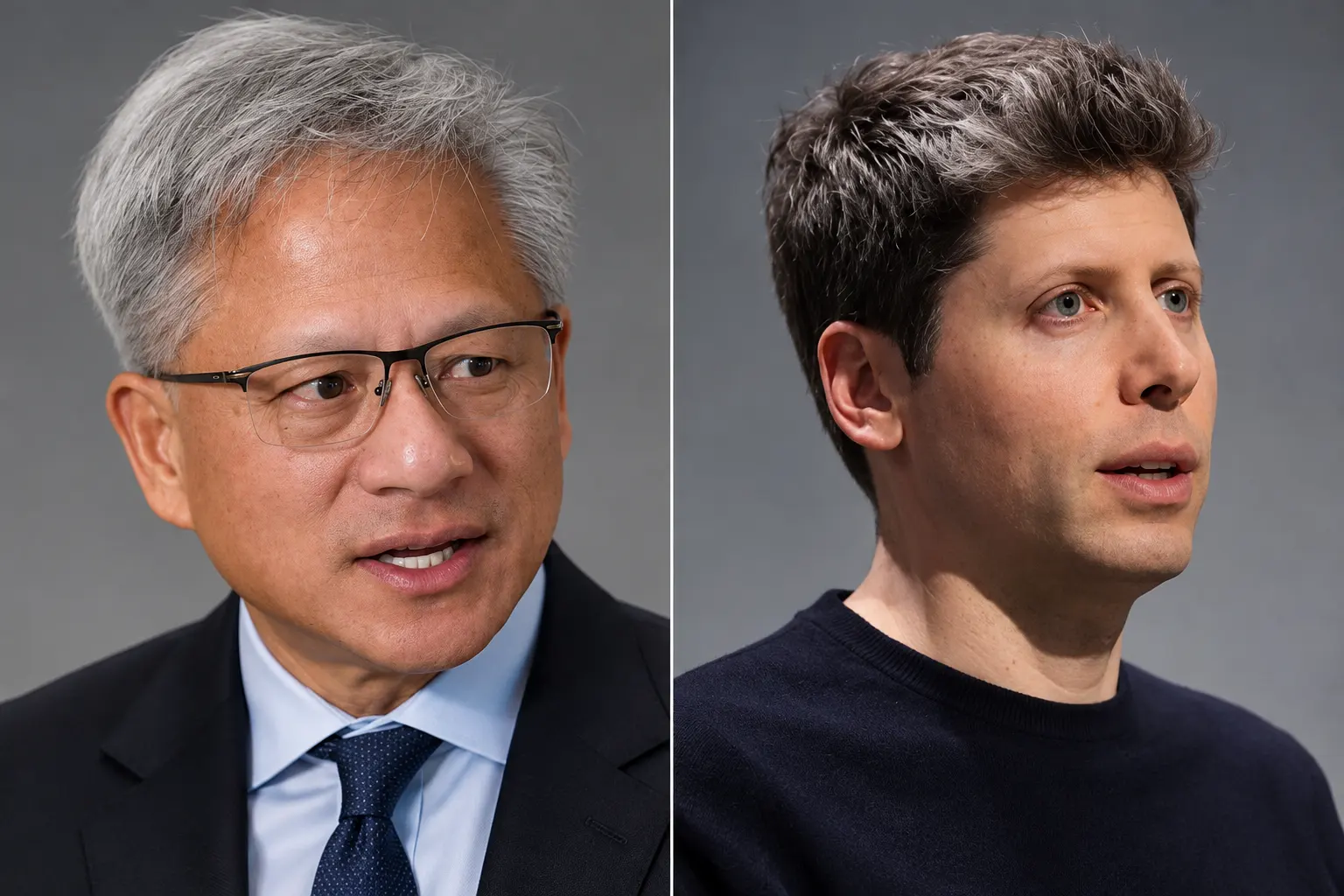
Sam Altman, CEO of OpenAI, spoke out about Jensen Huang's departure from Nvidia and expressed his admiration for the entrepreneur who led the semiconductor manufacturer for over three decades. However, he refrained from taking a position on his reinstatement and acknowledged that he does not have enough information to assess that possibility.
The statements were made on Monday, November 16, during the Silicon Valley & The World meeting, organized by Semafor in California.
“Jensen has always been one of my heroes”: Altman's acknowledgment
During the conversation, Altman was asked whether Huang should regain leadership of Nvidia after his resignation on Thursday, November 12.
“I don’t think I know enough to answer that question. Jensen has always been one of my heroes. Heroes have flaws,” he stated.
The entrepreneur also highlighted the importance Nvidia had for the growth of OpenAI and the entire industry.
“It’s hard to imagine the AI revolution without Jensen and the company he built,” he affirmed.
Altman recalled that Nvidia invested in OpenAI during its early years when the development of advanced models did not yet have the commercial dimension it has today.
The personal experience that shaped his stance
The executive acknowledged that he feels a strong empathy for Huang and mentioned his own experience from November 2023.
At that time, the OpenAI board unexpectedly dismissed Altman, which led to an institutional crisis that ended with his reinstatement a few days later.
Despite that background, he did not recommend that Nvidia make a similar decision.
Altman maintained that the semiconductor company has a sufficiently solid structure to continue operating without its founder at the helm.
The Nvidia board appointed Colette Kress as interim CEO and began a search process for a permanent successor.
What he said about the future of Nvidia and artificial intelligence
Altman emphasized Huang's role in expanding the computing infrastructure that allowed for the development of advanced models.
At the same time, he expressed confidence in the continuity of the sector.
“I believe there is so much demand, and it is so clear that artificial intelligence is real, that people want to use it and that revenues and demand are growing so strongly that the industry will be fine,” he noted.
His assessment relates to the growth in the consumption of AI services and the investments needed to sustain them.
The warning about chip demand
During the meeting, Altman also referred to semiconductor production projections.
He explained that for years Nvidia concentrated a large part of the supply of processors used for artificial intelligence. Now there are more manufacturers, and each is trying to estimate how much large clients like OpenAI and Anthropic might buy.
The problem, according to Altman, is that several suppliers may be simultaneously accounting for a demand that will not materialize in all cases.
The executive clarified that he considers the expansion of data centers to be solid, although there are physical and commercial limits to absorb all the planned production.
He also acknowledged that over the past year there has been strong investor interest in participating in artificial intelligence companies, exceeding the available investment opportunities.
The rejection of artificial intelligence controlling human decisions
Altman addressed social criticisms regarding the establishment of data centers and concerns about the future of employment.
He asserted that the industry must ensure that people retain control over the decisions that affect their lives.
Describing a scenario where technological advances allow for curing diseases and reducing product costs but require giving up individual autonomy, he stated: “I don’t want that world.”
The executive also acknowledged that OpenAI faced security challenges and defended an approach that combines innovation with appropriate controls.
His central message was that the development of artificial intelligence must remain at the service of people, even as companies multiply their investments in infrastructure and processing capacity.