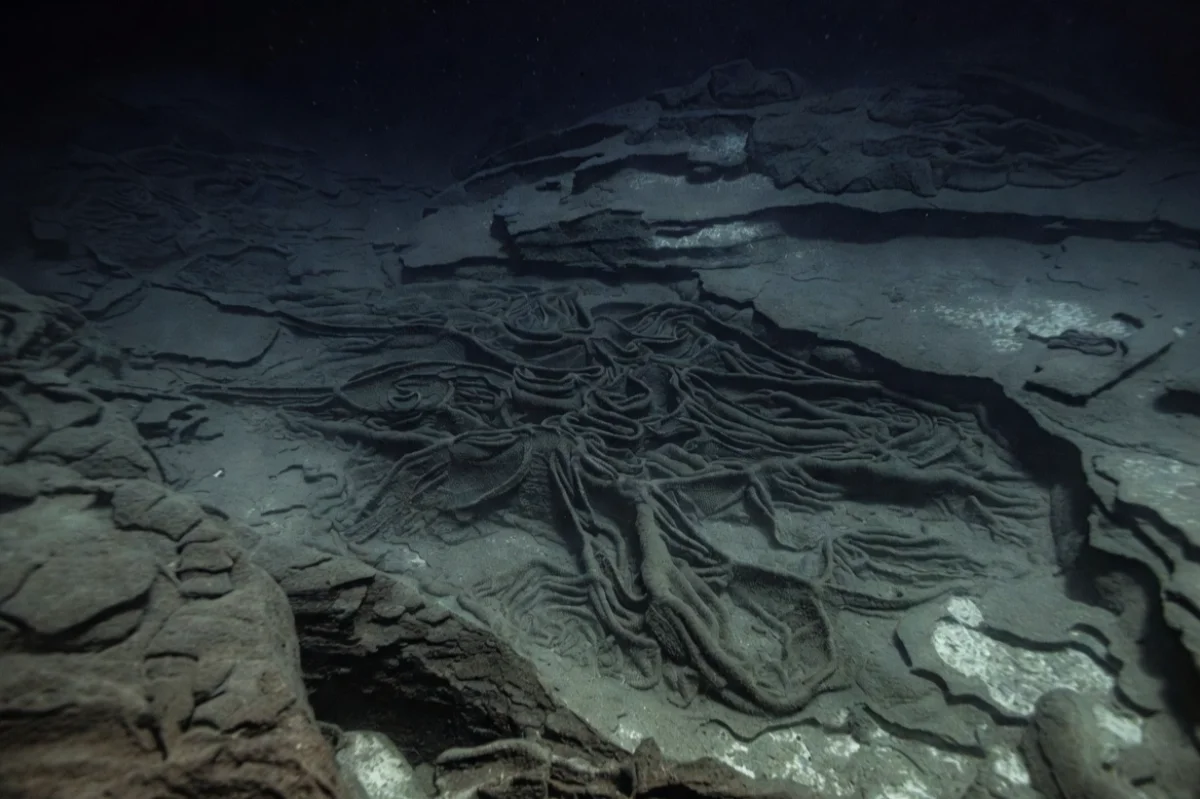
Scientists exploring ancient seafloor rocks in Morocco stumbled upon a surprising finding: mysterious wrinkle patterns in places where no one expected to find them. These formations are typically associated with microbial mats in shallow, sunlit waters, but the rocks in question formed hundreds of meters deep, in complete darkness.
The discovery suggests that chemosynthetic microbes were responsible for creating these textures, indicating that microbial ecosystems in deep waters were more common than previously thought. The team, led by paleoecologist Rowan Martindale from the University of Texas at Austin, made the finding while traversing turbidite layers in the Dadès Valley.
Turbidites are deposits formed by underwater avalanches of mud, sand, and debris that accumulate on the ocean floor. Amid these layers, Martindale noticed wrinkled structures over typical ripple marks.
"These are wrinkled structures," she told her colleague Stéphane Bodin, immediately recognizing the significance of the finding.
What are the wrinkled structures?
These structures are small ridges and depressions that form when microbial communities grow as mats over sandy sediments. Microorganisms, such as bacteria and algae, bind the particles and leave characteristic textures on the surface.
Normally, they are better preserved in shallow coastal environments where sunlight allows for photosynthesis. However, in this case, the rocks were deposited at least 180 meters deep, where light does not reach. This ruled out photosynthetic microbes as the authors.
The mystery was greater because 180 million years ago, during the Jurassic, animals were already abundant on the seafloor and often destroyed these delicate structures by stirring up the sediments. Despite everything, the wrinkles were preserved.
The team verified that these were deep-water turbidites and searched for chemical evidence. They found elevated concentrations of carbon beneath the wrinkles, a clear indication of biological activity.
The role of chemosynthetic microbes
To understand the phenomenon, they observed videos from submarines in current oceans. There, microbial mats form even below the photic zone, thanks to chemosynthetic bacteria that obtain energy from chemical reactions, such as the use of hydrogen sulfide or methane.
Turbidite flows likely brought nutrients and organic matter to the seafloor, reducing oxygen and creating ideal conditions for these microbes. During calm periods between avalanches, the mats spread out and formed the characteristic wrinkles.
Most of the time, subsequent flows erased them, but on exceptional occasions, they remained preserved for millions of years. This finding changes the way these structures are interpreted, which were previously linked almost exclusively to shallow and photosynthetic environments.
The researchers concluded that these are fossil chemosynthetic communities. This opens the door to searching for similar evidence in other sites that were previously dismissed.