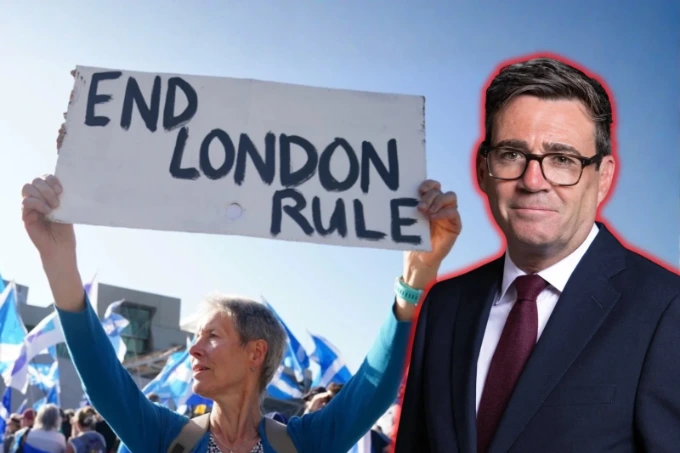
The SNP, Plaid Cymru, and Sinn Féin signed a joint declaration asserting the right of their respective nations to decide their future and called on the British Government to facilitate constitutional processes towards independence
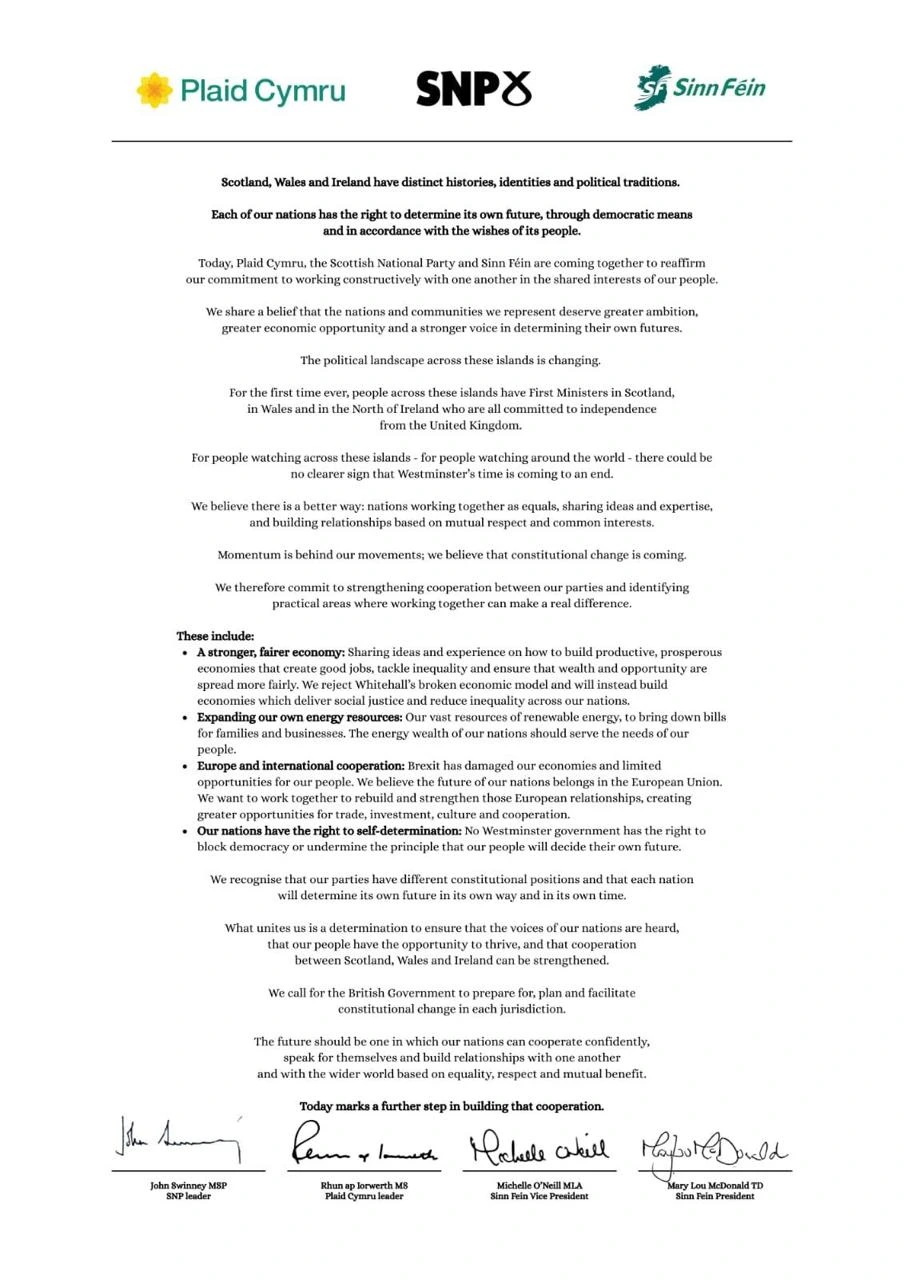
The main independence parties from Scotland, Wales, and Northern Ireland took a new step towards greater political coordination by signing a joint declaration asserting the right of their peoples to determine their own future. The document was signed by representatives of the Scottish National Party (SNP), Plaid Cymru, and Sinn Féin.
The three parties argue that the political landscape of the islands is changing and assert that there is an opportunity to move towards a different relationship among the nations currently comprising the United Kingdom. The document explicitly calls on the British Government to prepare to facilitate constitutional changes in each territory.
SNP, Plaid Cymru, and Sinn Féin demand the right to self-determination
The declaration begins by stating that Scotland, Wales, and Ireland have different histories, identities, and political traditions and that each of these nations has the right to determine their own future through democratic mechanisms and in accordance with the will of their inhabitants.
The parties assert that they share the intention to work constructively on issues of common interest and believe that the nations and communities they represent deserve greater economic opportunities and a stronger voice in deciding their future.
One of the central points of the document is the defense of self-determination. The three parties maintain that “no Westminster Government has the right to block or undermine the principle that our people will decide their own future”.
“Constitutional change is coming”
The document highlights that, for the first time, there are first ministers in Scotland, Wales, and Northern Ireland committed to independence from the United Kingdom, according to the interpretation of the signing parties.
The independence forces believe that this constitutes a sign of the political change occurring in the United Kingdom and assert that there is a growing momentum behind their movements.
“We believe that constitutional change is coming”, states the declaration.
At the same time, the parties acknowledge that they hold different constitutional positions and that each nation will determine its future “in its own way and at its own time”. The common goal, they explain, is to strengthen cooperation and ensure that the voices of their respective peoples are heard.
Rejection of the Westminster economic model
Rejection of Westminster's economic model
The declaration also outlines a shared economic agenda. SNP, Plaid Cymru, and Sinn Féin demand an economy that creates quality jobs, reduces inequality, and allows for a more equitable distribution of wealth and opportunities.
In this regard, they reject what they call the “broken economic model of Westminster” and propose developing more sustainable economies focused on social justice.
Another highlighted point is the exploitation of their own energy resources. The parties argue that their territories possess significant renewable energy resources that could be used to reduce bills for families and businesses.
They also call for greater European cooperation. The document states that Brexit harmed their economies and limited opportunities, asserting that the future of their nations is linked to the European Union. The parties seek to rebuild and strengthen European ties in trade, investment, culture, and cooperation.
They call on London to facilitate independence processes
The document concludes with a direct request to the British Government: “to prepare, plan, and facilitate” constitutional changes in each jurisdiction.
The signatories assert that the future should allow Scotland, Wales, and Ireland to cooperate with each other, speak for themselves, and build relationships with the rest of the world based on respect, equality, and mutual benefit.
The declaration was signed by John Swinney, leader of the SNP; Rhun ap Iorwerth, leader of Plaid Cymru; Michelle O'Neill, vice president of Sinn Féin; and Mary Lou McDonald, president of Sinn Féin.
The agreement thus represents a new attempt to coordinate the main nationalist forces of the different nations of the United Kingdom and once again places the issue of British territorial unity at the center of political debate.